
Story at a Glance:
•Throughout his career, NIAID director Anthony Fauci has been involved in unscrupulous activity which put America’s health at risk, with much of what he did through COVID building upon a successful blueprint he created decades ago during the AIDS crisis (at a now surreal time when Democrats like Pelosi grilled him during a 1988 hearing).
•As part of Senator Rand Paul’s six year quest to hold Fauci accountable for his role in creating COVID-19 and putting an end to gain of function research, Fauci recently was forced to testify in front of a Senate committee in an unusually candid and contentious hearing where Fauci took the unusual tactic of refusing to testify by pleading the Fifth on every question. This article will summarize the key highlights of that hearing.
•Immediately prior to hearing, private diary entries were released that Fauci had been keeping on a nearly daily basis that explicitly showed many of the public statements he made (and forced us to go along with) contradicted his actual beliefs.
•They also paint a unique picture into his personality, as the saint much of the world came to worship during the pandemic (despite him failing to provide any substantive results) was not at all focused on the science or wellbeing of the country, and instead was a petty man who was obsessed with the fame and media attention he got and using that fame to influence the media’s coverage of the pandemic (and hence the course of it).
•Many of the almost unbelievable revelations about Fauci’s personality and conduct mirror what two White House insiders witnessed as they tried to stop Fauci’s senseless pandemic policies—including his profound lack of scientific literacy Scott Atlas observed throughout the pandemic.
•Collectively, these events illustrate an unfortunate reality—the loudest “follow the science” voices are often the most illiterate grifters. Fortunately, as the hearing showed, public opinion is turning against this paradigm and now that the unconditional trust medicine relies upon has been broken, there is a real window for alternatives to the existing paradigm to flourish.
Yesterday, a rather contentious hearing occurred where Fauci was subpoenaed by the Senate to testify over what happened during COVID, which was immediately preceded by the private diaries (which HHS Secretary RFK Jr. team found sequestered on government HHS servers) being released to the public.
The hearing (after opening statements), began with Fauci giving a statement claiming he had been a dutiful servant helping the government for decades, that he was facing a malicious prosecution that put science itself at risk, and that he would be invoking his 5th amendment rights. Following this, Democrat members of the committee repeated this message, while Republican senators gave scathing criticisms of his conduct throughout the pandemic (eclipsing everything we’ve seen thus far), and Fauci, over a hundred times, in response to each question stating:
On the advice of counsel, I respectfully declined to answer based upon my rights under the Fifth Amendment to the Constitution.
While the focus of this hearing was largely directed at the scathing statements made toward Fauci (and his refusal to respond to or even acknowledge them), it was also apparent that many of the questions were designed to set up a future prosecution, and that Fauci’s allies gave speeches but never asked him a single question. This suggests the primary focus of both sides was executing a legal strategy each had worked out beforehand.
Note: there are widespread questions about the legitimacy of Fauci’s presidential pardon, which covers all of his federal actions between 1/1/2014 and 1/19/2025, given existing legal precedent that a pardon can negate one’s ability to invoke the Fifth Amendment’s protection against self-incrimination. Multiple Republican senators pressed this contradiction (that Fauci either does not have a valid pardon or is willfully committing contempt) and it will likely be an issue that plays out in the courts, especially if the committee votes to hold him in contempt.
Given all of this, there were a few noteworthy things about the hearing and Fauci’s diary I felt merited discussion.
Fauci’s 1988 Hearing
In each COVID hearing that has been conducted, Republican Senators and Representatives have grilled Fauci while Democrats have heaped lavish praise upon him. This is a remarkable contrast to the climate in 1988 where Democrats (whose constituents were dying while AIDS drug development proceeded at a snail’s pace) instead grilled Fauci over his program (while Republican members of Congress were largely neutral towards him).
Note: Fauci’s actions during the AIDS crisis (where he faced widespread pushback from the gay community for continually stonewalling effective off-patent therapies for AIDS to push through the toxic antiviral AZT), the fact that he was still in power over thirty years later, and his immediate endorsement of remdesivir played a large part in allowing me to accurately predict the trajectory of COVID-19.


To illustrate all of this, I will quote a few key lines from a 1988 hearing:
Chairman Ted Weiss (D-NY): “But then you told Mr. Waxman that you couldn’t develop a drug that’s been lying on the shelf for 13 months even though your committees have placed it on the highest priority list because you didn’t have one person full time to devote to it. You can understand how the people in the affected community, those who have the disease and who are struggling for their lives, feel when they hear that.” (p. 324)
Rep. Henry Waxman (D-CA): “Dr. Fauci, many people have complained that the NIH drug development process is too slow to put volunteers in trials. Thirteen months ago, your own drug selection committee said that aerosolized pentamidine, to prevent the deadly pneumonia in AIDS patients, was a very high priority for research. You have three protocols designed, but as best I can discover, no patients yet.” (p. 321)
Rep. Henry Waxman (D-CA): “The pneumonia costs us millions of dollars in Medicaid dollars. Why can’t we hire one full-time person to have gotten this study underway?” (p. 321)
Rep. Henry Waxman (D-CA): “Your own drug selection committee has named 24 drugs as high priority for development and trials. As best I can tell, 11 of these 24 are not in trial yet. Six of these drugs have been waiting for 6 months to more than a year. Why the delays?” (p. 322)
Rep. Nancy Pelosi (D-CA): “Well, it’s not the length of time — I’m in Congress, Dr. Fauci — it’s the length of time that a person with AIDS has left to live before something, some hope is there for him or her.” (p. 320)
Chairman Ted Weiss (D-NY): “Wouldn’t you say that... as far as drug development is concerned, very little has been achieved and you still have a long, long way to go?”
Dr. Anthony Fauci: “With regard to a cure, I agree with you; relatively speaking, little has been accomplished.” (p. 324)
Note: despite my best efforts, while I have a transcript, I have not been able to find a video of this contentious hearing (e.g., in C-SPANs archives, it somehow was removed from all the other Congressional hearing that occurred at that time).
A Plague Upon Our House
After I read Scott Atlas MD’s memoir about his time on the coronavirus task force (where he was brought in to serve as a counterweight to Anthony Fauci and Deborah Birx’s relentless push for mass masking, testing, and lockdowns), I was struck by the sense that he’d provided one of the most accurate accounts of what actually went wrong inside the White House in 2020.
The first thing that emerges from his account is that no one in the White House felt positioned to challenge the doctors’ “expertise,” so no one did. As Atlas explains, most of the task force “had no medical background... so they deferred to those deemed medical experts.” That deference ran all the way to the top. When Atlas pressed his case on testing, a frustrated Trump told him, “You’ll have to convince my son-in-law of that,” and as Atlas notes, “Kushner and everyone else had been deferring to Fauci and Birx on all things medical.” The two doctors, in his words, “commandeered federal policy,” and their prescriptions “had been instituted as though it were simple common sense.” No one questioned them, largely because of the prestige of the people delivering them.
However, on closer inspection, the expert doctors had an almost unbelievable lack of scientific literacy or COVID-19 data. Atlas (a Stanford physician and health-policy scholar who had spent decades around serious researchers) was flabbergasted by what he found in the Situation Room. Of the “troika” of Fauci, Birx, and Redfield, he wrote that “none of them showed detailed knowledge of ongoing scientific literature on the pandemic,” that he “never witnessed any of them provide any detailed critique of any journal publication,” and that “none of the three ever brought scientific publications into the meetings.”
Note: the third doctor, CDC director Redfield, during COVID unlike the other two tried to do the right thing, was repeatedly disparaged by Fauci in his diary, and since leaving the CDC has done a lot of really good work to make things right (whereas CDC directors typically take lucrative positions).
Fauci in particular receives a striking assessment. Despite his daily omnipresence in the media, Atlas records that Fauci “was not in charge of anything specific on the Task Force” and “served mainly as a channel for updates on the trials of vaccines and drugs.” More pointedly:
“A bigger surprise was that Fauci did not present scientific research on the pandemic to the group that I witnessed. Likewise, I never heard him speak about his own critical analysis of any published research studies. This was stunning to me.”
Nor was any of this open to correction. Atlas describes a group that had locked in its conclusions and would not engage with contrary evidence. As he put it, “They were fixated on lockdowns, school closures, and stopping COVID cases, no matter the economic and human costs” or the fact the approach was clearly failing as it was not targeted to the primary group (elderly patients in nursing homes) that was dying. Birx’s daily presentations, which drove national policy, were “fundamentally simple tabulations of weekly tallies,” propped up by “circular reasoning as ‘proof’ that locking down was successful.” When Atlas distributed peer-reviewed data on the flaws in PCR testing at a September meeting, it went entirely undiscussed:
“The White House Task Force doctors sitting in the Situation Room for months, Birx, Fauci, Giroir, Redfield, literally never discussed this critical error during the meetings I sat through. They never mentioned it, not even after I distributed the research at a Task Force meeting in September.”
He handed the papers out, he recalls, “while noting with a tinge of sarcasm, ‘I thought some people might actually be interested in reading the science.’” It only got worse from there. By his final task force meeting, nine full months into the pandemic, Atlas was asked to prepare a basic tutorial because the doctors still didn’t grasp the rationale for testing. He refused, writing to the vice president’s staff that he “had no energy or interest in teaching basic information to people who after nine months on the Task Force still lacked such fundamental knowledge.” His verdict was blunt. This was “not the expected level of legitimate scientists, let alone those supposed to be advising the president of the United States,” people operating below what, as he put it elsewhere, “every second-year medical student knew.”
In 2006, a movie premised on projecting the consequences of our society continually selecting for low-IQ individuals was released. It became a cult classic thanks to how accurately it predicted the future just a decade later. As I read Scott Atlas’s memoir, I was floored to realize the Coronavirus Task Force meetings were a real-life version of Idiocracy‘s iconic cabinet scene: one person reasons from the plainest available evidence, lays it on the table, and watches a room full of the nation’s most credentialed officials stare back blankly, unable or unwilling to follow, before defaulting to the slogan they’d already committed to.
However, while Fauci contributed little of substance in these meetings, Atlas made it clear about what he was good at. The gap between Fauci’s actual role and his public dominance is one of the book’s recurring themes:
“Dr. Fauci held court in the public eye on a daily basis, so frequently that many misconstrue his role as being in charge. However, it was really Dr. Birx who articulated Task Force policy [and pushed through the lockdowns].”
Atlas came to suspect this media fluency wasn’t incidental but strategic. After one private meeting between the two men, he glanced at the news afterward and was astonished to find Fauci had tipped off reporters in advance:
“It turned out that Fauci had alerted the media beforehand that he was going to talk with me that day. I wondered, ‘What kind of person would give a heads-up that he was going to speak with me?’”
Furthermore, Atlas’s claims that Fauci sabotaged the COVID response and quietly worked the press against internal rivals (e.g., press hysterias were incited each time Atlas began getting traction to overturn Fauci and Birx’s disastrous policies) was independently corroborated by Peter Navarro’s White House memoir. Navarro described the same behavior aimed at him, writing what “really frosted” him “was the shadow leak campaign Fauci ran to get me off TV even as he sought to free himself completely from any disciplined White House messaging.” Navarro also captures the broader dynamic that made Fauci untouchable. “During the Trump administration,” he writes, “Saint Fauci, the anti-Trump media’s favorite POTUS foil, was always off limits.”
Navarro corroborates the substance, too. Where I’ve long argued that remdesivir was essentially Fauci’s pet drug, Navarro documents the maneuver that got it approved. Fauci, he writes, “surprised the scientific community by abruptly moving this goalpost” for the remdesivir trial, shifting it from a reduction in mortality (the original “death off the table” endpoint) “to the much less consequential time to recovery.” The drug that couldn’t clear the bar it was originally measured against was waved through once the bar was lowered, all while cheaper, off-patent options were being publicly dismissed.
Navarro also connected Fauci’s COVID conduct to a much older pattern seen in the 1988 hearing. He notes that “during the AIDS epidemic in the 1980s, Fauci had sung the very same ‘there’s not enough data’ song to block approval of a suite of drugs proving to be quite effective” at preventing the pneumonia that was then the leading killer of AIDS patients. Navarro cites a documented 1987 exchange in which activist Michael Callen told Fauci there was ample evidence that the drug could prevent that pneumonia, and Fauci, by the account Navarro quotes, “practically screamed” back, “There’s no data.” One AIDS-era memoir Navarro references put Fauci’s share of the resulting body count at “nearly 17,000.”
That history came roaring back during a Situation Room showdown over hydroxychloroquine, which Navarro argues both Fauci and the FDA moved to undermine against Trump’s wishes. When Fauci played what Navarro calls “his ‘there’s only anecdotal evidence’ card,” (while the Vice President was present) Navarro walked over, dropped a dossier of studies on the table and exclaimed:
“Tony, these are not anecdotes. That’s more than fifty scientific studies in support of hydroxy. Fifty! So stop spouting your crap about there only being anecdotal evidence... You are going to kill people just like you did during the AIDS crisis when you refused to approve medicines that everybody but you knew worked.”
Within hours, in a room Navarro notes held only a small handful of senior officials, the confrontation was leaked to Axios and written up as an “epic Situation Room showdown”, providing a fitting illustration of exactly the kind of press leak Navarro was accusing Fauci of running.
Note: in Fauci’s February 28, 2020 NEJM editorial, “Covid-19 — Navigating the Uncharted,” he listed chloroquine by name among the investigational therapies being explored against the virus and back in 2005, CDC virologists had published “Chloroquine is a potent inhibitor of SARS coronavirus infection and spread” in Virology Journal, finding it active against the original SARS virus fifteen years earlier.
Fauci’s Diary
Since Fauci has a long history of lying to the public, I did not find it particularly surprising Fauci’s private diary that provided explicit proof the public statements he repeated made (I knew at the time to be false) were indeed lies. However, given the difficulty of definitively proving someone indeed intentionally lied and the consequences the country faces from those lies, Fauci’s private admissions have attracted significant attention. Specifically:
1. On January 31, 2020, weeks before most Americans had heard of the Wuhan Institute of Virology, Fauci recorded a call in which leading scientists told him “the mutations around the furin cleavage site of the spike protein could not have occurred naturally,” and raised “the possibility that this could have been deliberately inserted and either accidentally released or deliberately released by a crazy person in the lab, the former being the most likely.” He convened a group to examine it the next day. So at the exact moment the lab-leak hypothesis was being publicly written off as a bigoted conspiracy theory (and was aggressively censored online), the man presiding over that dismissal had been told privately, by serious scientists, that the virus looked engineered, and had quietly organized an inquiry into precisely that.
As Fauci recorded it, “there was not total agreement about the likelihood of deliberate [lab] insertion” creating the virus. Ron Fouchier (a gain-of-function researcher himself) insisted the virus’s genetics could occur naturally and that they should not waste time pursuing the question, and Christian Drosten sided with him. But the rest, by Fauci’s own tally, “felt that deliberate insertion was possible,” given that Dr. Zheng-Li Shi at Wuhan had spent years doing gain-of-function work on coronaviruses to adapt the spike protein to bind the human ACE2 receptor. In other words, on the pivotal early call, the two dissenters were the field’s leading gain-of-function advocates, and the majority thought engineering was plausible. Yet publicly, they all not only insisted the virus emerged naturally but denounced those who claimed otherwise.
2. On February 8, 2020, Fauci privately agreed with the CDC’s Tom Frieden that COVID was “acting like a bad influenza in its transmissibility” and that the real case fatality rate was “more like 0.2-0.3% rather than 2.0%,” roughly a tenfold gap from the numbers driving public panic. Days later, as Ian Miller noted, he told Sean Hannity’s audience “to make sure your viewers get an accurate idea about what goes on” the mortality rate was “about 2 to 2.5%,” probably “closer to 1%,” and even at 1 percent “10 times more lethal than the seasonal flu.” This detail is critical as the allegedly high mortality rate of COVID was used to craft many of its draconian containment policies.
Note: previously I attempted to answer how dangerous COVID-19 actually is alongside how that compares to the flu and discovered that despite all the fear mongering, no one actually knows the influenza fatality rate.
3. While he aggressively defended the lockdowns publicly at the Coronavirus task force meetings, privately, Fauci admitted doubting them and on June 18, 2020, barely three months into the shutdowns, he emailed this to Deborah Birx:
I have been obsessing about the increases in cases that do not seem to be related to openings or closings or massive crowds. I believe that ultimately we will see increases related to all of the above; however, right now we may be looking for the lost keys under the light of the lamppost. There is something inherent here that we are missing and that is insidiously keeping the outbreak alive in the USA, and that is more concerning than anticipated spikes associated with identifiable events.
Yet despite recognizing the questionable value of the lockdowns, three months later he was publicly warning that DeSantis’s Florida was “asking for trouble” for reopening. Furthermore in 2023, when public opinion had fully turned against this senseless policy, when asked by the New York Times to account for pushing school closures, Fauci said: “Show me a school that I shut down and show me a factory that I shut down. Never. I never did.” However, on a March 15, 2020 entry, he recorded phoning Mayor Bill de Blasio and personally convincing him “to close the NYC schools,” then adding that he should “close the bars and restaurants,” and logged an identical call to the chief of staff of California Governor Gavin Newsom, after which “the Governor has decided to close the schools in California.”
4. Regular masking was pointless (and arguably counterproductive) for COVID-19 because by March 13, 2020, due to a NIAID funded study, there was already strong evidence it spread by aerosols (which masks couldn’t block) rather than droplets.1,2,3 Around the same time, the WHO made a March 3rd announcement (I learned about from watching a WHO webinar around the same time) that one of the most critical things for combatting COVID would be to ensure there was an adequate supply of N95 masks for healthcare workers which could block the aerosol spread (after which I stocked up prior to the panic buying that hit America, and then later gave them to my colleagues in urban areas, who having not listened to my earlier warnings were desperate for PPE once all the supplies were emptied out).
Given this, I assumed the immediate pivot I saw in the media towards telling people not to wear masks had no medical basis (e.g., on February 29 Surgeon General Jerome Adams, in a now deleted tweet, stated “Seriously people — STOP BUYING MASKS! They are NOT effective in preventing general public from catching #Coronavirus"and on March 8 Fauci told 60 Minutes that “right now in the United States, people should not be walking around with masks”). Rather, I thought it was being done to protect the N95 supply until it could be scaled up—which in a June 2020 interview Fauci overtly admitted was the case.
As such, it put people through quite a lurch when the medical system pivoted from arguing against masks to advocating for cloth masks beginning with an April 3rd CDC announcement (and then ten months later, after that didn’t work, again re-enacting Idiocracy, recommended double masking—a policy Fauci helped lay the ground work for by claiming it was “common sense” a few weeks before).
Furthermore, as his private diaries show, when the White House comms team balked at the CDC’s April 2020 public-masking recommendation, Fauci’s actual argument for overriding them contained no science at all. “We should push back a bit on the [White House’s opposition to] masks,” he wrote Birx on April 15. “Since when do comms people dictate public health suggestions? Walk out of the streets and people are wearing them anyway. We should be on board with them.”
Note: additionally, in a FOIA’d February 2020 email, Fauci (correctly) disclosed to Obama’s former HHS secretary cloth masking was pointless.
However, while these actions were egregious (as each of these big lies were immensely consequential), one of the most salient things many took from Fauci’s entries was what they said about his character.
In turn, one of the most striking things about Fauci’s diary was how preoccupied and addicted he was to his newfound fame and popularity—which I believe it’s fair to say (both from Atlas’s accounts of his actions on the task force and an objective reading of his diary) was a much higher priority to him than actually addressing COVID-19.
Note: this touches upon a key theme I’ve highlighted here—when parties are tasked with addressing a problem and receive support for doing so, this incentivizes them to demand more and more but never actually solve the problem (e.g., this is why medical therapies are designed to temporarily treat rather than cure diseases and there is a constant demand for more research but that research is never funneled into areas which can treat the diseases at hand).
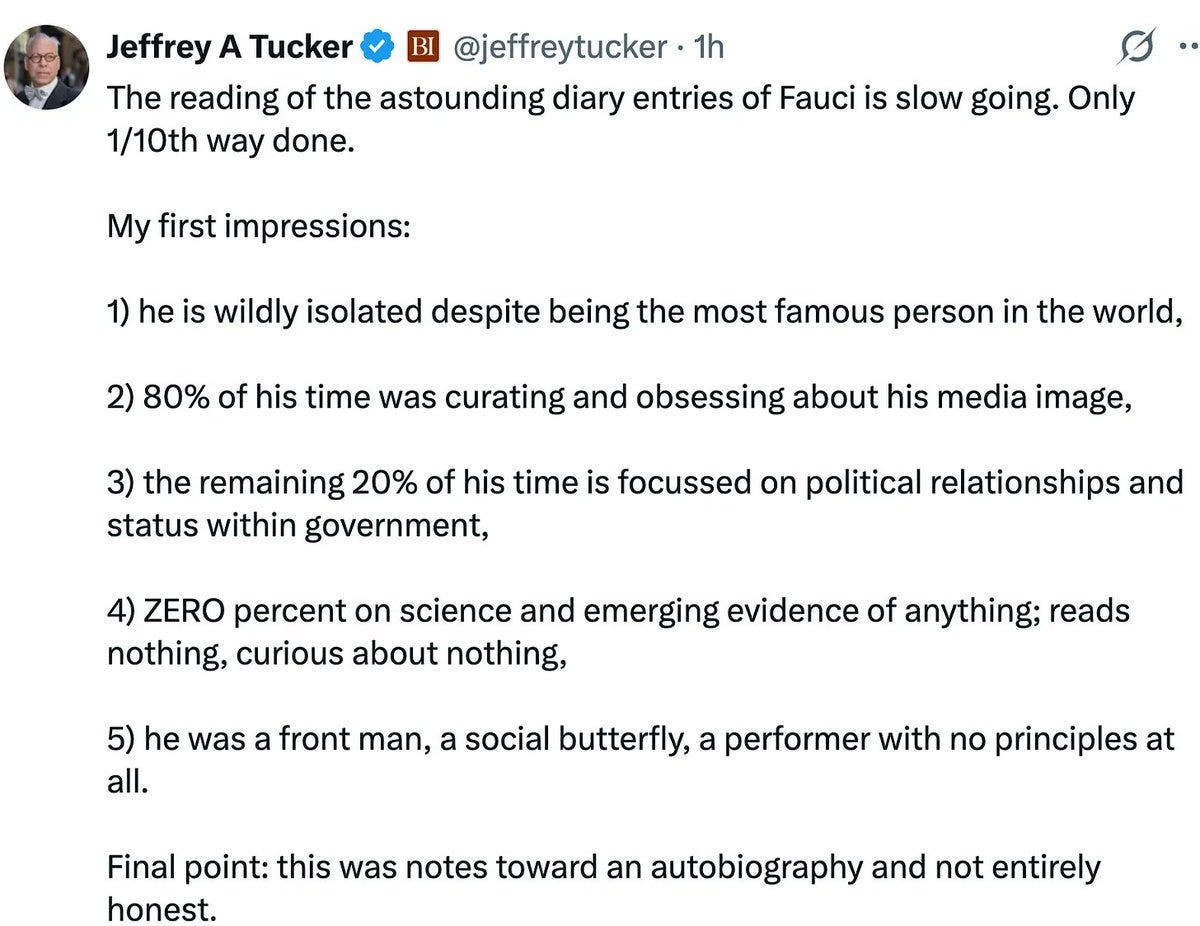
As there are so many examples, I was not sure which to flag, but this one Jeffrey Tucker found makes the point quite succinctly:
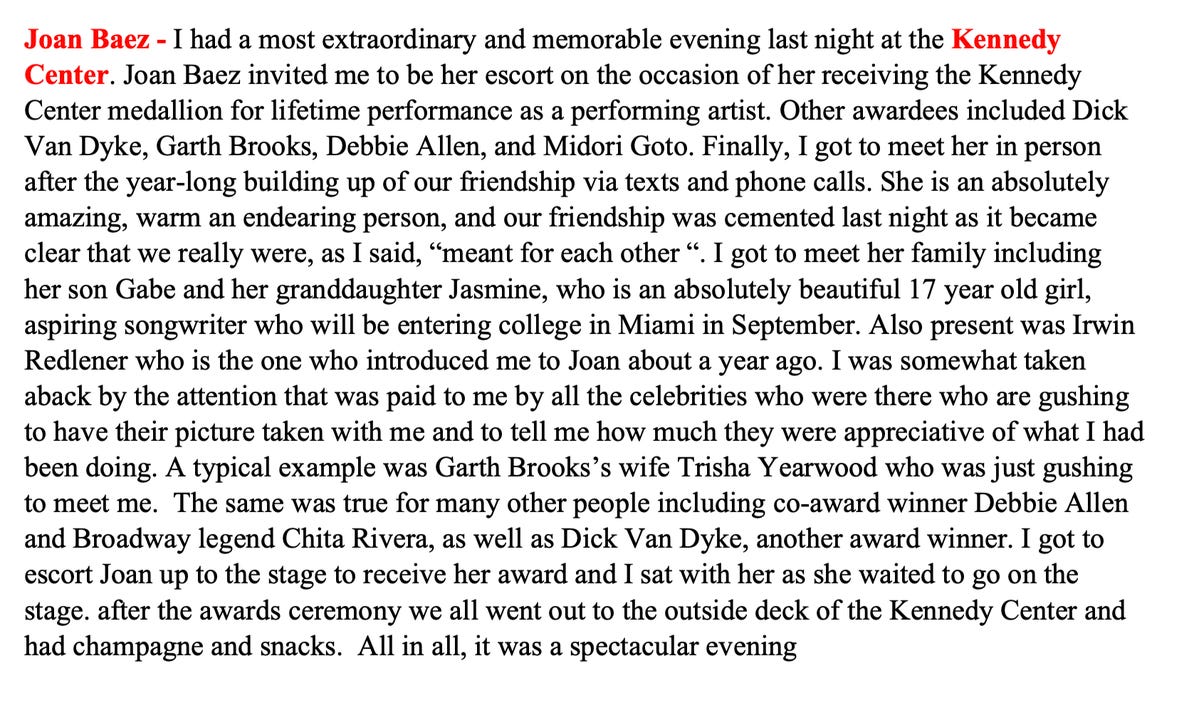
Fauci hence compulsively logged his media appearances day after day, in many cases making his vanity explicit: “It is not hyperbole to say,” he writes, “that today I am the most famous and talked about person in the country and one of the most recognizable person in the world.” He saved clippings about his childhood and his high-school basketball career, noted a petition to name him People‘s “Sexiest Man Alive,” logged “grandmothers who have crushes on me,” and archived an Atlantic profile headlined “America Is Thirsty for Anthony Fauci.” He transcribed the full guest list of a celebrity Zoom call Kim Kardashian organized for him — nearly thirty names, Katy Perry, Orlando Bloom, Gwyneth Paltrow, Ashton Kutcher, Chris Rock, Ariana Grande among them — logged Brad Pitt playing him on SNL, and tracked the songs written about him. As such, I feel I need to share one song that was made in Fauci’s honor (which is sung in full at the end of the segment):
Note: the only other thing Fauci compulsively logged was the daily COVID death count.
However, what immediately jumped out at me about the diaries was that they corroborated what Atlas had alleged about Fauci:
•He used his fame to manage the press directly. When Washington Post reporter Lena Sun called about reports that Beijing had pressured the WHO not to declare a global emergency, Fauci recorded that he dismissed it and “probably stopped her from writing the story,” noting that she backed down because, as he put it, “I am in all the important meetings.” He wasn’t merely enjoying the adulation; he understood it as leverage, and he used it to kill coverage he didn’t like.
•Fauci’s private remarks demonstrates his pettiness and vindictiveness. Fauci saw Atlas as a threat to be neutralized, never a colleague — accusing him of “deliberately trying to undermine Deb Birx[’s] interpretation of the data,” writing off the world-class epidemiologists behind the Great Barrington Declaration (Bhattacharya of Stanford, Gupta of Oxford, Kulldorff of Harvard) as “Atlas and his 3 stooges,” and grumbling that Atlas kept “causing problems” (at one point even pushing Kushner to have Trump remove him). Rand Paul gets it too: after one hearing, Fauci gloats that he “really stuffed him as he spouted out bullshit acting like he is an experienced epidemiologist.” The tell is that when Atlas’s account and Fauci’s are set side by side, it’s Atlas’s that the diary backs up.
•Atlas’s observation that Fauci lacked a basic ability to critically interpret scientific studies (demonstrated with individual exchanges they had such as when Fauci gleefully showed Atlas a study which at last vindicated Fauci until Atlas pointed out he’d misinterpreted it), an extreme bias towards only seeing the parts of literature that supported his own pre-existing biases and no interest in studying new science is corroborated by the fact scientific reasoning (wrestling with data, working through new studies, thinking on the pages) was absent from Fauci’s diary.
Peter Navarro’s accounts are corroborated too. For example, his “epic Situation Room showdown” over hydroxychloroquine was recorded by Fauci as “a big (unusual) argument with Peter Navarro who handed out a folder that he says shows studies that Hydroxychloroquine is effective in COVID,” notes that he “strenuously objected,” and adds, tellingly, “VP and Marc Short acted like Peter was nuts.” Both men place the same clash in the same room with Pence watching, each remembering the VP breaking his own way. Fauci even pasted the Axios writeup of the fight into his own diary, suggesting he was the one leaking (biased) summaries of these events to the press.
Note: one interesting admission from Fauci in his diary was that he initially favored hydroxychloroquine over remdesivir due to remdesivir’s “the potential toxicities” and “the need to prove that it works.” Not long after however, he stacked the NIH committee which decided the national protocols with longtime friends who had deep financial ties to remdesivir’s manufacturer and then predictably recommended it rather than the off patent-therapies with much stronger data.
Overall, I feel four critical insights can be gleaned about Fauci’s personality from these entries which apply to many people who worm their way into positions of power:
•The Dunning-Kruger effect is a psychological observation that the less competence or knowledge individuals have, the greater they will overestimate what they know or can do. Because of this, when people are overly aggressive with asserting something to be true, I tend to become inherently skeptical of their claims—which is unfortunate as humans are generally wired to follow the crowd and believe the most confident party even if what’s being promoted is insane.
•Many people in the public sphere (e.g., public health) have adopted the belief some degree of suffering is justified for the greater good (e.g., Fauci admitted lying to the public about masks to protect the N95 supply for healthcare workers). This mentality inevitably causes a lot of problems, because (due to the Dunning-Kruger effect) public health officials will become certain the bad policies available to them are justified and then come up with increasingly sophisticated rationalizations to continue them as more and more evidence (or public pushback) emerges showing they are not a good idea.
•Once people lie enough, they start to believe their own stories. My impression was that while Fauci flip-flopped on a lot of positions, once he became committed to one, he gradually began to rationalize everything to see all evidence as proof for his belief regardless of how at odds with reality it was (e.g., he constantly ranted about lab leak claims being “conspiracy theories” even though he’d previously acknowledged their validity).
•Certain insecure men (I’ve had my own share of bad experiences with) like Anthony Fauci and Peter Hotez have a deep craving for fame adulation and worship, will go to great lengths to attain sycophants and will be quite vindictive towards anyone who threatens their needs. As you might guess, these types of narcissists can cause a lot of issues once they rise to positions of power, particularly since power structures inevitably select for these types of people rather than competent or ethical individuals.
Note: while the conduct highlighted throughout both Fauci’s diary and the hearing is abhorrent (and likely the most consequential due to how many people COVID-19 impacted), I must emphasize that Fauci has engaged in far more abhorrent conduct throughout his career (which was the focus of RFK Jr.’s best seller The Real Anthony Fauci and covered in this previous article I wrote).
Fauci’s Hearing
Since the entire hearing was quite long, I wanted to highlight a few of the most noteworthy parts.
First, one of my “favorite” unbelievable facts about COVID-19 was that in 2021, Fauci received a $900,000 prize (from an Israeli foundation that gives out 3 million each year—typically split between 9 people and scholarship recipients) for “speaking truth to power.” In Hawley’s questioning (which given his background as a former Attorney General was clearly designed to expose and legally box in Fauci’s Fifth Amendment strategy), Hawley not only brought up the Dan-David prize, but also that Fauci not only had received many other cash prizes, but tasked numerous HHS employees with helping him to secure a multitude of prestigious cash awards.
Note: Fauci also had his employees lobby federal ethics watch dogs to allow him to receive the cash prizes (as it was a violation of Federal law for Fauci to receive them). This goes hand in hand with Fauci going to great lengths to cover up many of the pharmaceutical royalties he and his staffers had received (another point raised at this hearing) and Fauci’s wife effectively being the nation’s chief bioethicist for medical research.
During Senator Ron Johnson’s questioning, after highlighting the immense damage of the vaccines and the FDA cover-up of them he’s used his Senate authority to uncover, he noted that Fauci’s own diary (prior to being redacted1,2) recorded a pulmonary infarction around June 2021 (one of the flagged safety signals the FDA never disclosed). Johnson then asked whether it ever occurred to Fauci his own shots might have caused it:
Note: due to the political repercussions of acknowledging a COVID vaccine injury (especially if one advocated for them), but the nonetheless high rate of injury seen with them, I hypothesized we would likely see a spate of public officials who developed unusual injuries linked to the vaccine that were too severe to cover up (but nonetheless would never admit the vaccine association). As it so happened, these severe injuries were seen in numerous Senators (at a rate matching those detected in COVID-19 vaccine injury surveys), and I have since corroborated through direct sources sources other Senators have in private admitted they are suffering from less severe (concealable) injuries—all of which is detailed here (along with other cases like Biden’s sudden cognitive decline).
Fetterman (one of the Democrat Senators who suffered a stroke after COVID vaccination), then, to the best of my knowledge, became the first Democrat legislator to jump ship, adopting a neutral position towards Fauci and saying it was completely justified to question both the lockdowns and natural origin of COVID-19:
Lastly, Senator Moreno gave to the best of my knowledge the most scathing criticism a legislator has given to Fauci (which then went viral, in part due to the profanities within it and the vivid pandemic authoritarianism he recounted).
The full hearing had an excellent summary from a variety of Senators of many of the other egregious things Fauci did during the pandemic, and for those interested, can be watched in here:
Conclusion
From watching how this movement has grown over the last six years, two key themes have emerged. First, there has been deep gratitude from those who fought for vaccine safety and health freedom that these concepts are at last reaching public attention and that many of the seemingly insurmountable COVID-19 policies were successfully overturned. Secondly, there has been a widespread despair amongst those awakening to the reality of our situation both at how bad it is and the fact that regardless of how much we try to do things, nothing seems to change and no one is held accountable.
Since I belong to the former camp, rather than be distraught, I’m astonished at how much has been accomplished, but I also recognize how critical it is to have a tangible pathway forward so everything we are doing doesn’t seem like a perfunctory exercise in futility.
While I have been trying to do what I can to amplify specific leverage points that can shift things in a positive direction (which at times works), because of how entrenched vested interests are within the government, I’ve long believed that the only real solution to the predicament we are in is to shift public opinion and provide viable alternatives that allow them to opt out of the status quo (e.g., community food production frees you from the harmful food we are flooded with and DMSO is a freely available alternative to many of the less than ideal things we are forced to rely upon the medical system for).
Note: I have been publishing less over the last month because I’ve been working around the clock to collect the ozone literature base, and just finished the Russian part of that (which was harder to do than I expected because they’ve demonstrated a lot of uses for ozone therapy I would have never thought of). One notable thing about ozone therapy is that its demonstrated significant efficacy against a wide range of “incurable” viral pandemics and I believe a case could be made ozone therapy would be a superior approach to the billions we spend each year (and risky gain-of-function research) trying to make novel countermeasures to them.
As such, it’s been quite noticeable to me that we’ve seen a nearly historic loss of trust in vaccination and medical authorities (which I covered in detail here), with extensive polling now showing:
9%–34% of COVID vaccine recipients developed side effects from the vaccine, 7-13% developed serious side effects, 7.5-22% know someone with a severe vaccine injury, 24-28% know someone who they believe died from the vaccine and 46-55% believe the COVID vaccines have killed a significant number of people.
There has been an unprecedented loss of trust in doctors and hospitals since COVID (from 71.5% to 40.1%) which is mirrored by a significant loss of trust in the pharmaceutical industry, government health authorities and support for childhood vaccinations (which, now, almost half of the population no longer fully trusts).
As such, the political (and medical) system are now slowly responding to that pressure, with things such as RFK Jr. ascending to a previously unimaginable position (due to the MAHA coalition and public sentiment) and state bills across the country legalizing ivermectin for over-the-counter use. Fauci’s recent hearing, in turn, demonstrates that this pressure is continuing to build, as beyond him, for the first time in his career refusing to answer any questions in front of Congress (as he now has legitimate fears for his own freedom), not only were the Republican remarks against Fauci much harsher but one Democrat crossed over.
I never expected this to be an easy or quick battle, so it is still unbelievable to me how quickly all of this is progressing and I sincerely thank each of you for you help in bringing this new status quo to fruition.
To learn how other readers have benefitted from this publication and the community it has created, their feedback can be viewed here. Additionally, an index of all the articles published in the Forgotten Side of Medicine can be viewed here.
There’s a few other puppet masters or handlers who helped and guided Fauci, who should be held to account
CDC Director:
Rochelle Walensky
Pfizer CEO:
Albert Bourla
Vanguard CEO
(owner of Fox & CNN, J&J):
Mortimer J. Buckley
CDC Deputy Director:
Anne Schuchat
AstraZenica CEO:
Pascal Soriot
BlackRock CEO
(owner of Fox & CNN, J&J):
Larry Fink
CDC Director
Washington Office:
Jeff Reczek
BlackRock President
(owner of Fox & CNN, J&J):
Robert Kapito
Covid Czar:
Jeff Zients
Secretary of State:
Antony Blinken
Health & Human Services:
Xavier Becerra
Assistant Secretary for Health:
Rachel Levine
CDC Chief of Staff:
Sherri Berger
CDC Chief Medical Officer:
Mitchell Wolfe
Deputy Secretary of State:
Wendy Sherman
Moderna Chief
Scientist:
Tal Zaks
Johnson & Johnson
CEO:
Alex Gorsky
Pfizer Chief Scientist:
Mikael Dolsten
Senior Pandemic
Advisor:
Andy Slavitt
White House
Chief of Staff:
Robert Klain
Administrator of Small Business Administration:
Isabel Guzman
Attorney General:
Merrick Garland
Secretary of Treasury:
Janet Yellen
Secretary of Homeland Security:
Alejandro Mayorkas
Former Director of CIA:
David Cohen
AL INTEL
Deputy National Security
Advisor for Cyber and Emerging Technology:
Anne Neuberger
Director of National Intelligence:
Avril Haines
Terrific article, but in calling Fauci's log his "private diaries," you are accepting the corporate media's misleading framing of the documents. These were government documents. Calling them private diaries implies that Kennedy and Rand Paul were the bad guys in publicizing someone's private papers, as if they invaded his bedroom and seized his little diary book without a warrant. That's not what happened. We should not be going along with the corporate media's framing of this issue.
See: https://x.com/SecKennedy/status/2082236450758885868