
Story at a Glance:
•Since MAHA and RFK came into power, the pharmaceutical industry has disproportionately focused its lobbying on neutralizing vaccine safety reform, with a key tactic being to stall meaningful action until Trump’s term expires so everything can be quietly rolled back.
•A central tool in this effort was a single poll conducted in late 2025, which concluded that vaccine skepticism is political suicide — results so dire they convinced the White House to shelve vaccine safety as a public issue until after the midterms.
•However, 25 other polls told a starkly different story: institutional trust has collapsed to historic lows, clear majorities support vaccine safety research and liability reform, and three MAHA-allied polls found that championing vaccine reform made candidates more favorable to voters, not less — while the leading Senate opponent of RFK’s vaccine work just lost his primary with only 24.8% of the vote.
•The Fabrizio poll achieved its outlier results through a series of deliberately biased design choices not present in earlier versions (which got opposite results). This article walks through them in detail, as they exemplify the techniques and word games propagandists routinely use to manufacture public consensus; once you learn to recognize them, you will start seeing them everywhere.
•This article will also review how these common rhetorical games have been repeatedly abused to manipulate the American people (e.g., with vaccines and autism), and the many parallels between what is happening now and the tactics used in 2020 to convince leaders to commit political suicide by forcing everyone to follow useless and counterproductive COVID mitigation efforts while they waited for a vaccine. Fortunately, things have changed this time around, and there is much broader support for overturning this sinister pharmaceutical agenda.
Since MAHA and RFK came into power, massive industries with profound lobbying capacities have faced major threats to their profits which cannot be neutralized with the traditional tactics they’ve long relied upon. Yet while many industries are threatened, what I have been the most surprised by is that on every front, they have disproportionately focused on opposing meaningful reforms to the American vaccine schedule (with what often felt like a coordinated campaign, as the same talking points would simultaneously appear across mainstream outlets, Senate hearings, agency actions, and private lobbying efforts directed at the White House).
A few months ago, a few people I know with knowledge of the political dynamics within the White House shared that they were very concerned the pharmaceutical industry was managing to overturn the Trump administration’s unprecedented push for vaccine safety by producing polling that had made the White House conclude they needed to drop the vaccine issue completely until after the midterms. This was highly concerning as a key tactic industry has been using to obstruct vaccine safety reform has been to stall things out so that by the time Trump’s term is over, nothing meaningful gets done and it hence can easily all be rolled back.
The central problem with that “poll” was that it was completely at odds with what virtually every other poll showed and what the electorate has shown (e.g., last week, Cassidy, the primary senator obstructing RFK’s vaccine work not only lost his primary, which is extraordinarily rare for an incumbent senator, but got just 24.8% of the vote1—effectively ending his 20 year political career).
To try to change that course before it was too entrenched within the White House, I decided to confront it with a detailed summary of what all the actual polling data showed:

In the 25 applicable polls I found conducted between 2022 and 2025 (by many different reputable polling firms), their data consistently shows:
•9–34% of COVID vaccine recipients reported side effects, 7–13% categorized those side effects as serious, 24–28% personally know someone they believe died from the vaccine, and 46–55% of the general public believes the COVID vaccines have caused a significant number of unexplained deaths.
•This has been accompanied by an unprecedented collapse in institutional trust—a pivotal JAMA survey found trust in physicians and hospitals fell from 71.5% to 40.1% over the course of the pandemic—and an erosion of support for childhood vaccination, with a November 2025 Pew poll finding only 41% of Americans fully trust the CDC vaccine schedule (27% among Republicans).
Finally, three recent polls commissioned by MAHA allies to assess midterm viability (Zogby, Rosetta Stone, and FLA) found that a supermajority of voters support health and medical freedom policies including vaccine-related reforms, that MAHA is the single most effective issue for flipping swing voters, and that championing a reduced vaccine schedule made candidates more favorable to voters—not less.
The Fabrizio Poll
In contrast to these results, one poll conducted in November 2025, as mentioned before, found radically different results, with 80-90% of voters strongly supporting vaccines, 80% opposing anyone trying to reduce vaccine requirements and this translating to roughly a 12-31% point electoral swing. As this equates to a catastrophic loss in the midterms, the pollsters concluded:
Republican and Democratic candidates who support eliminating long standing vaccine requirements will pay a price in the election.…Vaccine skepticism is bad politics.
This thus allowed the voices within the White House opposed to Trump and RFK’s push for vaccine safety to have such a compelling argument they were able to make vaccine safety be off-limits from any public discussion until after the midterms (along with prohibiting vaccine policy actions the media could criticize and thus alienate voters). In parallel, food safety was presented as the overwhelmingly popular MAHA issue that hence needed to be focused upon (hence explaining the shift we saw).
In contrast, as I detailed previously, on a wide variety of vaccine safety questions, there was majority support for reform positions (including among Democrat voters), with the most relatable ones such as vaccine safety research being justifiable and opposing hard or soft mandates polling at 80 to 90% support. More telling than any poll, in 2022 (when significantly less vaccine skepticism existed than now), Ron Johnson became the first candidate to ever run on a vaccine safety platform, was relentlessly targeted for it throughout his campaign, and still won what, from the start, was one of the closest Senate races of 2022 (ultimately winning by 1%). In short, rather than being political suicide, in a very tight race, this issue energized his base more than it alienated voters.
However, while none of those 25 polls were promoted in the mainstream media (besides those highlighting the JAMA survey showing a profound loss of trust in medicine where the cause of that loss of trust was never discussed), that poll was. To quote the New York Times:
But underlying those promises was a political reality: Mr. Kennedy’s healthy eating agenda is popular. His vaccine agenda is not.
Just one in five voters approves of rolling back established vaccine recommendations, which has been a signature of Mr. Kennedy’s first year as health secretary, according to the Republican pollsters Tony Fabrizio and Bob Ward, who surveyed voters in 35 competitive congressional districts about the Make America Healthy Again movement.
“While the MAHA agenda is broadly popular” with respect to food and agriculture, they wrote in December, “vaccine skepticism stands as an outlier, rejected by most voters even within the MAHA movement.”
Within the Trump administration, there is a strong desire for Mr. Kennedy to focus on issues that unite people and to de-emphasize vaccine policy, according to a person familiar with internal strategy discussions who spoke on the condition of anonymity to describe them.
This hence suggests the poll was commissioned specifically to craft a narrative, and that like many of the other coordinated campaigns done to derail RFK’s vaccine safety efforts, immediately passed off to media networks establishment figures listen to (beyond NYT, this narrative was parroted by many other outlets including The Guardian, The Washington Post, Axios), with the likely goal being to pressure Republican candidates to not discuss vaccine safety through manipulative framing like what the NYT did in their article.
Jeffrey Tucker astutely noted that the sponsor for this poll was never disclosed — which is a significant red flag for any poll, but especially one that was then widely promoted by major media outlets as though it were authoritative (as basic journalistic standards require reporters to ask who commissioned a poll before treating it as credible)—indicating the sponsor likely wanted to hide their role, as most people would not place much weight on a poll concluding that vaccine skepticism is political suicide if they knew it was commissioned by the pharmaceutical industry.
More importantly, this poll used blatantly biased structuring (pollsters are not supposed to accept) which facilitated a result at odds with every other poll.
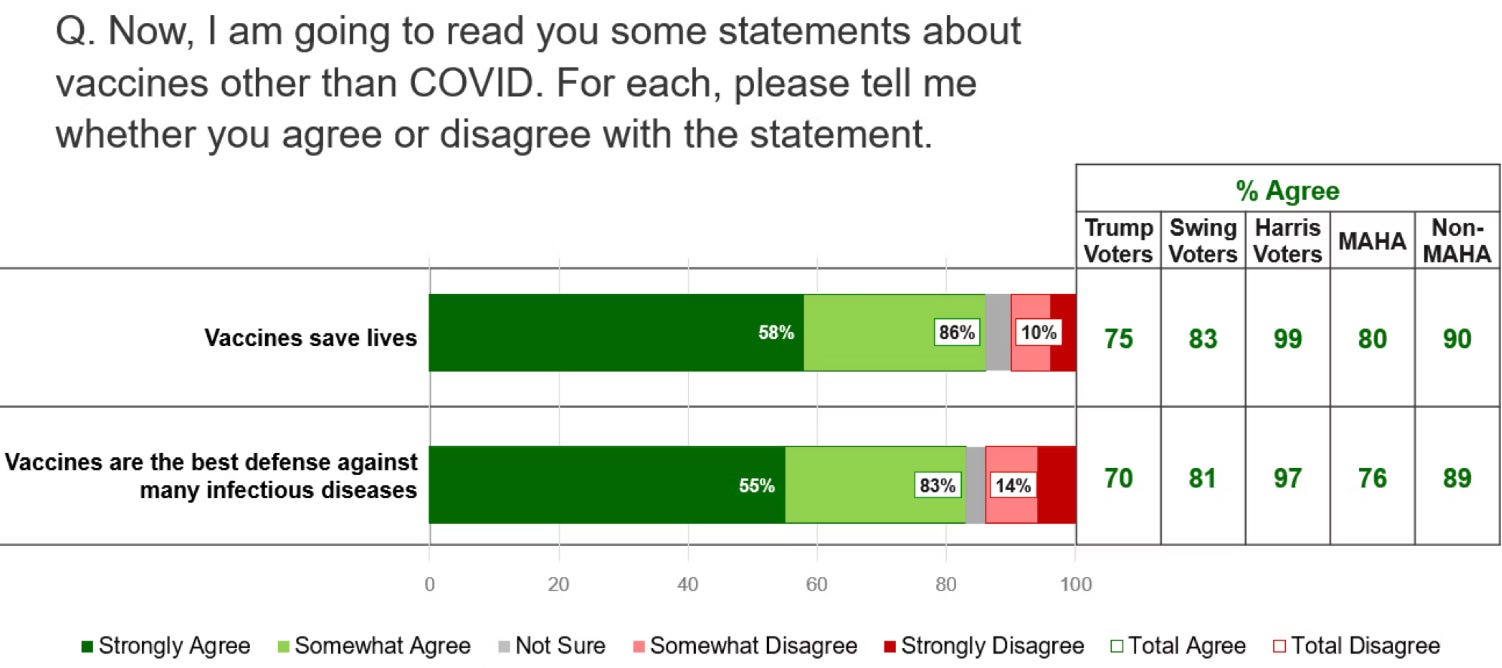
For the vague statement “vaccines save lives” to be true, all that is required is for at least two people in human history to have been saved from dying by a vaccine — something most people would be inclined to believe (e.g., receiving the rabies vaccine after being bitten by a rabid animal does save people from dying each year). As such, most respondents would feel pressured to agree, as disagreeing would seem to require denying something self-evidently true.
The second question uses “many” to make the claim extremely vague and hence hard to dispute (again pressuring respondents to agree rather than appear to be denying something obvious). Furthermore, actually assessing the validity of that statement requires an in-depth understanding of the existing treatment options for a very wide breadth of infectious diseases, how their efficacy data compares to vaccination (which even most doctors are not familiar with), and familiarity with alternative options few even know about — all of which again pushes respondents toward “yes.”
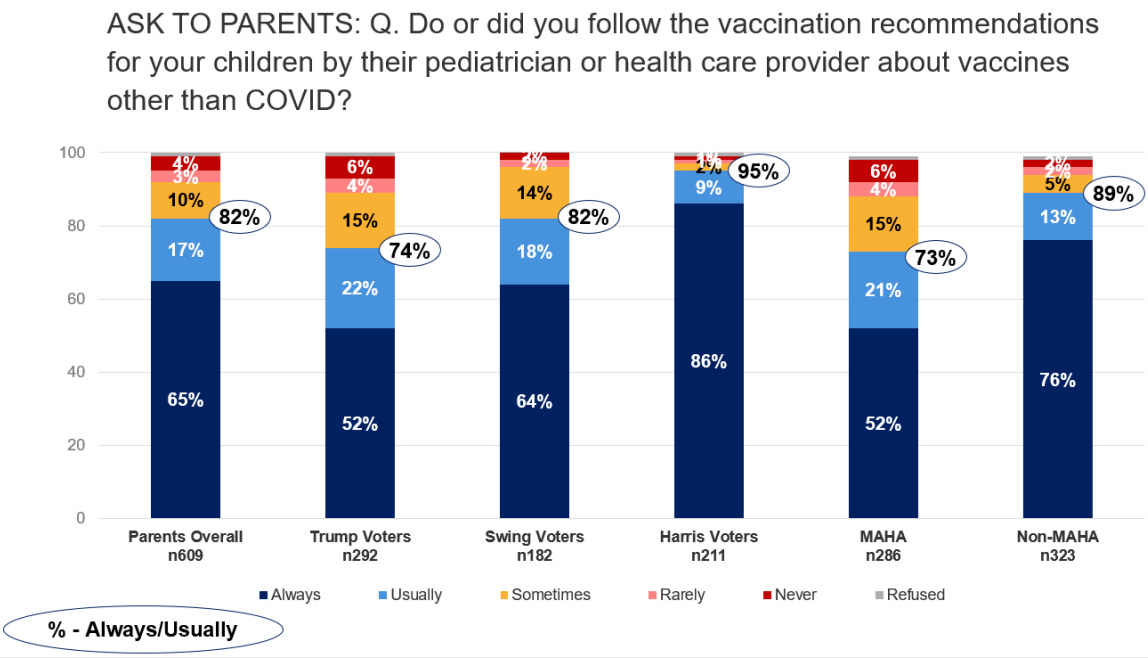
This question frames vaccine skepticism as someone questioning their doctor (who typically they will trust) rather than skepticism towards government guidelines or pharmaceutical manufacturers and per the wording, makes it so if you had trusted vaccines in the past enough to follow your doctors vaccination recommendations but no longer do (e.g., because your child had a vaccine reaction or you later learned about their dangers), you still are a “yes” here. In short, both of these created a fairly high bar to meet for vaccine skepticism that was not evident from a quick glance at the wording.
Following respondents being primed to support vaccines (by having answered yes to three successive questions designed to elicit agreement regardless of one's actual position), the poll then leveraged those freshly committed answers — asking respondents, in effect, whether they would vote against a candidate who challenges the very recommendations they had just affirmed supporting, and whether the government should dismantle the very protections they had just agreed were beneficial.
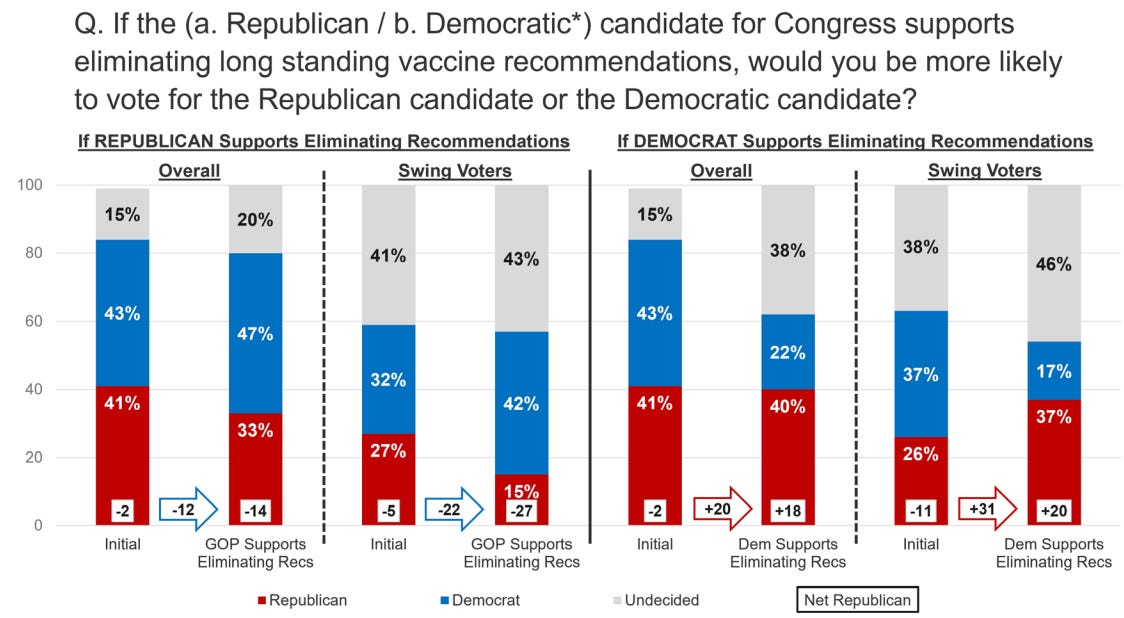
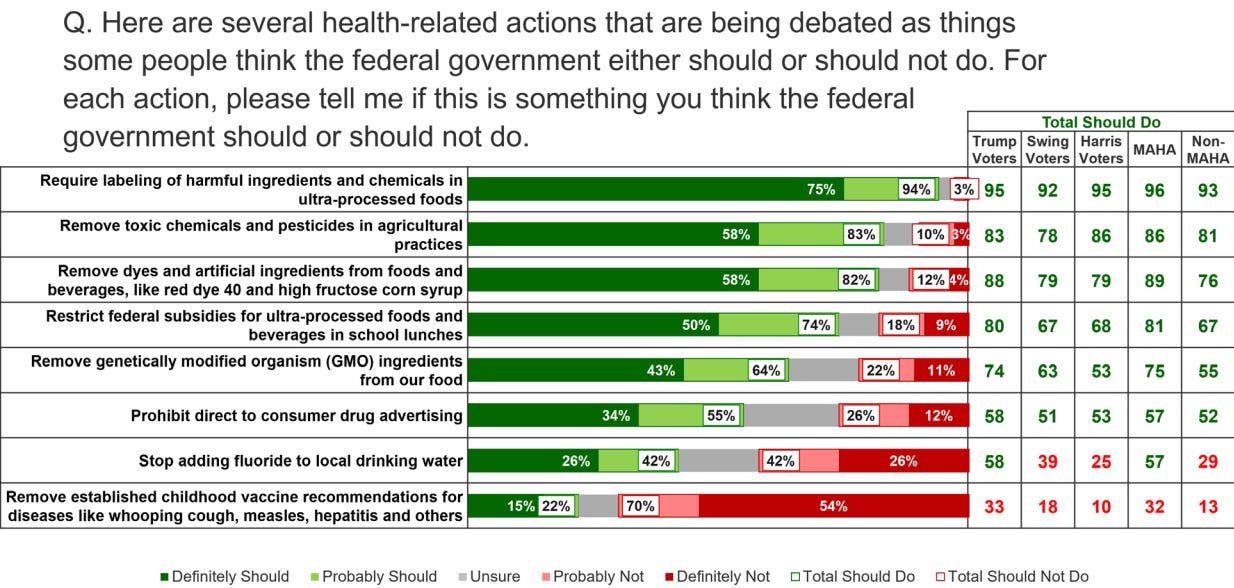
Like the previous questions, several design choices in these final two items worked in concert to inflate opposition to vaccine reform.
First, both questions ask about removing vaccine “recommendations“ rather than mandates — a word choice that mirrors the CDC’s own rhetorical sleight of hand, in which its “recommendations” are technically voluntary but are then adopted by schools, employers, and government agencies as de facto mandates. By using this framing, both the electoral question and the policy battery make the reform position sound like it is dismantling mere guidance rather than challenging compulsory requirements — which is what most vaccine skeptics are actually objecting to.
Second, in both questions those recommendations are characterized as “long-standing“ or “established,” which introduces a status quo bias — respondents aren’t just being asked whether these vaccines should be recommended, but whether they would overturn something presented as settled and time-tested. That is a significantly higher psychological bar.
Third, the policy battery item names the three diseases the media has most aggressively primed the public to fear — whooping cough, measles, and hepatitis — rather than asking about the schedule as a whole or about the vaccines that have generated the most public concern. This forces respondents to weigh “removing recommendations” against the specific diseases they’ve been conditioned to find most alarming (besides COVID which was explicitly excluded from this poll).
Fourth, there is a structural priming effect created by the sequence of items in the final question. Every preceding item frames the government as adding a protection or removing something widely recognized as harmful — labeling chemicals, removing pesticides, restricting subsidies for junk food. This establishes a pattern in which supporting government action feels like the reasonable, pro-health position. The vaccine item then abruptly reverses the frame: now the respondent is being asked whether the government should dismantle something it’s done for a longtime to help us. After six or seven consecutive items where “yes” meant supporting a health safeguard, “yes” now means removing one — a jarring shift most respondents would not consciously register but which biases them toward “no.”
Note: the poll never disclosed whether the items in this battery were presented in the order shown or randomized — a basic methodological detail any rigorous survey would specify. Given the clear directionality of the rest of the poll’s design, however, the most parsimonious assumption is that the order was fixed, and that this specific priming effect was intentional.
In short, this poll did what propagandists routinely do (and I periodically highlight instances of in this newsletter). They routinely are tasked with asserting something which is clearly wrong (or inherently contradictory), and to accomplish this they use a deliberately ambiguous phrase that is able to morph into their desired meaning for each situation encountered.
For example, like the vague but compelling statement ‘vaccines save lives,’ the phrase 'vaccines are safe and effective' is invariably stated in a manner that implies absolute (100%) safety and efficacy — but is never quantified, which gives its proponents the high ground to promote vaccines while simultaneously providing a built-in pivot whenever vaccines fail or cause harm (e.g., at a 2024 hearing Fauci stated “no vaccine is 100% effective” when asked why he lied to America about the COVID vaccine’s efficacy).
Likewise, I previously made the case that framing the vaccine injury discussion around autism was an elaborate rhetorical feat which resulted from the following:
1. Prior to the mass-censorship of medical journals, vaccines were recognized in the medical literature to cause encephalitis and brain damage.
2. The (original) DPT vaccine had a particularly high rate of vaccine encephalitis, with the injuries it caused (and NBC covering them) mobilizing parents to create what became the modern vaccine safety movement.
3. The media (which had not yet been bought out) then began covering DPT injuries where both parents of injured children and vaccine skeptical doctors, on national television, stated the vaccine caused “mental retardation.”
4. This media blitz galvanized vaccine injury lawsuits (primarily for DPT brain injury and death) and public support for the 1986 vaccine safety legislation.
5. That act provided guaranteed compensation for a small number of injuries that acknowledged to be linked to vaccination, a commitment to study a few more that many thought were (one of which was autism), and a commitment to add new injuries to the schedule as evidence emerged and new vaccines with their own unique risks entered the market.
Note: as the US government paid the compensation, it had a vested interest against doing so, and not surprisingly, the promised studies were never done and despite a glut of vaccines entering the market, virtually no compensated conditions were ever added.
6. Five neurological injuries were compensated, with encephalitis or encephalopathy being attributed to two of the three existing vaccines (MMR and DPT but not polio).
7. After the act was passed, a widespread push began to eliminate the use of the stigmatizing word mental retardation, culminating in a 2009 law which effectively banned it from Federal statues.
8. This coincided with mentally retarded children being relabeled as autistic (e.g., this is what actually is shown in two of the most commonly cited studies which claim the autism explosion is a result of diagnostic criteria changes1,2).
9. Two different conditions were then blurred together. Severe intellectual disability (profound autism—a term most people outside the autism community do not even know exists) and autistic behaviors (frequently in individuals who were otherwise completely functional).
10. Autism was never clearly defined.
This accomplished the following:
•The government no longer had to compensate vaccine encephalitis (which would have bankrupted the compensation program), as parents instead were primed to believe they had to fight for acknowledgment “vaccines cause autism” and the debate was reframed around this (which included the academic journals and mass media doing all they could to debunk it).
•Individuals with less severe forms of autism (or their associates) became foot soldiers to attack anyone who claimed vaccines caused debilitating brain injuries by citing the fact their own (non-profound) autism was a gift not a disability.
•Unlike the stark contrast “mental retardation” provides, autism became such a vague and amorphous label it was very easy for most people to write it off in their mind as something quirky and inconsequential they didn’t need to think about.
So because of some sneaky word games, parents of (profoundly) autistic children have been stuck in a nightmare for decades where everyone gaslights them about what happened and they are on their own to manage (often lifelong) care demands that most people cannot fathom without experiencing them firsthand.
Sadly, this issue is not unique to autism, and once you understand the basic formula, it’s quite infuriating to see how often selective ambiguity is abused by propagandists and their mouthpieces so they can “have their cake and eat it,” particularly because of how effectively it again and again manipulates the public.
The Secret Poll
One of the major challenges you encounter when entering the world of alternative narratives is how easy it is to get pulled into endorsing claims that have suggestive but not definitive evidence behind them and ultimately turn out to be false—so a major priority for me in this newsletter has always been to avoid doing that.
Because of this, I am always acutely aware of when definitive evidence emerges that corroborates what I was virtually certain was happening behind the scenes (e.g., recently I highlighted here and here how Ron Johnson’s Senate investigations provided definitive evidence the CDC and FDA knew the COVID vaccines were causing a host of severe injuries but suppressed that to protect the vaccine program).
Initially, I strongly suspected the Fabrizio poll was doctored as, beyond the reasons mentioned above (e.g., highly biased language and it contradicting every other poll), a subsequent poll MAHA commissioned from the same firm found that support for vaccine safety advocacy — while the least powerful of the MAHA issues tested — still made voters more likely to support Republican candidates, not less, which is a very different conclusion from ‘vaccine skepticism is bad politics.’”
However, a leaker just disclosed to journalists that Fabrizio conducted another (unpublished) poll prior to the December 2025 one which showed that:
•The number one concern of voters was the pharmaceutical companies having too much influence over medical research, the news, and politicians
•A clear majority of voters were concerned about vaccine mandates (hence why they needed to be relabeled as “established recommendations”).
•74% of voters were concerned that vaccines were shielded from liability for injuries.
•Seven out of ten voters want more research on vaccine toxicity.
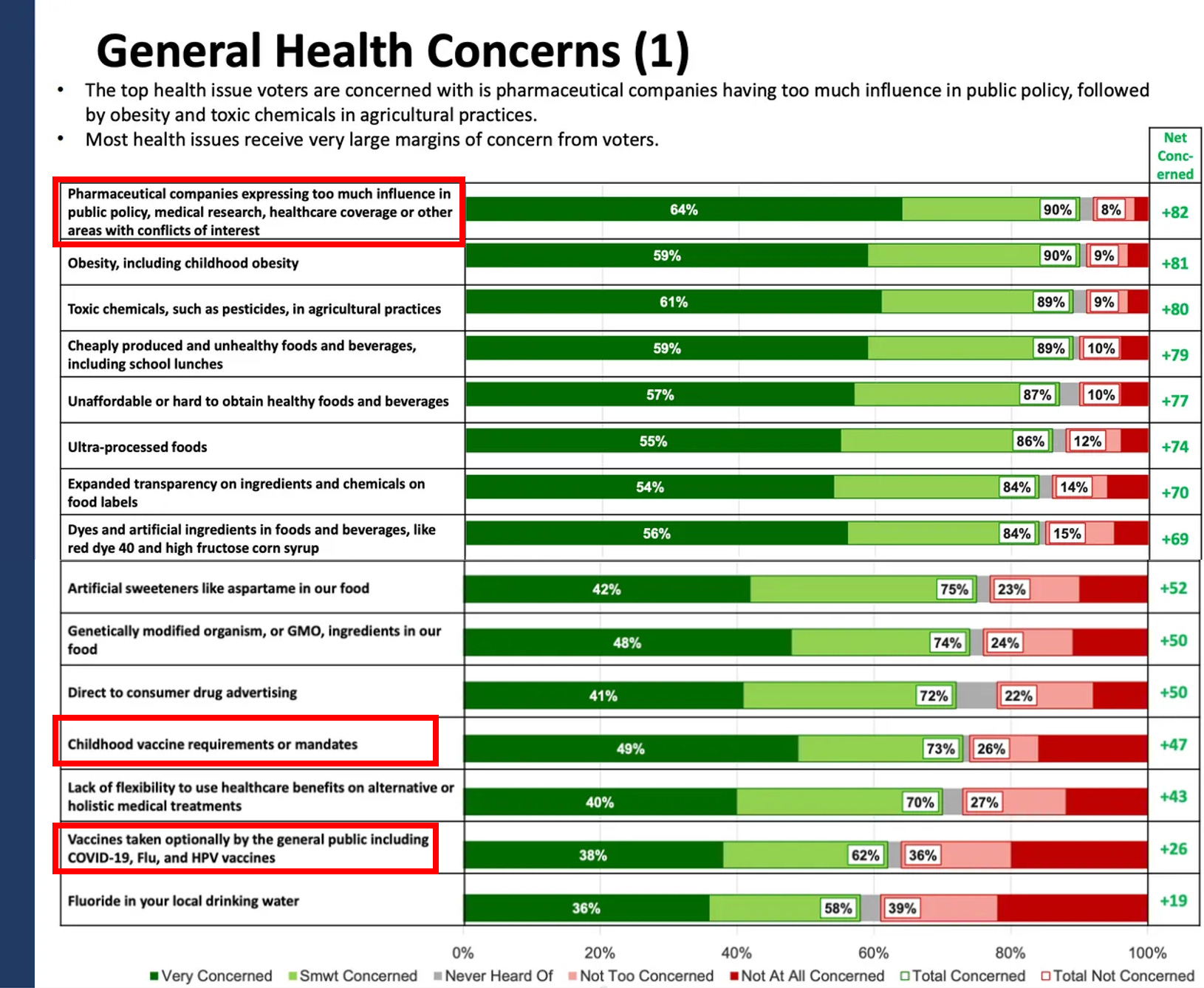
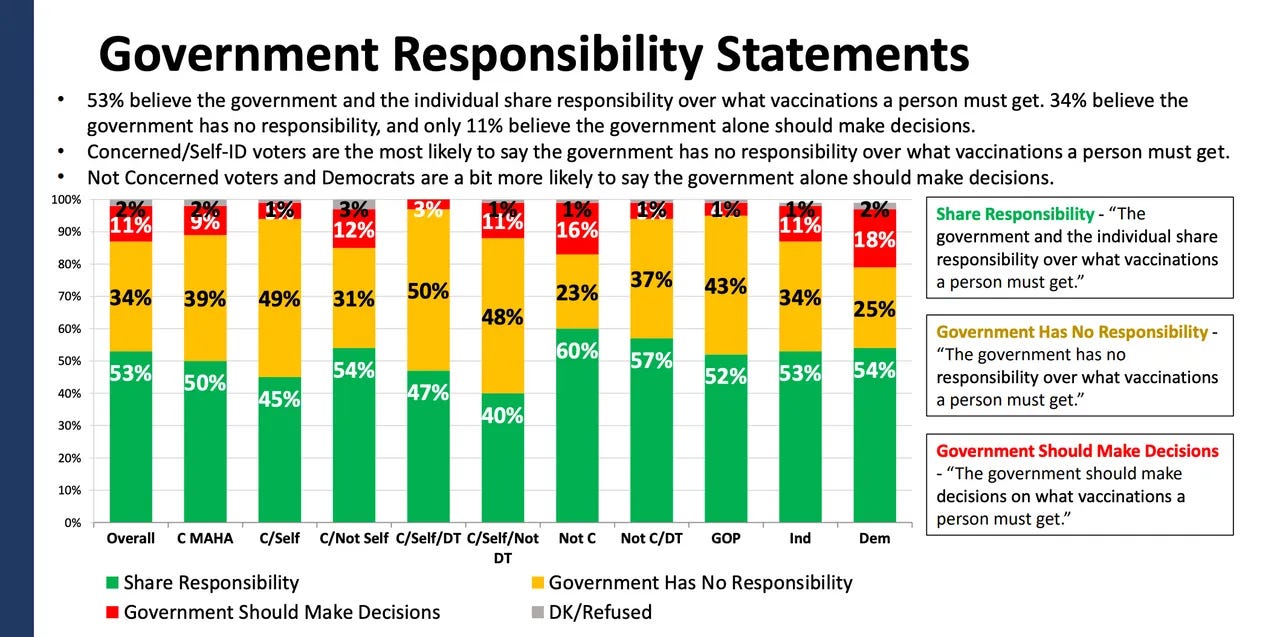
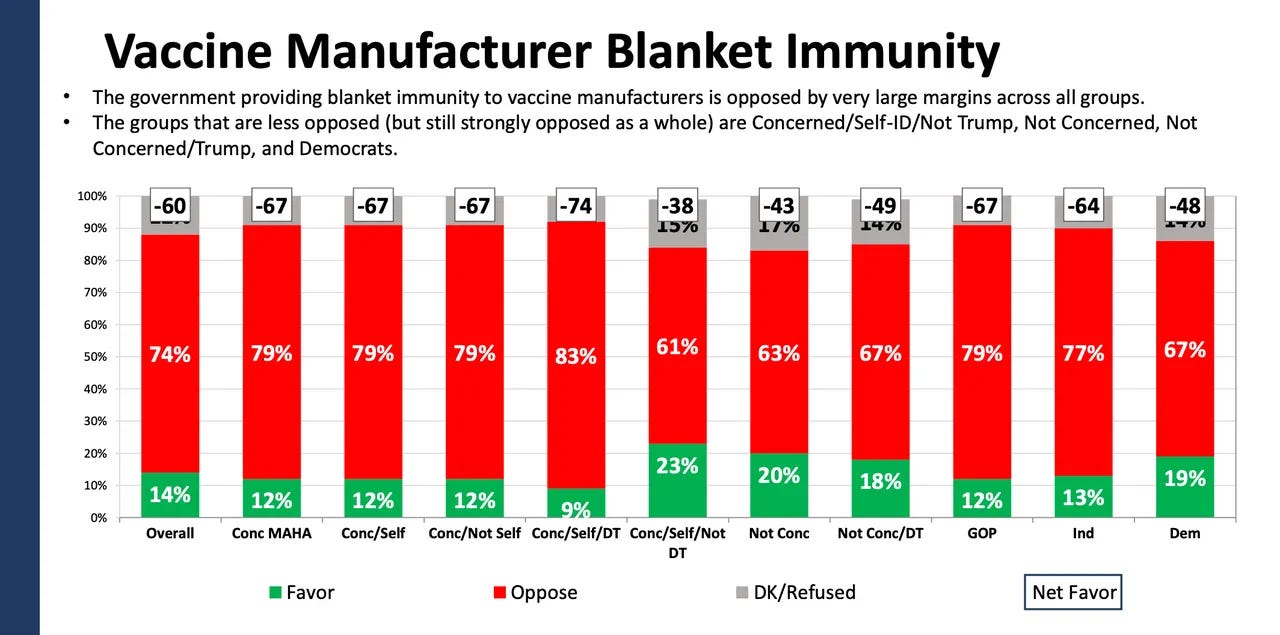
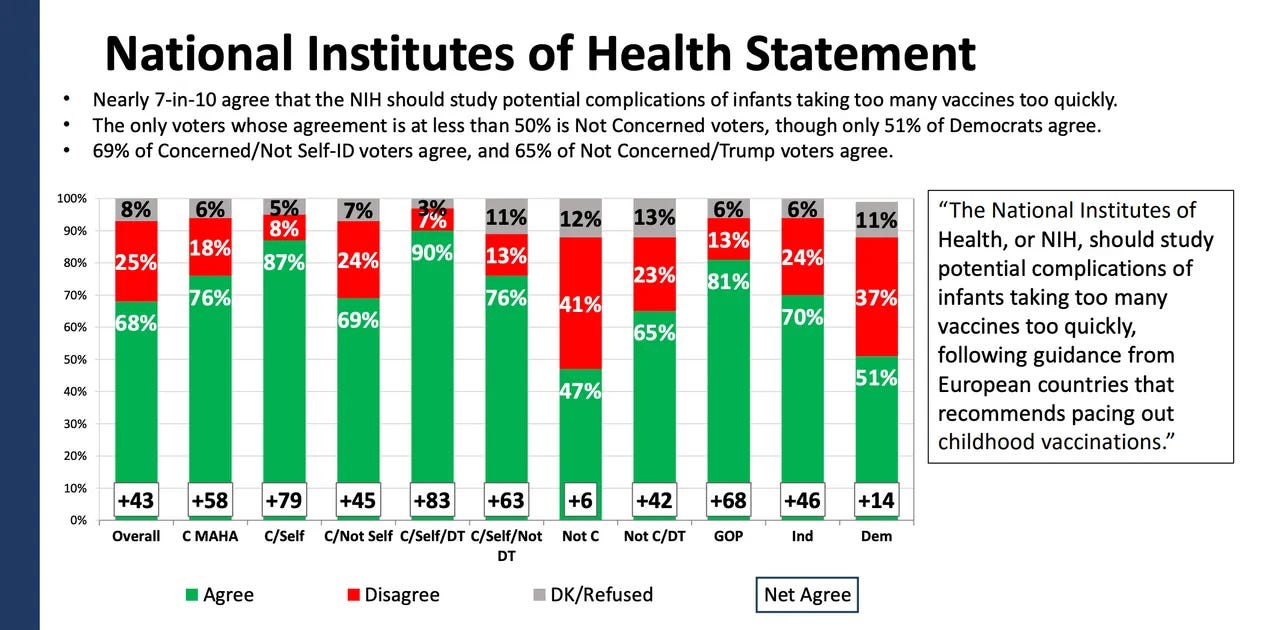
So like the others, it showed there were widespread concerns about vaccine safety and that voters supported candidates addressing it. If we compare the language between the two and consider that the first was not released, two reasonable conclusions can be drawn:
1. The sponsors who commissioned it did not like the initial results they got and hence did not release them.
2. The initial poll was used as a prototype to develop a poll which could be structured get the results they wanted.
All of this touches upon a broader issue, which is that political polling is fraught with biases (either due to methodological errors of pollsters or deliberate actions by sponsors to get specific results they can use to promote their agenda). Because of this, analysts have gotten better at spotting “bad polls” that should be disregarded and certain polling companies have gradually established themselves as “reputable” because they consistently predict election results.
However, while reputational incentives exist, they have clear limits. Polls consistently underestimated Trump’s support in both 2016 and 2020 (contributing to a significant loss of public trust in the polling industry), and despite post-mortems identifying the errors, there were no meaningful consequences for the firms involved — because no federal law prohibits publishing a biased poll. While Trump is currently engaged in a protracted lawsuit against Iowa pollster Ann Selzer over a pre-election poll he alleges was deliberately falsified to influence the 2024 election (which might create a legal precedent), no major prosecution has ever resulted from standard polling bias. In practice, the worst a firm faces is reputational damage, and the worst a sponsor faces is public scrutiny — which they can sidestep entirely by never disclosing their involvement, as happened here.
Note: when the Daily Caller News Foundation broke the story of the secret October poll, they reported that Fabrizio’s firm did not respond to requests for comment.
Will History Repeat?
My own takeaway from all of this was that, once again, I felt history was effectively repeating.
Specifically, the inadequate COVID-19 response cost Trump the 2020 election (due to the media constantly blaming the failure to contain COVID and its deaths on Trump, lockdowns crashing the economy and lockdowns facilitating a dramatic expansion of mail-in voting—all of which is why many still believe COVID-19 was released to end his presidency). Through memoirs written by Scott Atlas and Peter Navarro (and watching the media throughout the pandemic), I learned that Trump had wanted to implement a variety of sensible policies that would have effectively reduced COVID-19 (and restored the economy), but each time he attempted to, he was shut down by the Federal health bureaucracy, who led by Fauci, worked in collusion with the media to create a public hysteria each time an attempt was made to shift towards a COVID policy besides lockdowns and continual repeated testing (which resulted in his advisors nixing every reasonable COVID-19 policy as they “did not want to rock the boat” before the election).
In tandem, while the media attacked every COVID-19 therapeutic even lightly proposed by the Trump administration, it strongly endorsed the COVID vaccines, and before long much of the entire administration did all they could to expedite the vaccine so it could be released prior to the election and the administration was pulled into a daily routine of waiting with bated breath for each new update on it. However, at the last moment, Pfizer delayed the vaccine (specifically announcing that their massive trial showed it was over 90% effective) until 6 days after the election, thereby preventing the wave of positive media coverage that would have likely swung the election (with Congressional investigators finding evidence indicating this was deliberate).
I hence believe a similar corralling is occurring here, where numerous angles of pressure are being used to push Trump away (or have his staffers push him away) from threatening the vaccine industry, and since most of the existing strategies they used in 2020 weren’t sufficient (e.g., obstruction from officials throughout the Federal health bureaucracy, misleading internal advice from trusted experts, and widespread opposition from both Democrat legislators and the media) as his team were now somewhat wise to them, new ones needed to be implemented such as doctored polls (and somehow convinced Trump’s trusted pollster to do the deed).
Fortunately, unlike 2020, our attempts to reach them were successful, and on May 10th Trump resumed publicly espousing his “controversial” concerns on vaccine safety (albeit in a more tempered way) after being asked about the original vaccine safety commission he planned in 2016 that the pharmaceutical lobbyists successfully convinced his administration to shut down.
Note: Sharyl Attkisson was an award-winning CBS News investigative correspondent who during her tenure, conducted many of the final investigations ever permitted by the mainstream media into the dangers of vaccines (which can be viewed here). She continues to do excellent work as an independent journalist and can be followed on Substack (here) or Twitter/𝕏 (here).
Conclusion
What ultimately stands out from all of this is not just that a single poll was manufactured to silence vaccine reform — it’s that the people behind it believed they needed to. The very existence of the Fabrizio operation is an admission that the pharmaceutical industry knows it is losing the public, and that the only way to maintain the status quo is to prevent elected officials from discovering just how much support exists for changing it.
MAHA is not a fringe movement. It is one of the largest and most motivated voting blocs in the country, and as Cassidy’s historic defeat demonstrates, politicians who position themselves against it do so at their own peril. The polling data (all 25 surveys the industry hoped no one would compile) makes this unambiguous, and the voters who showed up to end a 20-year Senate career over this issue are not going away.
Fortunately, despite the enormous effort that went into creating this communication blockade, it appears to be failing. Trump’s return to publicly discussing vaccine safety in May — after months of being corralled away from the topic — signals that the wall erected between him and his base on this issue is beginning to crack. That crack exists because enough people refused to stay silent, and I want to sincerely thank each of you for what you have done to make that possible, as without this community and many others like it, that wall would still be firmly intact.
Unfortunately, the data manipulation seen in polling is crude and trivial compared to what routinely occurs in clinical trials, where the financial stakes are orders of magnitude greater and, unlike elections, no immediate real-world outcome exists to unmask the deception. In the next article, I will use the Fabrizio poll as a springboard to walk through the far more sophisticated — and far more consequential — tactics the pharmaceutical industry uses to doctor the research all of medicine depends upon.
A recently updated index of all articles published in the Forgotten Side of Medicine (including the DMSO ones) can be viewed here. Additionally, to learn how other readers have benefitted from this publication and the community it has created, their feedback can be viewed here.
Hoo Rah! This is the Truth and we don’t hate the big pharma / MSM conglomerate enough. !!!
Another wrinkle in this whole business is that a lot of people who don't vaccinate their kids are unlikely to participate in a poll at all, which would skew the results toward people who do believe vaccines are safe. My experience was that I felt like I was always under assault when my kid was young and I didn't want to give anyone any more ammunition than I had to.