
Story at a Glance
• Our political system is shaped by left versus right than by vested interests that capture whichever party holds power, which is why policies with overwhelming public support so rarely become law.
• Republicans lost both chambers of Congress, as the strategy their leadership bet on largely failed. Notably, voters ranked government corruption as the most important factor in their vote.
• Days later, Calley Means, who led MAHA implementation at the White House until October, went on Joe Rogan and laid out how a handful of former lobbyists who controlled the policy process blocked popular MAHA reforms while advancing the priorities of the industries paying their firms. Hours after it aired, Trump announced the chief of staff he named was out.
• Much of what he described is in the public record: the executive order shielding glyphosate, the administration’s brief that helped Bayer win immunity at the Supreme Court, the push for fruit-flavored vapes that preceded Marty Makary’s exit, the reversal on “gas station heroin,” and the record revenues of the lobbying firms tied to the chief of staff.
• Holding MAHA back “until after the midterms” was the same advice that cost Trump the 2020 election, when his advisers agreed the COVID policies were wrong but refused to “rock the boat” before the vote.
• The internet has broken the top-down messaging that once let a small group decide what the public cared about. This election (along with the data center revolt) showed voters are increasingly identifying the problems they feel matter independent of media messaging
• In this article, I will review what Calley revealed, why it reflects a structural problem in both parties rather than a single administration, and what I feel is the best path forward available to us now.
Three different views are often cited to describe our political system:
• Various factions have sinister agendas, and because those agendas are so harmful, it is vital to support the side opposing them even if you don’t agree with all of its positions.
• The same donor interests own both sides and constantly divert our attention to divisive topics so that neither side ever comes together on the major issues almost everyone outside the donor class supports.
• The nature of power and government causes vested interests and factions to emerge that do more and more to advance their interests at the public’s expense (particularly as government grows larger and larger).
For most of my life (especially since starting this newsletter and having numerous insiders share their experiences with me), rather than seeing these as mutually exclusive, I’ve believed all three are at work. For example:
• At every scale of government I’ve seen the inner workings of (e.g., an HOA, a small activist movement, a small business, a university, a small town, a city, a state, the national government, and many levels of the healthcare system), no effective mechanism existed to prevent waste, fraud, abuse, or corruption, and the people managing the money did not own it (so they had nothing to lose if it was misspent). As a result, people pocketed benefits they should not have, overpriced, poor-quality, or unnecessary work was done, and the solution was always to raise more revenue (e.g., higher taxes or HOA dues) rather than fix the actual problem. Likewise, competence at a role is very different from competence at advancing within a system, so you frequently find incompetent or emotionally underdeveloped people wielding far more power than is appropriate for them.
Note: a major reason this thrives is information asymmetry, as it takes a lot of time and work to expose even one small example of corruption or mismanagement (and doing so invites an immense amount of pushback), so most people never learn what is occurring or what it directly costs them. One thing I am very hopeful for is that AI will make it possible to breach this barrier, since provided the data is made accessible to it, AI can rapidly and impartially show everyone what is happening.
• I also concluded early on that game theory dictated all these parties preying on the public would adopt niches that hurt the public but did not threaten each other. So when an absurd policy is pushed (e.g., treating every infectious disease as a deficiency of vaccines), I frequently see many different interests each getting their slice of the pie at our expense, whereas whenever a pro-human policy is put forward, it’s like shaking a beehive, as so many different parties emerge to stop their grift from being threatened. This, for example, is why an unhealthy food system (and the massive healthcare costs it creates) is not only tolerated but subsidized, as while that spending is bankrupting the country and hence seems like something the government would never accept, so many industries profit from it that they are all incentivized to keep the food status quo in place.
Watching this play out again and again is extremely depressing and frustrating (to the point many inevitably become black-pilled and want to give up on everything). However, I also always try to clearly distinguish between “impossible” and “difficult but possible,” and much of what I’ve done here was built on watching decades of attempts to make things better fail and using those failures as guidance for finding what can nonetheless have a real chance of working. Put differently, the way I avoid falling into negativity and hopelessness (despite an overwhelming flood of frustrating and tragic events) is to stay focused on results and be grateful for each thing that happens (particularly the ones I had long felt were “impossible”).
With that context, Calley Means recently gave a very poignant interview on Joe Rogan about MAHA’s first two years in the White House, where he laid out the critical policies with immense public support (and backing within the administration and much of the government) that, again and again, lobbyists working through Trump’s Chief of Staff Susie Wiles (and a few others whose firms profited immensely) torched, including things Trump directly supported. His account matches the details insiders shared with me over the last two years. Furthermore, as Calley noted, this problem is not unique to the Trump administration, as while Republicans were heading toward losing the midterms (after following the terrible strategy the lobbyists had convinced them was vital to “win the midterms”), those same lobbyists were already shifting to the Congressional Democrats.
None of this is new. For example, over a decade ago, a short online campaign (and a great Youtube clip) concisely showed that the chance of a bill passing has essentially no relationship to its public support, but is instead largely determined by what economic elites and the interests able to hire lobbyists want, since bribery is effectively legal in America:
Calley and Rogan raise many critical points for understanding how the system works, why this corruption is not a “left” or “right” issue, and what we actually need to do right now to fix it. So, while I never do this here (as I know your time is short), I sincerely request you consider watching this interview, as it gives a realistic summary of the actual problem we are dealing with:
Note: Calley’s demeanor in this interview (where the polished, measured delivery he used to publicly advocate for MAHA policies was replaced by a raw, tired, and visibly angry one, as he swore freely and no longer bothered to soften anything while repeatedly describing how Susie Wiles & co. ****** over MAHA) illustrates why I’ve never tried to work inside the system, as you continually encounter unconscionable setbacks and, despite working as hard as you can, are forced to make compromises you hate just to get smaller positive things done. Likewise, while many are understandably dissatisfied with what MAHA has not done, I have not joined in because I know that in the appointees’ shoes, given the obstacles they faced, I would have gotten far less done (and probably quit out of frustration within a few months), and I wish far more of our ire had instead been directed at Wiles.
Since it may nonetheless not be possible for you to watch the whole interview, I would like to highlight some of the key points from it and how I believe they tie to the broader moment we are in.
The Midterm Results
On Tuesday, Democrats won both chambers of Congress, taking a 54-seat Senate majority1 (which may become a 56-seat majority) with victories in Iowa, Kansas, Ohio, Texas and South Carolina that would have been unthinkable two years ago,1 a blowout which will likely significantly shift the direction of the country in the years to come.
A few key factors drove the results (e.g., the Iran war, data centers, and the economy), but the most telling one received far less attention, as when NBC’s exit poll asked voters what drove their House vote, the top issue was not the cost of living, but government corruption, which 90% called a crucial or major factor.1
Within hours of the Rogan episode going live, Trump announced that Susie Wiles, the chief of staff Calley focused much of the interview on, was out and that Stephen Miller would replace her (according to ABC, Trump had privately blamed her for the midterm losses, and she submitted her resignation the night before).1
Note: I suspect no one was willing to publicly criticize what Wiles was doing until she was pushed out, both because they knew the media (which takes money from many of the same interests) would not cover it and because they knew she would retaliate and cut off their ability to do anything else.
Calley Means’s Account
Calley Means (and his sister Casey Means) rose to prominence following a viral interview with Tucker Carlson, as they presented many of the health points long discussed in the natural health community persuasively enough to reach the mainstream (and hence inspire many more people to look into natural health), after which other large platforms like Rogan also had them on.
Note: having a good message you know well and being able to effectively convey it are two different skillsets, and a major thing the health freedom field has struggled with for decades is having effective media advocates. For example, despite having extensively explored how to “make things better,” I never wanted to be a politician or media figure as I just did not feel I would perform that role to the level it required to be impactful.
After gaining traction, Calley had the opportunity to broker an alliance between Trump and Robert F. Kennedy Jr., then served as a senior adviser at the White House leading MAHA implementation and frequently engaging with the media. On October 22, he resigned without giving a reason,1 though it was reported he was frustrated by the stalled definition of ultra-processed food,1 after which processed food stocks immediately jumped.1
Calley’s core argument is that things get done in Washington in only two ways: special-interest money or public shame. Everything MAHA accomplished (e.g., the psychedelic executive order, the food dye phase-out, the dietary guidelines, and removing soda from SNAP in 30 states) came from the second, often after someone with a large audience made the issue impossible to ignore (e.g., Rogan’s call to Trump on psychedelics). Everything blocked was blocked by the first (money).
Note: I also believe there is a third way—shift public consciousness on the issue by empowering people to understand it in a non-polarized manner, and then build the grassroots support to reject the status quo in favor of a better alternative. For a long time, this was essentially impossible (or took forever), but in the last ten years, due to a variety of converging trends, it has become possible to do at a rapid pace.
The Gatekeepers
According to Calley, this White House centralized more control in the chief of staff’s office than any administration in history, so no policy moved without the approval of Wiles, a few of her deputies, and Trump’s pollster Tony Fabrizio, and every cabinet secretary spent much of their time trying to win their favor. Many of the facts about these individuals are a matter of public record:
• Before joining the administration, Wiles worked at Ballard Partners, a Florida lobbying firm. After her move, its federal lobbying revenue went from $19.3 million in 2024 to $87.6 million in 2025, more than any firm has ever reported in a single year,1 and it then brought in another $57.3 million in just the first half of 2026.1
• Her daughter Katie is a partner at Continental Strategy,1 whose revenue rose from $1.8 million to $27.4 million over the same period.1 Calley said it was openly discussed inside the White House that a company which hired her daughter was “getting a high priority.” Likewise, a reporter recently learned Hims & Hers hired Continental while facing potential federal investigations.1
• Fabrizio’s own firm lists Pfizer, Juul, Dow Chemical, Altria and PepsiCo among its corporate clients.1 Calley said Fabrizio’s polling decided which policies were “worth the squeeze,” that he told Calley MAHA was “not really a big part of our strategy,” and that he and Wiles halted any vaccine inquiry for a year until Trump overrode them.
Note: a common tactic was for Fabrizio to cite his polling as proof that a policy wasn’t “worth the squeeze” (e.g., he concluded vaccine inquiries were unpopular and that MAHA was “not really a big part of our strategy”), and since Wiles had told the entire cabinet that Fabrizio was “smarter than anyone in this room” and to listen to him, people deferred to him. For example, after insiders asked me for help because his poll (which claimed vaccine safety was such a toxic issue that pursuing it would cost Republicans the midterms) was being used to derail vaccine safety until after the midterms (and likely indefinitely), I put a lot of work into exposing that beyond the poll being clearly doctored, it went against every other poll that had been published on the topic—which fortunately seemed to reach the right people as Trump gradually started talking about the topic despite his advisors imploring him not to touch the topic.
The strategy this group ran was to raise as much money as possible (which they used to rationalize breaking every MAHA promise that would offend industry donors) and redraw congressional maps, and Calley quoted Wiles telling him many times, “We need money for the midterms.” As we saw, that clearly didn’t work. Of the 15 House seats Republicans redrew to flip, they are projected to lose more than two-thirds.1
Glyphosate
Bayer (which bought Monsanto) has faced more than 100,000 lawsuits from people who developed cancer after using Roundup, and this year proposed a $7.25 billion settlement to resolve thousands of them.1 Unable to get immunity through most state legislatures or the farm bill, it turned to the executive branch.
Calley described being called into a room with one of Wiles’s deputies, who put an executive order on the table, told him it was final and “not up for discussion,” and said Kennedy should not call the president or anyone else about it. On February 18, Trump signed that order, which declares glyphosate-based herbicides critical to national defense under the Defense Production Act, confers the Act’s legal immunity, and directs that no regulation implementing it place “the corporate viability” of the country’s sole domestic producer at risk (i.e., Bayer).1,2 The order opens with phosphorus’s role in munitions, then pivots to the herbicide’s “critical role in maintaining America’s agricultural advantage.” Calley noted that no one in military leadership viewed a shortage of glyphosate on corn fields as a national security issue, and said the order was driven by a National Security Council staffer working with Wiles’s office. That staffer, Courtney Knupp, was named CEO of the United Soybean Board (the soybean industry’s checkoff organization) in July.1
Around the same time, the Supreme Court asked the Solicitor General for the administration’s view on whether to hear Bayer’s appeal of a Missouri jury verdict. In December, the administration filed a brief urging the Court to take the case and rule for Bayer,1 signed in part by officials who had come from Williams & Connolly, a firm that has represented Bayer.1 Kennedy, per Calley, was never consulted. In June, the Court ruled 7-2 that federal pesticide law preempts state failure-to-warn claims, effectively ending most of those lawsuits.1 Later, when a regenerative farmer raised it in a meeting with Trump, Calley said the president called it a terrible decision and asked how it happened, as he had no idea his own Justice Department had pushed for it.
Calley repeatedly warned Wiles’s team that this would be a political disaster, as the issue was so toxic that even the Biden administration (which rarely hesitated to side with industry) refused to intercede on Bayer’s behalf, and that should have been obvious given how many problems have come from shielding vaccine makers from liability (and how much public opposition that shield now faces). What made it so frustrating, he emphasized, was that no one was asking to ban glyphosate. The only question was whether someone who got cancer could sue, which is how a free market is supposed to price in harm. Likewise, farmers themselves were increasingly worried about cancer and their water (e.g., in Iowa, which has one of the highest cancer rates in the country, water quality was the top issue of the election, and Calley noted both candidates for governor opposed the liability shield), and Republicans went on to lose Iowa.
Note: a major point not made in the interview is that Monsanto’s primary business was never Roundup itself (whose sales fell once glyphosate went off patent), but rather selling farmers Roundup-resistant seeds, which (as patented products) they cannot save and must buy again every season. Since those seeds are only valuable as long as glyphosate can be sprayed on them, protecting glyphosate was ultimately about protecting that far larger business. This, I believe, is why the glyphosate issue must be attacked not by banning it (as beyond immense opposition, the alternative herbicides are actually more toxic) but rather by providing farmers with non-toxic herbicide options (which do exist but have been suppressed), so there is no longer a need for this overpriced and toxic approach to agriculture.
The FDA Under Pressure
Calley’s account of the FDA was even more troubling, as in his view, the single most prioritized HHS issue for the White House political team was not food, Medicare or chronic disease, but getting fruit-flavored vapes onto the market (on the completely absurd theory that young male voters wanted them). In May, the FDA authorized two fruit-flavored vapes at the White House’s insistence, over Makary’s objections.1,2 Days later, Trump signed off on firing him (the only holdup being that the White House had not yet found a replacement), and Makary resigned before it could happen.1,2 At the confirmation hearing for his replacement, Senator Murphy laid out a timeline in which Reynolds donated $8 million to Trump, met with him days later, and the FDA authorized flavored vapes three days after that.1 Likewise, the New York Times reported tobacco companies gave at least $20 million to Republicans this year.1
The same pattern played out with 7-OH, the concentrated kratom opioid sold in gas stations. The FDA had recommended scheduling it, but in October, the administration reversed course and proposed allowing certain concentrations in “natural” products, a reversal the New York Times found followed an industry lobbying campaign and about $2.9 million in Republican donations from a kratom executive whose company faces wrongful-death lawsuits (the White House says the decision was based on science).1,2 Calley said the threshold the White House pushed through was 20 times what the FDA had settled on.
Note: while kratom does really help some people, we also know numerous people who have had significant issues from using it without the supervision of a physician (which is why I instead advocate for natural pain treatments like DMSO that work and do not have these issues).
Vaccines followed the same pattern. In February, the FDA refused to review Moderna’s mRNA flu vaccine because its trial compared it to a standard-dose flu shot rather than the high-dose shot recommended for older adults,1 a decision reversed within eight days.1 By June, Makary and Vinay Prasad were both gone, and an advisory committee voted 9-0 that the shot’s benefits outweighed its risks.1 Calley described the review as a sham and said the trial showed a negligible benefit and deaths in the vaccine group. Similarly, as a condition of keeping its COVID vaccine on the market, Makary had required Pfizer to run a placebo-controlled trial in healthy adults aged 50 to 64.1 Pfizer halted it in April, citing low enrollment,1 (although I suspect the real reason was that the trial would have shown the shots had poor safety and efficacy), and Calley noted that since Makary’s departure, the FDA has quietly released Pfizer from the requirement, thereby killing what Calley believed was one of the most realistic paths we had to actually stopping these shots.
Given how much resistance there was around doing anything on the vaccine issue, it’s difficult to describe how much work and creativity likely went into enacting these FDA maneuvers to stop the mRNA vaccines (or earlier efforts like their immensely controversial reporting of pediatric myocarditis deaths from the vaccine1). Calley, in turn, described Heidi Overton, the nominee to replace Makary, as someone Makary had mentored who broke with him once corporate pressure mounted. Not surprisingly, at her confirmation hearing, she told the Senate that “every vaccine on the U.S. market right now is safe and effective, according to the FDA.”1
Note: through a variety of sources (e.g., their previous work, talking with people who knew or worked with them, and someone sharing a private like on an aligned tweet with me), I knew Makary’s team was on our side, and drastically better than the industry sellouts that typically occupy that position. This is why I tried to defend them when others were demanding their resignation for not doing enough on mRNA vaccines (where tragically, their value was only recognized once they left—at which point those voices switched to treating them as martyrs who were expelled for trying to stop the vaccines).
School Lunches and Ultra-Processed Food
The fight that finally led Calley to leave was over two policies that should have been the easiest wins in the entire agenda. The first was a definition of ultra-processed food (with no regulatory requirements attached to it), which he had spent six months getting every agency, Harvard and Tufts, and even groups suing the administration (e.g., the American Heart Association and American Academy of Pediatrics) to agree on. The second was a school breakfast standard that would stop serving children donuts and sugary pastries (currently the most common breakfast in American schools) and require some protein.
When Calley asked a Mondelez (one of the largest processed food companies) lobbyist for scientific feedback on the definition, he said the lobbyist told him they simply did not want it because it would hurt their business, and that he was going to call Wiles. The policies were then delayed indefinitely, and when Calley and Kennedy met with Wiles, she told them she knew of no special-interest concerns. On an earlier initiative examining the amount of sugar in children’s diets, which had already cleared the full interagency process, Calley said Wiles told him plainly, “I need the sugar money.”
Note: while there have been many heartbreaking setbacks MAHA faced within the federal bureaucracy, I do not want that to take away from the fact they were also able to get many important things done over the last two years within a system that fights any type of reform.
Don’t Rock the Boat
As Calley highlighted, again and again (much like the previously mentioned vaccine safety reform sabotage), much of what MAHA wanted to do was held back “until after the midterms”—something I felt was almost certainly a stalling tactic to run out the clock, since I saw so many other ways they were stalling and there was no reason two more years of excuses could not also be concocted to put things off until a friendlier administration was in place that would roll everything back.
What I found particularly notable about this was that Scott Atlas’s account of his time on the COVID task force1 (when Fauci and Birx were locking down and mass masking and testing the country while blocking any measure to actually reduce COVID) describes the same dynamic we witnessed with Wiles. Trump’s chief of staff at the time Mark Meadows and the vice president’s chief of staff Marc Short both repeatedly told Atlas he was right about the lockdowns, yet whenever he pushed to change the policy, their answer was always “we don’t want to rock the boat,” as “we were so close to an election.” Atlas’s reply was that “the boat is frigging capsized,” and the election was then lost.
Both times, advisers treated holding back what voters wanted as the safe choice, and both times it was the choice that lost. Moreover, as Calley pointed out, the reasoning never made sense even on its own terms, since if a policy was being delayed to keep industry money flowing before the election, there was no reason the industry would allow it after. Instead, what stalling accomplishes is running out the clock until 2028, which is precisely what the industries opposing these reforms have been working toward from the very start.
Note: another noteworthy parallel is that in 2020, everyone in the Trump administration deferred to Fauci and Birx because they were doctors and hence experts in the area (despite them routinely demonstrating a basic lack of critical thinking or medical knowledge, and their policies both not making sense and continually failing), much in the same way the current administration deferred to Fabrizio and Wiles as the political experts, despite their strategy not making sense and examples like the doctored vaccine polling showing it was at odds with reality. This underscores a critical fact about governance: individuals rarely have expertise outside their primary skillset (e.g., during COVID, Ron DeSantis was one of the few governors who looked objectively at the data and grasped that what the experts were telling us to do was essentially the worst possible advice to follow), so it is very easy for disingenuous “experts” to manipulate institutions, particularly ones where everyone is afraid of making a mistake.
What makes this especially notable is that the people giving this advice were not incentivized to help the Republican party win (but nonetheless enough of the Trump administration again trusted them). Their loyalty was to the interests paying their firms, and regardless of who is in charge, they convinced the party that what served those interests was what it needed to win. Trump was corralled the same way during COVID, as each time he moved toward early treatment, the media went hysterical, so his advisers steered him into staking his reelection on a vaccine, which led to every corner possible being cut to get one approved at Warp Speed. Then, at the last moment, Pfizer abruptly dropped its planned October look at the trial data (which, as Atlas details, already had triple the cases needed for a result), delaying the announcement until six days after the 2020 election.1,2
Now that Republicans have lost Congress, the same thing is happening again, as two days after the election, Bloomberg Government reported a surge in demand on K Street for Democratic lobbyists1 (just as occurred in 2006, the last time Republicans lost both chambers of Congress in a single election1). In the same way it has no regard for the American people, the donor class has no loyalty to either party, and switches sides the moment the other one looks likely to hold power. Nor is any of this new. During the Obama administration, Google employees and lobbyists met with White House officials 427 times (more than once a week) and roughly 250 people moved between Google and the government,1,2 while on the agricultural side, Obama put Monsanto’s former vice president for public policy in charge of food safety at the FDA1 and signed the 2013 “Monsanto Protection Act,” a rider that let genetically engineered crops (which have many issues) keep being planted even after a court ruled their approval invalid.1
Data Centers
The issue that best illustrates this is data centers, something I have become increasingly concerned about, as beyond the potentially dystopian control grid they are ushering in, they are ruining communities while leaving residents with essentially no recourse due to how much money (and hence lobbying and legal firepower) is behind them. So unless the sector goes broke or an economically feasible way to keep the buildout from ruining communities is found, the best we can hope for is the parties taking turns absorbing the blame while data centers continue to proliferate (and the tech industry funds whoever is in power to keep the project going).
For this reason, I put a great deal of thought into whether a viable solution existed, and found that one does, provided the right infrastructure investments are made (detailed here). I published it on the slim hope it would be seen by the right people and, if not seriously considered at first, considered once enough pressure mounted against the centers.
To push them through, the messaging has been that AI is the path to our prosperity, that communities benefit immensely from hosting data centers, and that any attempt to slow the buildout (even through reasonable compromises) amounts to helping China win the AI race. Nonetheless, because so many voters are directly affected by data centers (particularly since most of the new buildout is happening in red, rural areas,1 including several states and districts that flipped in this election1,2), that messaging did not work:1
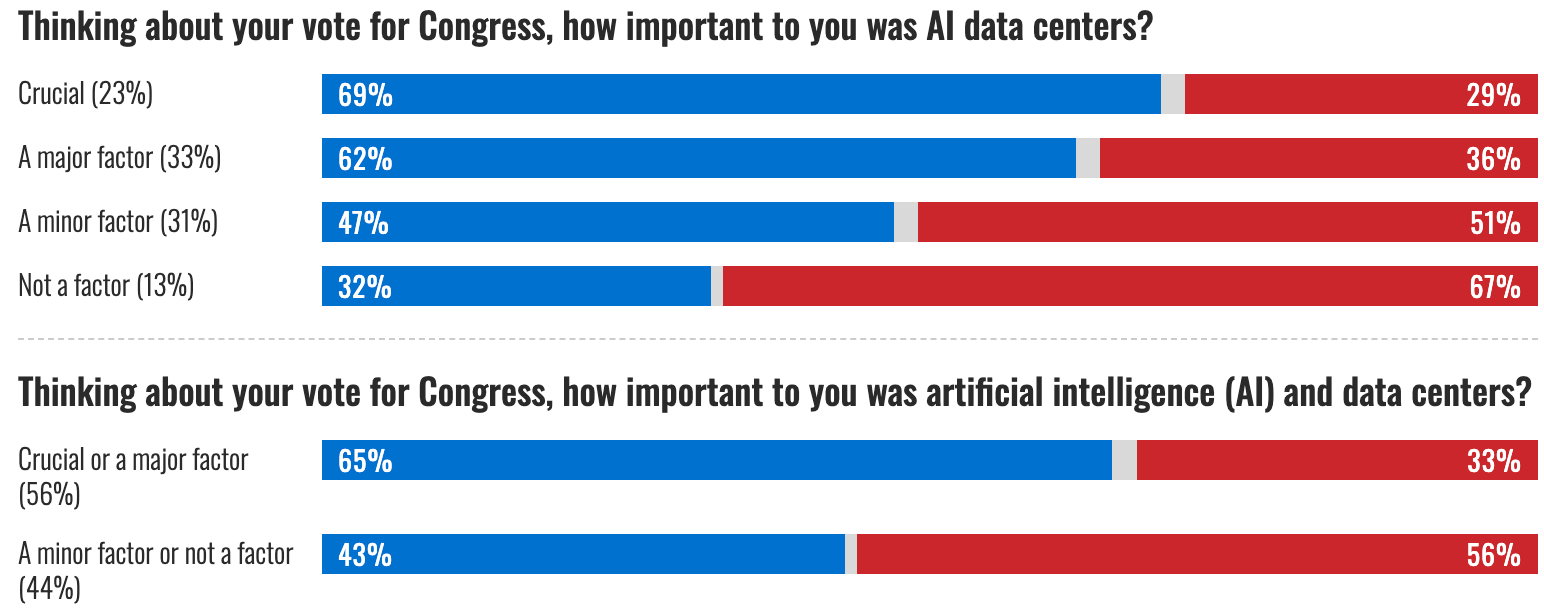
Democrats, in turn, flipped the governor’s offices in Texas, Ohio and Georgia after campaigning on pausing or reining in data centers,1 Sherrod Brown won back his Senate seat by framing his opponent as “the face of data centers,”1 and data center restrictions or moratoriums passed in 40 of 41 local elections.1 None of this should have come as a surprise, as before the election, about 6 in 10 Americans (including most Republicans) already supported limiting new data centers, yet the one Senate bill that would have made data centers pay for the grid upgrades they require still failed before the election.1
The MAHA Constituency
Before the election, polling commissioned by MAHA allies found the MAHA agenda was more popular than the MAGA agenda (59.1% vs. 45.8%), and that it was the single most effective issue for flipping a voter (detailed here). Calley likewise cited polling showing Kennedy was the most popular public official in America. Despite this, the people setting White House strategy simply treated MAHA as a distraction from fundraising.
So, rather than consider their value, the Wiles strategy lead to some of the strongest MAHA candidates going down. Roger Marshall MD founded the Senate MAHA Caucus to help pass Kennedy’s agenda,1 and as Texas’s attorney general, Ken Paxton sued Pfizer over its COVID vaccine claims and Johnson & Johnson over Tylenol in pregnancy,1,2 went after Gerber over heavy metals in baby food,1 got Kellogg’s to sign a binding agreement to remove artificial dyes from its cereals,1 and opened an investigation into glyphosate in children’s food starting with Bayer, the very company the White House was shielding,1 (along with fighting Biden’s vaccine mandates and going after the organizations pushing vaccines on children) yet neither race was fought on that record. Marshall spent his campaign defending the war and the tariffs while his opponent made the race about his character (e.g., his practice having sued more than 700 patients over medical debts).1 Paxton’s case is even more telling, as the attacks that sank him started in his own party. During the primary, pro-Cornyn groups outspent him more than 15 to 1 ($70 million to $4.4 million), largely on ads about his ethics,1 with the largest of them tied to Chris LaCivita, one of the insiders Calley named, who also publicly criticized another group’s plan to run ads supporting Paxton.1,2 Once Paxton won the nomination anyway, neither Trump’s super PAC (sitting on $356 million) nor Senate Republicans’ main super PAC initially committed money to his race,1 and his Democratic opponent simply picked up where Cornyn’s ads left off, building his campaign around calling Paxton “the most corrupt politician in America.”1 Both carried baggage their opponents exploited, but in an election decided on corruption, voters heard almost nothing about the one thing each had done that most of the country actually supports.
MAHA voters do not belong to either party. Many came to Trump because of Kennedy, and they will go wherever what they voted for is actually delivered. Notably, several of the Democrats who won this week ran on MAHA issues, such as Michigan's new senator, Abdul El-Sayed, who called for banning certain pesticides and serving healthier school meals,1 and Iowa's new governor, Rob Sand, who made the state's cancer crisis and water quality a centerpiece of his campaign1 (although, unlike Kennedy, most avoided the vaccine issue entirely1), and before the election, a progressive think tank's polling found 37% of Trump voters were open to a Democrat running on core MAHA issues.1 Likewise, one strategist observing the results pointed to an NBC poll showing Democrats’ own approval at 29% and said voters were “leasing, not buying” Democrats.1 So whichever party actually delivers on these issues stands to win a constituency large enough to decide national elections, and both parties now know it.
Note: one immediate consequence of this election for MAHA is that Ron Johnson, who (not needing special interest money due to being independently wealthy) has been the strongest advocate for vaccine safety (and medical reform) in living memory and used his recently attained chairmanship of the Permanent Subcommittee on Investigations to hold a series of hearings on medical abuses and the agencies that hid them (something few other committees have been willing to do),1,2 will lose the ability to hold these critical hearings when the new Congress is seated in January. From then on, hearings like those will only happen with bipartisan support, which does not currently exist on the vaccine issue given how strongly the Democratic Party has defended the vaccine program.
The End of Vertical Propaganda
Modern public relations was pioneered by Freud’s nephew Edward Bernays, who applied the emerging science of psychology to marketing and achieved astonishing feats. For example, in 1929, to break the taboo against women smoking, he branded cigarettes as “torches of freedom” and had young women light them while marching in New York’s Easter Parade, which the press covered as a stand for women’s equality, and which helped open an enormous new market for the tobacco industry.
At the time, many within the ruling class (particularly the educated experts) believed society had become too complex for voters to understand the issues well enough to decide its direction. As such, they argued that experts should determine policy and that propaganda (which Bernays openly described as an “invisible government”) should then be used to engineer the public’s consent. Others, most notably the philosopher John Dewey, saw this as antithetical to democracy. They believed the collective wisdom of the public provided a crucial check on the “experts,” and that if citizens could not understand a crucial topic, the solution was to educate and empower them so they could, not to strip them of their agency with propaganda.
A passionate debate ensued, but the propagandists won, in large part because Nazi propaganda was so effective that many feared the war would be lost unless America answered it with propaganda of its own. After the war, the debate was largely forgotten as an increasingly sophisticated public relations industry emerged to sell whatever policy or product a government or corporate client wanted. This in turn led to a media landscape where nearly every mainstream outlet disseminated the current campaign in unison (often crafted by a PR firm for a client), which is why we constantly see things like this:
Note: this also resulted in unwanted stories (e.g., those on vaccine toxicity or things that would make the public doubt the current war feeding the military industrial complex) being mass-censored.
One of the most notable things about the current era is that the internet has broken that model. While vertical propaganda (crafting a message and mass-distributing it through established channels) still works, horizontal propaganda (e.g., a lightly edited phone video, a clever meme or tweet, or a Substack article) can now reach far more people than a prime-time, multi-million-dollar TV special (e.g., one tweet I made that helped get RFK confirmed was seen by 33 million people). Since it costs virtually nothing to produce and millions of people create it every day, there is no feasible way for the mainstream media to maintain its monopoly on the truth, particularly once it is forced into an open debate and challenged on the absurd positions it defends for its clients (where doubling down, as it always does, simply makes the public trust the message even less).
As such, since a counterargument is now always a click away, a narrative without merit has a much harder time staying on top (although, as the Consilience Project points out, this has also fueled an endless information war, since social media algorithms reward whatever provokes the strongest reaction). My hope is that as the old model becomes increasingly untenable, society will be forced to revisit that century-old debate and ask whether we need to shift to empowering the population to understand and decide policy rather than forcing the expert consensus down its throat (which, as COVID-19 showed, is far from an optimal strategy).
Note: AI is the major wildcard here. On one hand, it is the simplest and fastest tool for dispelling a propaganda campaign (since you can immediately check whether a narrative holds up). On the other, it is the one scalable tool that could still enable vertical propaganda (if it is designed to support only predetermined narratives and persuade users of them). Presently, enough diversity exists in the AI market for the former to win out, and one of my fears is that the existential crisis the current model faces will push the system to drive AI toward the latter (although I suspect open-source models will make it impossible to ever fully monopolize AI).
For this reason, much as the legacy media is gradually going extinct, politics appears to be shifting toward a climate where campaigns can no longer rely on vast sums spent on attacks, divisive cultural issues, and empty promises, and must instead offer concrete plans for the issues voters actually care about, even when those plans threaten special interests. The people advising the White House told it voters did not care about pesticides, food, or vaccines (while being paid by the companies selling them), yet independent polling consistently showed voters cared intensely about all three, and in this election, voters ranked corruption above everything else.
Note: much of the above was sourced from an excellent article on the history of propaganda.
Conclusion
My sense for a while has been that the world is entering an increasingly unstable and chaotic period where life for many will be much more difficult than it was in the past, and as the years have gone by, this has only become clearer, making it vital to have the fortitude, the resources, and the community to get through it until things stabilize.
For this reason, I have long been a fan of “building parallel systems” which provide the critical things we need without forcing us to depend on systems contaminated by vested interests pursuing profit at the expense of humanity. This is particularly important because it creates the actual pressure that forces institutions to change, as they can no longer survive once enough people stop participating in them because there is a superior option elsewhere. In this newsletter, I’ve tried to focus on all the ways this can be done with medicine, as the current status quo often becomes one of the largest and most harmful expenses for those who participate in it (making it vital both to be able to navigate the system in an empowered manner so you get the best outcome, and to know when a better option exists outside of it).
However, this framework goes far beyond medicine (e.g., the Amish have essentially done it for everything), and there are now viable options in nearly every area of life, such as growing your own food or buying directly from local farmers, homeschooling, getting your news from independent outlets, and learning practical skills rather than relying on others for everything. Better still, much of this is becoming increasingly easy to do, as the same technologies that broke the media’s monopoly have also made it possible to learn almost anything online, connect directly with local producers, and find the resources and communities that once would have been out of reach for most people. Most important of all, though, is having a local community you can rely on. Many of the fastest-growing industries today profit from the exact opposite (people who are isolated, dependent on screens, and reliant on large institutions and the state for everything from their health to their income), whereas people who know and can count on their neighbors are far harder to exploit, far more resilient when things go wrong, and far less susceptible to whatever narrative is being pushed at them.
On a more practical level, I believe local races are where we have the most power and can do the most good. Local and state officials decide far more of what touches our daily lives than most people realize (e.g., what children are fed at school, what goes into the water, and whether a data center gets built next door), they are often elected by a few thousand votes, and they are far harder for distant interests to capture. To illustrate, data center restrictions passed in 40 of 41 local elections this year,1 despite the administration and the industry pushing hard for the buildout. Likewise, in numerous states, many candidates who signed a pledge to get the mRNA vaccines pulled were elected,1,2,3,4,5 as were aligned candidates in many other races my network followed across the country. Local government can become the political equivalent of a “parallel system,” as it lets communities opt out of decisions made far away by people who will never bear their consequences, and it is something we can rely on regardless of who controls Washington.
Looking to the future, Calley argued that no policy promise will survive this system without structural reform (e.g., ending super PACs, barring officials from taking money from foreign governments, and closing the revolving door through which, he noted, 19 of the 20 HHS officials he worked with will become lobbyists for the industries they regulated), and that Congress will never do this on its own, as nearly all of the incentives align against doing so. Rather, it will only happen if a president runs on it and uses the mandate to shame Congress into passing it, or if two-thirds of the states call a constitutional convention to do it without Congress.
That is a long-term project that will require the parallel systems described above to mature, but a great deal is possible now, as the Overton window has shifted to a degree that never previously seemed possible (on both health and non-health topics). Many of the things our community was ridiculed for raising a decade ago are now supported by roughly 90% of the country (e.g., informed consent for medical interventions, letting doctors openly discuss vaccine concerns, and labeling harmful chemicals in ultra-processed food, as the polls I compiled here show), and this week, 90% of voters said corruption factored into their vote. We are no longer a fringe asking to be tolerated, but a majority that needs to be heard. Yet rather than letting us come together on the issues almost everyone prioritizes, the vested interests that profit off human suffering continue to keep us divided over a steady stream of comparatively trivial fights, and that division is precisely what allows a small group with no public mandate to quietly decide what becomes policy.
What makes this moment different is that votes now have to be earned. For decades, a candidate could count on winning with enough money, favorable coverage from the major networks, and party loyalty, and this election showed all three are failing. John Cornyn lost his primary despite his side outspending Paxton more than 15 to 1, the redistricting strategy the White House bet everything on collapsed, and Republicans lost states Trump had won by double digits two years earlier, as voters who felt their priorities had been ignored no longer cared what letter was next to a candidate’s name. Many in Washington have not grasped this yet, but it means a constituency as large as ours now has real leverage to demand what it needs in exchange for its votes.
Likewise, we no longer need anyone’s permission to make our case. Much of what MAHA accomplished came from someone with a large audience making an issue impossible to ignore (e.g., Rogan’s call to Trump on psychedelics), and those same horizontal channels are now available to everyone reading this. Every time one of us shares what we know with the people around us, we do what a centralized propaganda campaign once required millions of dollars to do, and it is far harder to counter, since it comes from someone people actually trust rather than figureheads with no real incentive to tell the truth.
In the short term, due to the political earthquake from the devastating loss the Republican party experienced, the people Calley named have begun to leave (with many more likely to follow) and it has become much easier to shift policy toward what the electorate rather than the donor class wants. The next two years, in turn, will determine whether anything changes, and the one force that has moved Washington throughout this administration has been the public refusing to let an issue go.
Lastly, if you get a chance to watch the interview, I’d love to hear what you thought of it in the comments, as from the reactions I’ve seen elsewhere (e.g., the comments on Youtube), it seems to have deeply resonated with (and enraged) a much larger audience than these points typically reach. While fairly grim, his description of Washington is congruent with what everyone else I know who’s spent extended time there has told me.
To learn how other readers have benefitted from this publication and the community it has created, their feedback can be viewed here. Additionally, an index of all the articles published in the Forgotten Side of Medicine can be viewed here.
For all the flack that RFK Jr. gets, I give him a ton of credit for remaining focused on swimming through the swamp while handcuffed. I understand people’s frustration with him… but I believe we are far better off with him leading HHS, opposed to him following suit with the many others who have resigned in protest or said something that triggered Trump to force them out.
It’s RFK Jr.’s ability to navigate through elite-infested waters that had my hopes up had he become president… many, if not virtually everyone, who goes to DC thinking they can enact change, quickly become aware of how out of their league they are. Given RFK Jr.’s (and his family’s) unique position in US history, he’s well aquatinted with the “devil’s chessboard”.