
Story at a Glance:
For centuries, broth was one of the first things given to the sick, the elderly, new mothers, and infants, and doctors relied on the gelatin it contains for digestive disorders, infections, and wasting illnesses, until canned soups and acid-reducing drugs replaced it. Since then, the art of making broth has largely been lost, and its modern replacements rarely provide the medicinal effects long ascribed to it.
The collagen peptides in bone broth have been found to signal the body to rebuild cartilage, skin, ligaments, and bone, while decades-old research found that cartilage extracts relieved arthritis in most patients who had failed nearly every drug.
Most adults are estimated to fall roughly 10 grams a day short of the glycine their bodies need, and bone broth is one of the few foods that can make up the difference. Glycine heals the gut, improves sleep, raises glutathione, and blunts blood sugar spikes, and broth appears to help the body end inflammation rather than simply suppress it.
Cranberries have been used for urinary tract infections for generations, yet the compound most often credited for this is not what makes them work (which is why many cranberry products don’t work either).
Many of the antibiotics routinely prescribed for UTIs carry serious and sometimes permanent risks, and many recurring UTIs keep coming back because their root cause was never identified.
This article will also cover the forgotten therapies we have found most helpful for UTIs, how to source and make the most medicinal broth, which store-bought broths are worth buying, and how to unlock the full medicinal properties of cranberries (which extend far beyond UTIs).
The growth of this newsletter (it just reached 400,000 readers) has been an incredible privilege to steward. However, the time commitment to meet the standard that I feel that responsibility entails has forced me to cut back on a lot of things I value, which has included not being able to respond to most of the people who reach out to me. The best solution I have found to this dilemma is to host monthly open threads where I answer all the pressing questions that have accumulated from readers over the month and tag it to a topic which fits better within an open thread than a stand alone article. This month, I decided to tie it to a forgotten part of the meal many of you will be having next week.
Thanksgiving is one of the few times of year when many of us still cook a whole animal, and once the meal is over, most of what remains (the bones, joints, skin, and drippings) gets thrown away. In the past, those leftovers would have gone into a pot of broth, which, beyond stretching the meal, was relied upon as a remedy for a wide range of ailments. Fortunately, a growing body of research has begun to show why those leftover bones are the most medicinal part of the bird.
Likewise, cranberries, the other Thanksgiving staple typically eaten only once a year, have a rich medicinal history of their own. Over the years, many of you have reached out to me with questions about urinary tract infections (UTIs), and since cranberries contain compounds shown to prevent them (and have helped many people get through one without antibiotics), this seemed like an appropriate time to address the subject, along with other effective treatments for UTIs. This is particularly important, as some of the most commonly prescribed antibiotics for UTIs are quite toxic and can create permanent disability in their recipients.
Bone Broth
Bone broth is made from the parts of an animal that are otherwise inedible (bones, knuckles, skin, and feet), simmered for hours until their collagen, minerals, and marrow have dissolved into the water, extracting nutrients that eating those parts directly would never provide. For most of human history, it was among the first things given to the sick, the elderly, new mothers, and infants, and in 1760s Paris, shops began selling it to those too weak or worn down for a full meal. The broth was called a “restaurant” (from the French for “to restore”), and over time, the shops that served it took its name.
Broth’s body comes from collagen, the protein that holds bones, skin, and cartilage together. Most protein-rich foods firm up when cooked (eggs set and meat toughens), whereas collagen melts into the water as gelatin, which is why a well-made broth thickens or turns to jelly in the refrigerator and liquefies again on the stove.
Long before Paris, broth had been used as a remedy across much of the world.
• Before pots came into common use, people made soup by dropping stones heated in a fire into the stomach pouches of butchered animals, simmering meat, fat, bones, herbs, and water together.
• A 12th-century physician prescribed chicken broth for colds and asthma, and it later became known as “Jewish penicillin” due to many benefitting from it.
• In several Asian cultures, soup made from bones soaked in vinegar has traditionally been prescribed for calcium and iron during pregnancy and after childbirth.
• In 1756, the Royal Navy began contracting for “portable soup” (broth boiled down until it dried into a hard, glue-like cake) and issued a daily ration of it to sailors on long voyages. One of the era’s most celebrated explorers carried it on each of his voyages around the world, convinced it was one of the reasons his crews stayed healthy.
• By the 1930s, a broth of bones and vegetables was widely fed to infants in Britain.
Note: aboard ship, the broth was typically cooked with peas, oatmeal, or fresh celery when it was available. Likewise, the most promising human research on gelatin (discussed further below) paired it with vitamin C, which the body cannot build collagen without.
How much a broth can do for the body, however, depends largely on which bones go into it. The marrow bones most stores sell for broth add richness but little of what joints are built from, whereas over the years, I’ve found one cut in particular to be among the most helpful things for people whose joints are injured or wearing down. Additionally, broth is one of the best food sources of glycine, an amino acid most of us are short on, which has a range of benefits, particularly as a sleep aid when combined with other nutrients.
Note: this mirrors a principle found in many traditional systems of medicine, that eating a part of an animal nourishes the same part in the person who eats it—something we have repeatedly observed with specific broths.
The Oldest Remedy in the Kitchen
For much of human history, most households kept a pot simmering over the fire or on the back of the stove, eating from it throughout the day and adding whatever bones, scraps, and vegetables came their way, making it one of the original “fast foods.” Since it was always on hand, it was also the first thing reached for when someone fell ill or needed their strength back. Throughout Asia, for instance, medicinal herbs and roots are still routinely simmered into the soups served at daily meals, and the parts of the animal that make broth gel are prized there rather than discarded, which is why chicken feet are so hard to find in American stores (most of those produced by the American poultry industry are shipped to China).
The pressure cooker (and the Instant Pot sitting in many kitchens today) traces back to a device invented to make bone broth faster and more cheaply. In 1679, a French physicist built a sealed, pressurized “digester” designed to extract the nourishment locked inside bones, hoping it would let the poor benefit from them without needing to buy fuel for days of cooking. Several years later, when he served a dinner prepared in it to members of England’s leading scientific society, the guests reported that it had softened beef and mutton bones until they were as soft as cheese and turned them into a clear jelly as delicious as any they had tasted.
Broth’s most enduring role, however, has been at the bedside. The bowl of soup many of us were handed as sick children is a holdover from what was once formal medical instruction, as an influential 1859 nursing manual taught that food for the sick should do half the work of the patient’s weak digestion. For roughly the next century, most cookbooks included a chapter on cooking for the sick and recovering (then commonly called “invalid cookery”), filled with beef teas, meat jellies, and broths meant to restore those too sick to eat, and many of their recipes came with assurances that they had never failed to help.
That changed in the 20th century, as canned soup companies built their early marketing around the idea that keeping a stockpot going was laborious, inconvenient, and outdated. Over time, the products that replaced homemade broth were made more and more cheaply, with flavor enhancers and artificial flavors standing in for the bones and meat that once gave broth its taste, to the point that the head of the largest American soup company later acknowledged it had cut so much from its recipes that it was taking the chicken out of its chicken noodle soup.
As such, broth is yet another example of a pattern seen throughout the modern food industry, where a time-tested food is gradually cheapened to cut costs until it no longer provides the benefits it was once relied upon for (not unlike how modern medicine repeatedly displaced our ability to use traditional remedies to heal ourselves).
When Gelatin Was Medicine
Through the 1800s and early 1900s, gelatin came to be viewed as one of the most valuable foods in medicine. Doctors relied on it for cholera, typhoid, and other infections that caused severe diarrhea. A 1908 medical textbook on what we now call celiac disease argued that gelatin’s value in intestinal infections had never received the attention it deserved. In one case, a two-year-old whose diarrhea flared with any carbohydrate could not gain weight until 15 grams of gelatin were added to his daily diet, and his gains stopped and resumed each time it was removed and restored. Adults were given broth for much the same reason, as it was a staple of the “bland diets” prescribed from the mid-1800s to the mid-1900s after stomach surgery and for ulcers, heartburn, and morning sickness.
Gelatin was also one of the most valued foods for infants. Over more than thirty years of research, adding gelatin to cow’s milk was found to make its curd softer and closer to that of human milk, and as a result, nutrition textbooks of the 1920s and 1930s recommended mixing it into infant formulas, as infants fed gelatin-enriched formulas had less colic, vomiting, diarrhea, and constipation than those fed plain cow’s milk. Likewise, adults who had lost weight and strength from surgery, dysentery, or cancer fared better once gelatin was added to their diets, and in 1909, one physician wrote that it was “retained by the most sensitive stomach and will nourish when almost nothing else will be tolerated.”
Note: because a host of issues exists with commercial infant formulas, the natural health community has developed home made infant formulas for parents needing something to supplement breastfeeding, with gelatin being a key ingredient in what is widely considered to be the best home formula recipe.
The most thorough case for gelatin came in 1938, when a physician published research on what happened to meals in the stomach when gelatin was added to them. With gelatin present, the stomach contents stayed less sour, and digestion took place throughout the meal rather than in separate layers. He argued that cooking strips food of the water-holding qualities raw food naturally has, and that gelatin restored them, which may be why many of his patients could then tolerate foods they had previously reacted to, including the raw vegetables and salads normally forbidden to those with digestive disorders. After reviewing everything published on the subject, he found that every investigator, working independently over many years, had reached the same conclusion about gelatin’s value for digestive complaints, which he noted rarely happens in medicine.
He also described gelatin as a hydrophilic colloid (a substance that attracts and holds water), and decades later, the University of Washington researcher Gerald Pollack found that water placed next to such surfaces does not behave like ordinary water. Instead, it organizes into a structured, gel-like layer, often called the fourth phase of water, which pushes particles out of its way and grows when exposed to infrared light (as this structured water appears to store the energy it absorbs from light). I suspect this is part of why gelatin is so soothing to the gut, as it may help the lining of the digestive tract form and hold this structured water (particularly since chia seeds and okra form a similar gel in water—which is why chia seeds stay suspended rather than sinking).
Note: as with many other inexpensive therapies, this enthusiasm was at times taken too far. During the 1800s, hospitals, soup kitchens, and poorhouses looking to cut costs began serving gelatin at nearly every meal in place of other protein, and those fed little else fared poorly, since gelatin is not a complete protein. As a result, most researchers of the era concluded that gelatin worked best as part of a varied diet rather than as a replacement for one.
Despite this consensus, gelatin and broth gradually disappeared from medicine. Once antacids and other acid-reducing drugs became widely available, “bland” diets were deemed unnecessary, and a food physicians had relied on for nearly a century was replaced by a prescription—which was quite unfortunate as acid reflux is typically caused by a shortage rather than excess of essential stomach acid.
What Leaves the Bone
Most of us picture bones as the dry, lifeless objects left behind once an animal has died, but living bone is remarkably different (something that becomes clear the first time you hold a freshly cut piece of it during an orthopedic surgery). It is constantly being broken down and rebuilt, to the point that the entire adult skeleton is replaced roughly every ten years. It is laced with blood vessels and nerves, its marrow produces the body’s blood cells, and it stores the minerals the rest of the body draws on whenever its supply runs low. More recently, researchers at Columbia found that bone also acts as a gland, releasing a hormone (osteocalcin) that helps regulate blood sugar, testosterone, and memory. Mice unable to make it were essentially diabetic, and restoring it nearly normalized their performance on memory tests.
Roughly 90% of bone’s protein is collagen, which gives healthy bone the elasticity to bend under a load and spring back rather than snap. Unfortunately, as I showed in a previous article, conventional medicine focuses almost entirely on bone density instead, and the most commonly prescribed osteoporosis drugs raise it by disabling the cells that break down and reshape bone, leaving patients with denser but more brittle bones. In turn, most people who break a bone do not have osteoporotic bone density at all. Conversely, in a 12-month trial of 131 postmenopausal women (sponsored by the manufacturer), 5 grams a day of collagen peptides increased bone density in both the spine and hip, along with a marker showing new bone was actually being formed.
Since all of this is locked inside dense, hard tissue, bone is one of the most nutritious parts of an animal and one of the hardest to get to, and our ancestors went to great lengths to reach it. Stone tools for breaking open bones to get at the marrow have been found at prehistoric sites throughout Africa, Europe, Asia, and the Middle East, and some of the oldest known butchered bones show marks from extracting marrow alongside those from cutting meat. Likewise, Plains tribes pulverized bones and boiled them to render the grease inside, which they mixed into pemmican, whose name comes from the Cree word for “he makes grease.” Fortunately, a long simmer does the same work without needing to crack the bone open.
Bone broth is often cited for its minerals (e.g., calcium and magnesium), and most recipes are designed around drawing them out of the bones. Yet what a long simmer produces in the greatest abundance is gelatin, along with the collagen fragments it breaks down into, which most people now rarely eat since the skin, cartilage, and connective tissue of animals have largely disappeared from the modern diet. This is a significant gap, as collagen is the most abundant protein in the body, making up about 30% of its total protein.
This was first measured in 1934, when researchers simmered veal bones for seven hours and tested the water at regular intervals. The protein continuously leached out of the bones, rising at the same steady rate from the first hour to the last, and because the broth contained none of the amino acids tryptophan and tyrosine (which nearly all other proteins contain but gelatin lacks), they concluded that almost all of it was gelatin. In essence, this is the work the long hours on the stove do, slowly dissolving the collagen that holds bones, tendons, and cartilage together, which is why a broth made with plenty of collagen-rich parts (e.g., feet, knuckles, and joints) and not too much water will thicken or even set into a jelly once it cools.
Note: fish collagen is much less tightly bound than that of mammals and birds, so fish bones need nowhere near as long, which makes fish broth one of the most convenient broths to make.
As the broth simmers, much of the gelatin is cut into short chains of amino acids (peptides) that come almost entirely from collagen. In a 2026 analysis of beef bone broth, each cup held roughly 7 grams of amino acids, most of them glycine, proline, and alanine, and over 90% were still bound together as peptides rather than free amino acids. Unlike most proteins, which are broken down into single amino acids before they are absorbed, some collagen peptides survive digestion intact, and a 2005 study found them circulating in the blood after gelatin was consumed.
This is key, as these intact peptides appear to act as signals telling the body to rebuild its connective tissue. For example, in a 1999 study, mice fed gelatin labeled with a radioactive tracer accumulated it in their cartilage at twice the rate of mice given the amino acid proline alone, suggesting the body directs these peptides to the tissues they came from. Likewise, once there, they appear to switch on repair, as in a 2003 study, cartilage cells exposed to them produced more of their own collagen, and in a 2010 study, Pro-Hyp (the most common of these peptides) caused skin cells to multiply 1.5 times faster and produce nearly four times more hyaluronic acid, the compound that keeps joints lubricated and skin hydrated.
These effects also appear in people. In a 2018 study of 120 patients with pressure ulcers (bedsores), those given collagen peptides alongside standard wound care had wounds roughly a third smaller after 16 weeks than those given a placebo. As such, I believe a rich broth is one of the most useful foods to turn to when recovering from an injury or accident. Broth made from cartilage-rich parts also carries the other compounds cartilage is built from (e.g., chicken broth has been found to contain both collagen peptides and chondroitin sulfate).
The minerals, in contrast, came out of the bones readily, as in the 1934 study, the calcium, iron, and magnesium had all entered the water within the first hour. Most traditional broths, however, were never made from bones alone, as cooks have long added vegetables to round out the flavor, thereby increasing the mineral content. In the same study, broth made with potatoes, onions, and carrots contained several times more calcium than broth made from the bones alone, along with more iron and magnesium, and about twice the potassium (roughly as much as human milk). However, nearly all of the vegetables’ minerals were released within the first hour of simmering—which is why the traditional recipe the researchers studied added the vegetables only for the final hour of cooking.
Glycine and the Chemistry of Flavor
A well-made broth has a taste that is hard to reproduce any other way: savory and rich with a faint sweetness underneath, and much of it comes from the compounds responsible for its nutritional value. In a 2026 analysis of beef bone broth, about 62% of its amino acids belonged to the group that tastes sweet (led by glycine, alanine, and proline), while roughly 14% were the savory (umami) amino acids glutamic acid and aspartic acid. The most abundant of all was glycine, whose name comes from the Greek word for sweet.
Broth’s savory depth also comes from peptides. In a 2024 study, researchers identified three peptides in beef bone broth that tasted savory on their own and made glutamate (the compound MSG is made from) taste noticeably stronger, meaning a long-simmered broth produces its own flavor enhancers from the bones.
Glycine is also one of the most underappreciated nutrients in the modern diet. It has long been classified as non-essential, since the body can make it, yet a 2009 analysis titled “A weak link in metabolism” estimated that an adult produces only about 3 grams a day and obtains another 1.5 to 3 grams from food, while needing roughly 12 grams a day for collagen alone. This leaves a shortfall of about 10 grams every day, which led the researchers to argue that glycine should be considered “semi-essential,” and that this shortfall limits how well the body can maintain its collagen. For reference, 10 grams is roughly the amount in six cups of a typical homemade broth, or one to two serving of the 96-hour broth discussed below. Historically, much of this glycine came from eating the whole animal, as skin, cartilage, and connective tissue are where most of it is found, whereas the muscle meat that now makes up most of what we eat contains comparatively little.
Note: for this reason, some widely followed parts of the health community advocate regularly eating gelatin, broth, and the other parts of the animal besides muscle meat, to restore the balance of amino acids that eating the whole animal once provided.
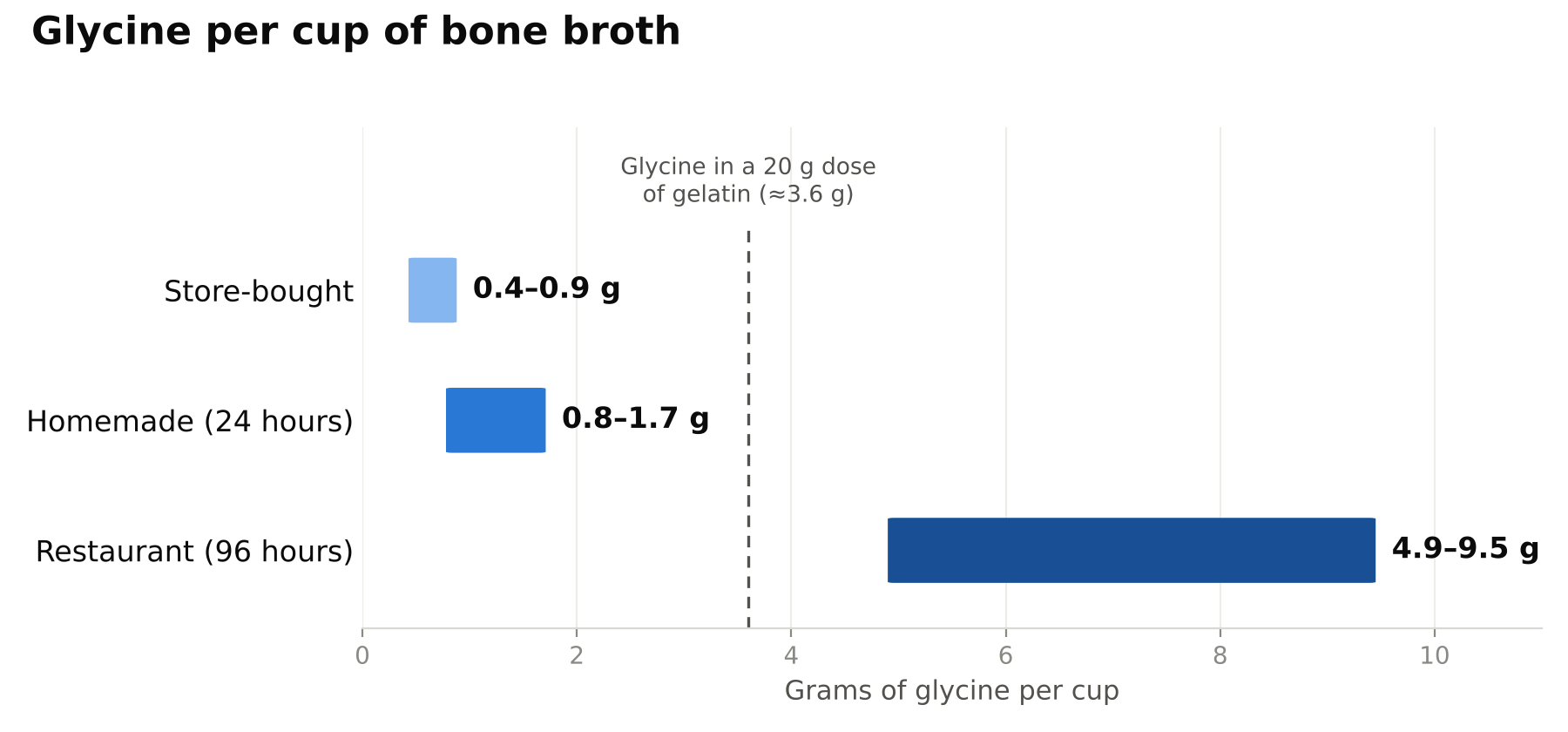
Bone broth is one of the few foods that can supply a significant portion of glycine. For example, the beef broth in the 2026 analysis contained about 1.5 grams of glycine per cup, while in a 2018 study comparing homemade, store-bought, and restaurant broths, homemade broths ranged from about 0.8 to 1.7 grams per cup (with store-bought broths providing roughly half that). The richest by far was a restaurant broth whose bones were simmered for 72 hours and then another 24, and this 96-hour broth contained between 5 and 9 grams of glycine in a single serving.
Glycine’s benefits also extend beyond collagen:
• It calms the nervous system, particularly when combined with magnesium. In a 2007 study of people who slept poorly, 3 grams of glycine taken before bed improved how well they slept, shortened the time it took them to fall asleep and to reach deep sleep, and reduced their sleepiness and improved their memory the following day. That, for context, is about the amount in two cups of a good homemade broth, and I believe this is part of why a cup of broth in the evening has long been regarded as settling.
Note: in contrast, there are many problems with the conventional alternatives (e.g., most common sleeping pills have been linked to twice the risk of death).
• It is one of the three building blocks of glutathione, the body’s primary internal antioxidant. In a 2011 study, older adults had nearly half the glutathione of younger ones because they were not making enough of it, and two weeks of glycine and NAC (a form of cysteine) raised their levels by 95% while significantly lowering markers of oxidative stress, bringing them in line with the younger group.
• It blunts the rise in blood sugar that follows a meal. In a 2002 study, healthy adults given about 5 grams of glycine along with a glucose drink had less than half the rise in blood sugar they experienced from the glucose alone, and their bodies did not need significantly more insulin to achieve this.
• It is used by the liver to make the bile acids that digest fats and to clear benzoate (e.g., sodium benzoate, one of the most common preservatives in soft drinks and processed foods) from the body, using up a molecule of glycine for each molecule of benzoate it removes. In turn, a 2014 review warned that this can leave too little glycine for the brain’s chemistry and for building collagen, DNA, and the heme that carries oxygen in our blood, and concluded that the risks of using benzoate as a preservative “should not be underestimated.”
• It helps maintain the intestinal lining, which is why broth and collagen are staples of functional medicine protocols for healing leaky gut. In a 2016 study, glycine strengthened the barrier of intestinal cells by regulating the tight junction proteins that seal the gaps between them, and as discussed later in this article, it also protected mice from colitis.
Most notably, a 2019 study from a government-funded program that tests potential longevity compounds in mice (with each compound tested at three separate laboratories) found that adding glycine to their diet extended lifespan by roughly 4–6%. The researchers suspected glycine works by offsetting methionine, an amino acid abundant in muscle meat that extends lifespan in many animals when it is restricted, which is noteworthy, as eating the whole animal naturally kept the two in balance, since collagen is rich in glycine and contains little methionine.
As such, glycine is likely one of the main reasons so many cultures independently came to rely on broth to calm the stomach, ease the sick into sleep, and help them recover, as broth restores a nutrient that largely disappeared from our diets once we stopped eating the whole animal.
Note: how much glycine a broth contains depends on which parts are used and how they are cooked.
The Collagen Myth
For decades, the prevailing view in nutrition was that eating collagen could do nothing for the collagen in our own bodies, as digestion breaks it down into the same amino acids found in any other protein. When gelatin-based joint supplements became popular in the late 1990s, a prominent university nutrition newsletter advised readers not to buy them, calling the idea that gelatin could help build cartilage and bone “a theory that has yet to be investigated.” Yet as discussed earlier, some collagen peptides survive digestion intact, and much of the research since has supported what traditional cultures have long held.
One of the clearest demonstrations of this came in a 2017 study, where eight young men drank either a placebo or gelatin mixed into a drink containing vitamin C (which the body needs to build collagen) an hour before six minutes of jumping rope, three times a day for three days. Those given 15 grams of gelatin had twice the marker of new collagen production in their blood as they did on the placebo. Likewise, when the researchers grew ligaments in the lab and bathed them in blood drawn from the men after they drank the gelatin, the ligaments built more collagen and became mechanically stronger, and the more gelatin the men had consumed, the greater the effect.
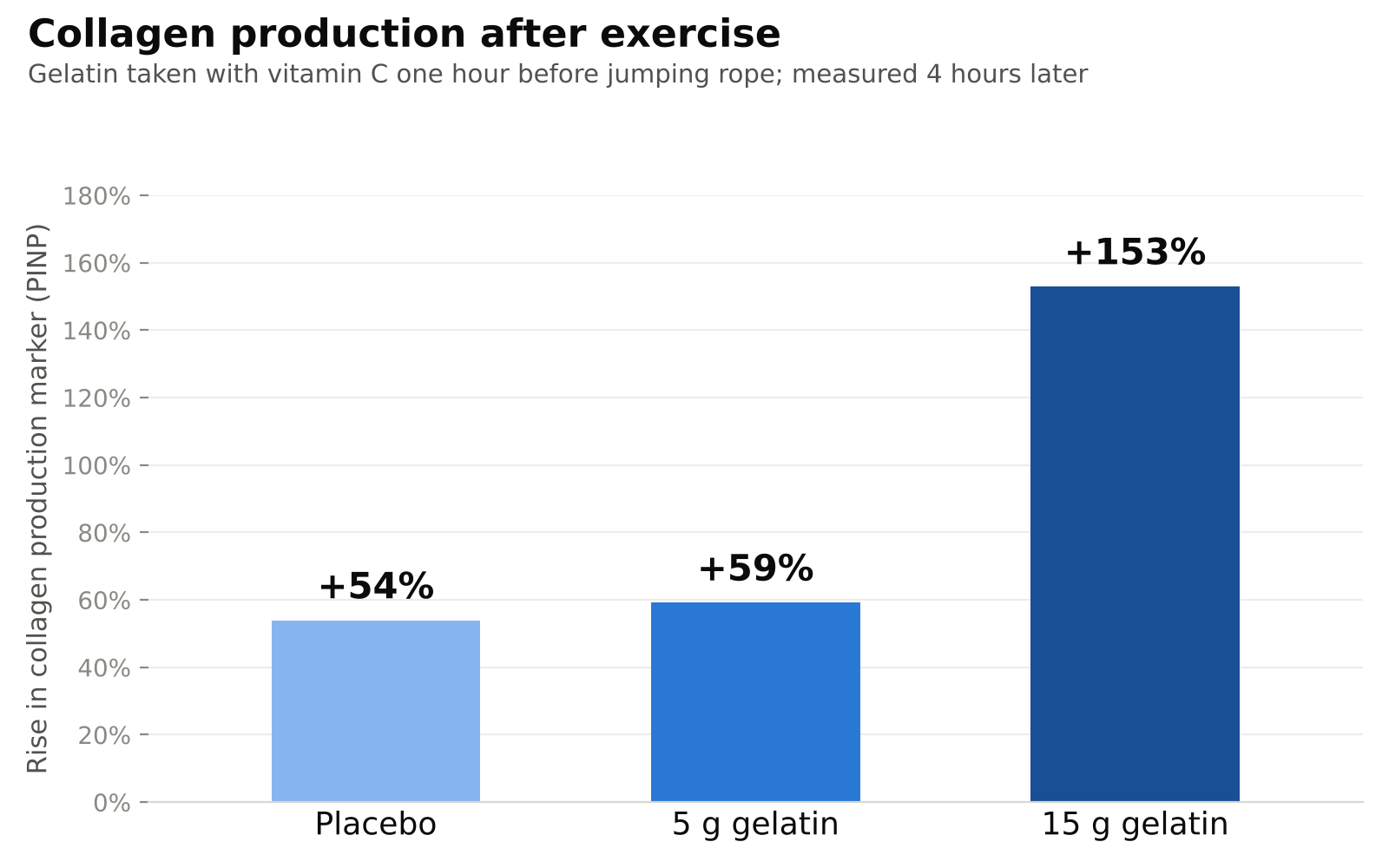
Finally, in that study, the amino acids from the gelatin peaked in the blood about an hour after it was consumed, which is why the researchers timed the exercise for then, and why some consider gelatin-rich broth valuable as a pre-workout.
Note: collagen (and hence ligament) formation also depends on manganese, as prolidase, the enzyme that recycles proline from old collagen so it can be used to build new collagen, requires it to function, and those born unable to make prolidase develop wounds that will not heal. Appropriate manganese supplementation is particularly relevant for those with Ehlers-Danlos syndrome or other forms of hypermobility, whose collagen is weak to begin with, and as I showed in a previous article, many individuals with loose ligaments or sensitivities to environmental toxins (e.g., pharmaceuticals) significantly improve in many different areas once they take manganese for a prolonged period.
Gelatin is only one part of what a long-simmered broth draws from the bones. The other is cartilage, which is made largely of its own type of collagen bound together with compounds like chondroitin, and when broth is made from joints, feet, or knuckles, much of that cartilage dissolves into the pot. Remarkably, cartilage was once the subject of decades of medical research, nearly all of which has been forgotten.
In 1954, researchers at a New York medical school were searching for a way to counteract cortisone, a new wonder drug that stopped inflammation but also stopped wounds from healing (to the point that surgical incisions in patients taking it would split back open), and found that cartilage did exactly that. A surgeon who went on to build his career on this discovery found that cartilage, ground into a powder from cows’ windpipes, sped the healing of wounds in animals, including diabetic rats that otherwise healed poorly, and in a 1965 study of 15 human volunteers, incisions treated with cartilage powder were on average 42% stronger than untreated incisions on the same person.
Note: steroids also weaken the ligaments themselves, which is why, as I showed in a previous article, the steroid injections commonly given for joint pain often leave the joint worse off over time.
He then turned to arthritis and in 1974, published the cases of 28 people with osteoarthritis who had failed nearly every available drug, and after three to eight weeks of daily cartilage injections, 19 had their pain eliminated entirely and six more improved markedly. When he later gave cartilage pills to 700 patients, 85% improved. Likewise, a 10-year study in Eastern Europe published in 1987 found that arthritis patients treated with a cartilage extract missed an average of about 20 days of work each year, while those on standard anti-inflammatory drugs or placebo steadily worsened, until in the tenth year alone they were unable to work for 180 of their 250 working days. Notably, a correctly made bone broth is itself a cartilage extract.
Cartilage also appears to help autoimmune conditions, but through a different mechanism. The immune system in the gut is designed to tolerate food rather than attack it, and researchers found they could use this to calm autoimmune reactions by feeding patients small amounts of the same tissue their immune system was attacking (an idea that also underlies some of Royal Lee’s most popular nutritional extracts). In a 1993 trial, 60 people with severe rheumatoid arthritis who had stopped their usual immunosuppressive drugs were given either a placebo or small doses of collagen from chicken cartilage for three months. Those given collagen had fewer swollen and tender joints, four went into complete remission (which, as one of the researchers noted, rarely happens on its own), and the placebo group worsened. In a larger follow-up of 274 patients, the lowest dose tested (20 micrograms a day, a minuscule amount) produced the best results, though later trials have been mixed. This suggests the cartilage dissolved in a single cup of broth may be more than enough for this effect, and may also be why chicken soup has long been a folk remedy for rheumatism.
Nature’s Anti-inflammatory
When cortisone was first given to a patient in 1948, it was hailed as a miracle for its ability to stop inflammation almost overnight, and two years later its discoverers won the Nobel Prize. Within a few years, however, doctors began seeing what it did to patients who stayed on it. Their bones thinned, they became far more vulnerable to infection, and, as discussed in the previous section, their wounds would not heal.
Since then, this pattern has repeated with nearly every anti-inflammatory drug. Each one works by blocking part of the inflammatory response, and because inflammation is also how the body defends and repairs itself, there are consequences to suppressing it. NSAIDs, for instance, can cause stomach ulcers and kidney damage. The biologic drugs that block TNF-α, including Humira (for nearly a decade the best-selling drug in the world), carry the FDA’s strongest warning that patients taking them are at increased risk of serious infections that may lead to hospitalization or death.
Note: by the early 1960s, steroids had been so thoroughly abandoned by rheumatologists that the drugs that followed (e.g., ibuprofen) were named non-steroidal anti-inflammatory drugs (NSAIDs) to distinguish them. Yet steroids returned in the 1980s at lower doses and remain widely prescribed today, even though, as I showed in a previous article on the dangers of corticosteroids, a month or more of them causes diabetes in nearly one in five patients.
Broth, on the other hand, has been used for the same complaints for centuries, and the research on it suggests it helps the body resolve inflammation on its own.
Chicken soup in particular has been a cold remedy for so long that researchers eventually decided to test it. Since moving mucus is how the nose clears out viruses and bacteria (and part of why a stuffed nose loosens up), a 1978 study had fifteen volunteers drink hot water, cold water, or hot chicken soup while researchers measured how fast mucus moved through their noses. Cold water slowed it, while hot water sped it up only when sipped from a cup and had no effect through a straw, showing that its steam was responsible. Chicken soup, however, sped mucus up whether it was sipped or drunk through a straw, leading the researchers to conclude that something in the soup itself was working, possibly in its aroma or taste. The effect wore off within half an hour, which I believe is a good argument for the old habit of a bowl of broth every few hours.
Note: during the 1918 influenza, physicians repeatedly reported the patients most likely to survive were those who ate little more than light broths while sick.
Much of the congestion, cough, and sore throat of a cold comes from neutrophils (the white blood cells the body sends first) flooding the airways. In a 2000 study, researchers put a homemade chicken soup in a dish with human neutrophils and found it slowed their migration. The effect held when the soup was diluted 200 times, which the researchers compared to a single bowl spread through an adult’s body. Even then, the soup slowed the neutrophils without killing them, calming the response that causes a cold’s symptoms while leaving the cells intact to fight the infection.
Broth’s reputation has always been strongest for the gut, and a 2021 Mexican study tested it against one of the gut’s most severe diseases. The researchers simmered beef femur bones in water acidified with vinegar for eight hours. For ten days, one group of mice drank the broth freely in place of water and another drank plain water, and the researchers then chemically induced ulcerative colitis. In the mice that drank water, the lining of the colon eroded and filled with neutrophils and blood, whereas in the mice that drank broth, the lining stayed largely intact, and the signals that drive inflammation in colitis were far lower (e.g., IL-6 by 95%, and TNF-α, the same signal Humira is designed to block, by 69%).
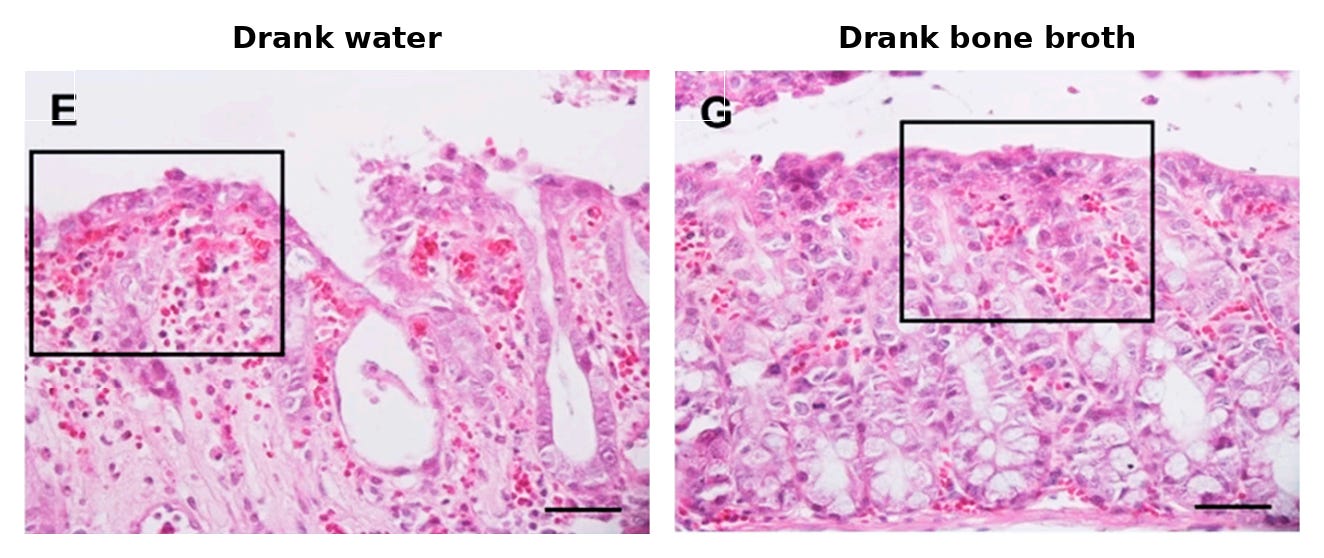
More notably, the broth also raised IL-10 and IL-4, two of the body’s own anti-inflammatory signals, which were each roughly five times higher in the broth group, even though IL-10 typically falls to almost nothing during a colitis flare. Broth hence did more than suppress inflammation, as it also raised the signals the body uses to end inflammation itself. Additionally, the broth’s most abundant amino acid was glutamic acid, making up over a fifth of the total, followed by histidine, both of which the researchers noted are low in people with ulcerative colitis.
A 2018 study tested several of broth’s key components on their own. Mice with chemically induced colitis were given gelatin, glycine, or Pro-Hyp (the collagen peptide a 2005 study found circulating in the blood after gelatin was eaten), and all three protected the colon. Each reduced weight loss, damage to the colon lining, and the buildup of inflammatory cells, and each lowered the same inflammatory signals seen in the 2021 study, with Pro-Hyp having the strongest effect.
Glycine’s protective effect likely comes from the same mechanism by which it calms the nervous system, as it opens a channel on nerve cells that keeps them from firing, and a 1999 review showed that many immune cells (e.g., macrophages, neutrophils, and lymphocytes) carry the same channel, so glycine calms them in the same way. In rats, dietary glycine protected against shock from bacterial toxins, liver injury during transplantation, and kidney damage from drugs, leading the review’s authors to call it a new anti-inflammatory nutrient.
Broth has also been studied for pain. In a 2018 study that modeled temporomandibular joint disorders (TMJ) in rats (leaving their jaws hypersensitive for a week afterward), rats given an enriched chicken bone broth for two weeks beforehand had far less of that sensitivity, along with lower levels of PKA, a protein that keeps pain nerves primed. In the lab, the broth also inhibited COX-2, the enzyme NSAIDs block to relieve pain, while leaving COX-1 untouched (COX-1 is the enzyme that protects the stomach lining, and blocking it is why NSAIDs cause stomach bleeds).
A 2020 American study tested an enriched chicken bone broth on migraine. Rat pups were raised near a stressed adult, which leaves them with sensitized facial pain nerves for life (much as early life stress raises the risk of migraine in people), and from weaning onward, some drank water mixed with 1% broth. As adults, the rats were exposed to the scent of the California bay laurel, known as the “headache tree” because its vapors trigger migraines in susceptible people. In stressed females that drank plain water, sensitivity to facial pain stayed elevated for two full days afterward, while in stressed females that drank broth, it remained at the level of unstressed rats at every point measured. The researchers attributed this to the broth’s antioxidant activity, its inhibition of COX-2, and the anti-inflammatory effects of its collagen peptides and chondroitin.
In short, broth appears to calm inflammation while leaving the body’s ability to defend and repair itself intact, something the drugs that replaced it have never managed to do.
The Lead Question
Lead is one of the most studied toxins in medicine, and an adult’s body stores over 90% of its lead in the bones. Since animals do the same, many question whether simmering bones for hours draws lead into the broth. This concern took hold in 2013, and it is still frequently cited as a reason to avoid broth.
That year, a British study reported that chicken broth contained several times more lead than the tap water used to make it. The researchers made three broths, one from the bones, one from the meat, and one from the skin and cartilage. The bone broth contained 7.01 micrograms of lead per liter, the skin and cartilage broth 9.5, and the tap water 0.89. Since the chickens were described as organic, the study was widely taken as evidence that even the highest quality broth was contaminated.
However, the study was much less solid than its conclusions suggested. Its own authors described it as a very small pilot study. It tested only one sample of each broth, and it never reported how long the broths were cooked, what they were cooked in, or where the chickens came from. Six months after it was published, the clinic that conducted it acknowledged the chickens had not been organic but had come from a local supermarket, and the larger study its authors called for was never published. Likewise, when broths made from pastured chickens and grass-fed cows were sent to a lab for testing, no lead was detected, even at a detection limit of five parts per billion.
In contrast, a 2017 Taiwanese study took a far more thorough approach. The researchers simmered pork and beef bones for up to 12 hours while testing the broth throughout, and they also analyzed nineteen bowls of bone broth soup bought from local shops. On average, a full two-cup bowl contained 1.73 micrograms of lead, which led the researchers to conclude that the risk from lead in broth was minimal, as only a tiny fraction of the lead in bones makes its way into the broth. Additionally, while adding vinegar to the water raised the calcium drawn out of the bones roughly 17-fold, it had little effect on lead. More importantly, while calcium and magnesium rose steadily the longer the bones simmered, the amount of lead stayed roughly the same from the first half hour to the twelfth (and in the beef broth, it declined). No study has yet measured lead in a broth simmered for days, but this pattern suggests the long-cooked broths richest in glycine are unlikely to carry much more lead than shorter ones.
For reference, the FDA’s 2022 daily limit for lead from food is 8.8 micrograms for women of childbearing age. A cup of the commercial broths in the 2017 study provides under a tenth of that, while a cup of the skin and cartilage broth from the 2013 study (made from supermarket chickens) provides about a quarter, meaning only someone drinking more than a quart of poor quality bone broth a day could exceed the limit. The limit for children is a quarter of the adult figure, which is one reason sourcing is especially important when broth is given to children.
As such, I believe the lead in a broth reflects the life of the animal it came from, which makes the source of the bones the single most important factor in making broth safely.
Broth Sensitivities and Healing UTIs
While most people do well with broth, sensitive individuals sometimes find it leaves them flushed, wired, or with a headache, and many give up on it as a result. In most cases, this comes from a sensitivity to one of the same compounds that give broth its benefits, and once the cause is identified, it can usually be worked around by changing how the broth is made.
One issue some people run into is a sensitivity to glutamate. Broth is naturally rich in glutamic acid, and in a lab analysis of chicken broths made from pastured birds, a long-cooked broth contained nearly three times the glutamic acid of a short-cooked one (3,040 mg versus 1,100 mg per 24 ounces). Most people handle this without issue, but some react to it, particularly those with damaged guts or neurological sensitivities, and some of them react to other glutamate-rich foods such as meat, eggs, and dairy as well. Notably, most of the glutamate in homemade broth is bound into protein chains and released gradually during digestion, rather than existing in the free form that the body absorbs fastest (hence reducing reactivity).
For those who do react to homemade broth, gut-healing protocols built around broth have long gotten around this by changing how the broth is cooked.
Similarly, some people report flushing, hives, headaches, a racing heart, or anxiety after drinking long-cooked broth, a pattern that typically points to histamine. According to a 2020 review, histamine intolerance is estimated to affect 1% to 3% of the population. Histamine in food forms when bacteria break down histidine, so its levels depend largely on how fresh the ingredients are and how they are handled. No study has measured histamine in bone broth, but a broth that simmers for days, cools slowly, or sits in the refrigerator for a week gives those bacteria the most opportunity. As a result, those who are sensitive generally do best with fresh bones, shorter cooking times (many find a pressure cooker helps), rapid cooling, and freezing the broth in portions rather than keeping a large batch in the refrigerator.
Note: the cooling process is important to do properly regardless of your histamine tolerance, as some bacteria form spores that survive cooking and multiply as a large pot slowly cools, which is why broth should not be left out overnight. Letting the broth cool for an hour or so before refrigerating it (or dividing it into jars so it chills faster) is all that is needed. Alternatively, if you use broth regularly, you can keep it in a slow cooker on the warm setting. For example, it’s great to always have some on hand to sip as a snack, or to use in place of oil when sautéing vegetables or reheating leftovers on the stove.
Those prone to kidney stones may also want to be mindful of how much broth they drink, as the body converts part of collagen’s hydroxyproline into oxalate, the main component of most kidney stones. In a 2006 study, 30 grams of gelatin a day raised urinary oxalate by 43%, and smaller increases appeared after 5 to 10 grams (roughly one to two cups of a rich broth). This is unlikely to affect most people, but those who have had calcium oxalate stones may do best with moderate amounts of certain broths.
Note: likewise, those with gout may want to moderate their intake, as broth contains purines, which the body breaks down into uric acid (the compound that crystallizes in the joints during an attack). That said, in a 2021 Chinese study of twelve commercial chicken broths, purine levels ranged from roughly 22 to 86 mg per cup, well below the 400 mg daily limit used in Japanese gout guidelines.
In short, how well someone tolerates broth largely comes down to how it is made, as the same choices that determine how much collagen ends up in the pot also determine how a sensitive person responds to it. As such, many who gave up on broth after reacting to it can drink it without issue once they change how they make it.
In the final part of this article (which serves as an open thread for you to ask the questions that have come up over the last month) I will extensively cover how we source and make our broth (including the surprisingly cheap cut we’ve found most helpful for injured joints or rehabilitating the spine and how to turn your Thanksgiving leftovers into a full pot), along with which store-bought broths are worth buying and why many popular brands, though sold as bone broth, lack the qualities that make it medicinal.
Additionally, since the conventional approach to UTIs relies almost entirely on antibiotics (some of which are remarkably toxic), by reader request, in addition to reviewing the unnecessary dangers of certain UTI treatments, I will also discuss natural treatments for isolated or recurrent UTIs, including cranberries (which have been used for urinary tract infections for generations, even though the compound most often credited for this is not what makes them work—and is not even made from cranberries), and many of the other remarkable uses of cranberries that make use of those same properties (e.g., for H. pylori infections or dental plaque).
