
Story at a Glance
Large randomized controlled trials cost tens of millions of dollars, which turns drug approval into a pay-to-play process only industry can afford and creates enormous pressure to manipulate the results (a playbook I detailed last month).
The agencies meant to catch this are financially and professionally captured: industry user fees now fund roughly half the FDA’s budget, nearly every recent FDA commissioner has left for a pharmaceutical company, and scientists who push back are marginalized, surveilled, or driven out.
At the NIH, compliance is enforced through control of research grants (which Fauci was notorious for weaponizing) and through massive royalties from partnerships with the pharmaceutical industry.
Because the agencies cannot legally take corporate money directly, industry routes it through nominally independent “foundations” that act as legal bribery channels, shielded from FOIA and staffed by future pharmaceutical executives.
Leaked NIH emails show Bill Gates used this foundation structure to effectively merge his private foundation with the NIH (much like he did with the WHO), buying influence over the federal research agenda while profiting from the vaccine investments that agenda favored.
NIH emails (and earlier work) also show the captured apparatus was used to build much of the COVID response years in advance, around a plan centered entirely on vaccines, with no place for the cheap effective treatments that would have undercut it.
Last month, I highlighted the unfortunate state of medical research where “science” that supports corporate interests is held to much lower standards than science which opposes those interests, thereby ensuring “the science” becomes what benefits industry rather than the American people. The central vehicles for this are large randomized controlled trials, something which in theory seems like an excellent idea as they can eliminate unwanted bias and lead us to the truth. Unfortunately, large RCTs suffer from four major issues:
1. They cost tens of millions of dollars to conduct.
2. The small benefits they are able to detect are often small enough they offer no meaningful benefit to patients.
3. Much cheaper trials that could independently be conducted (e.g., by doctors in practice) have been shown to effectively detect the clinically meaningful benefits patients care about (typically as well as RCTs), but as regulatory standards do not permit this “low quality” research, drug approval (or becoming part of “the science”) is effectively a pay-to-play situation which can only be achieved by companies that can afford to invest in a profitable pharmaceutical.
4. As I showed previously, there are a lot of ways to rig clinical trials that are routinely used throughout clinical research (to the point it has developed into a standard playbook you can easily spot once you know how to look for it):

All of this hence leads to a few recurring issues:
1. Because of how much money is on the line for drug approvals (and how much has been invested in drug development and their studies), there is an inevitable temptation to doctor them so that they arrive at results which benefit their sponsors.
2. Because of how much money is on the line, a large amount is invested to ensure studies are supported by the entire establishment (e.g., regulators, medical journals, guideline committees and the mass media). As such, despite the ways studies are doctored being readily apparent (and routinely complained about), everyone we trust to safeguard us against them instead turns a blind eye to it and allows this to continue.
3. As a result, large numbers of pharmaceuticals enter the market (and standard medical practice) which provide minimal benefit to patients and frequently have significant toxicity. Yet, each time this happens, rather than upholding their responsibility to remove or restrict those drugs, medical authorities fight tooth and nail to defend them and gaslight everyone who is injected by them. I’ve hence tried to show how this continually has happened with key drugs (e.g., the SSRI antidepressants) to provide a way for everyone to come to terms with the fact the COVID vaccines were pushed on the public (and continue to be) despite:
•The trials providing negligible evidence the vaccines had any meaningful value.
•The “95%” effective vaccines failing to meet any of their promised benefits (eventually pivoting to the easily doctored outcome of reducing “severe COVID”).
•The vaccines injuring (or killing) more people than any pharmaceutical product in history, countless datasets showing their extreme danger and half the public recognizing this (to the point the impossible happened and got MAHA elected into power).
•Numerous whistleblowers coming forward to testify the COVID vaccine trials were rigged.
Note: a much more technical audit of all the proven issues in the COVID-19 clinical trials (which builds upon the playbook I laid out for how trials are routinely rigged) can be read here.
However, while all of this is extremely unfortunate (to the point Senator Johnson has effectively dedicated his term and unique investigative position within the Senate to exposing how the CDC and FDA again and again willfully covered up their data showing the dangers of the COVID vaccines1,2,3,4,5,6), it only touches upon half of the picture.
Too Big to Fail
The phrase “too big to fail” originally described banks so large and so entangled with the rest of the economy that governments felt they had no choice but to bail them out rather than let them collapse and take everything down with them. Medicine now sits in a similar position: so much wealth, so many careers, and so large a share of the market are tied to the existing system that almost no one with the power to change it can afford to, and so, rather than fix the corruption, everyone involved has every incentive to keep it running.
For example, because of how much money is on the line with the trials, it is inevitable not only that pharmaceutical companies will pay off everyone they need to ensure investors can be guaranteed a reliable return on their investment, but also that those institutions will reshape themselves around those facilitating those payoffs and that their employees will fight to defend the existing status quo (rather than challenge it) because they too are dependent upon it.
In parallel, the FDA (the agency responsible for catching trial manipulation), is itself financially dependent on the industry it regulates. Industry user fees now account for nearly 51% of the FDA's total budget (up from roughly 20% in 2007), with pharmaceutical user fees specifically funding 77% of the prescription drug review program. Likewise, its personnel situation is equally compromised: a 2024 BMJ investigation found that nine of the FDA's last ten commissioners went on to work for or sit on the board of a pharmaceutical company, and a follow-up investigation found every commissioner since 2000 had gone to industry.
More broadly, a 2023 study of 766 HHS political appointees found that 38% of FDA appointees exited to private industry (with the CDC and CMS being even higher, at 53-54%). Among the rank and file, a 2016 BMJ study found that 57% of FDA hematology-oncology drug reviewers who left the agency went to work for or consult with the pharmaceutical industry, and a 2018 Science investigation found that 11 of 16 FDA medical examiners who left after working on drug approvals took jobs with the very companies they had recently regulated.
Likewise, in addition to the FDA commissioners who oversaw the COVID vaccine’s development joining Pfizer1 or Moderna,1 two recent noticeable examples were Peter Marks (who was directly responsible for stonewalling all the evidence of COVID vaccine injuries) leaving the FDA to become a high-paid pharmaceutical executive and the 2021-2024 director of CDER (oversees the review and approval of most new drugs in the U.S) leaving the FDA to become Pfizer’s chief medical officer.
In contrast, anyone who challenges the status quo is normally targeted either by their superiors, or the White House (e.g., over a century ago, the very first FDA commissioner, despite immensely popular with the public, Congress and the courts was successively neutralized and pushed out by industry lobbyists who got to the Secretary of Agriculture).
As such, honest scientists who have tried to push back from within have been marginalized, surveilled and driven out:
•A FDA safety researcher was ostracized by management after his 2004 Senate testimony exposing the Vioxx catastrophe.
•FDA device reviewer was fired and covertly surveilled (the agency planted spyware capturing his emails, including messages to Congress, lawyers and the White House) after he warned that certain breast cancer screening devices exposed patients to needless radiation.
•A group of nine FDA scientists wrote to President Obama that the agency had “ordered, intimidated, and coerced” them to alter their scientific conclusions
•FDA drug reviewer Ronald Kavanagh reported a systematic culture of intimidation and suppression of safety findings.
•A 2022 GAO investigation found employees across the CDC, FDA and NIH had observed political interference alter or suppress their scientific conclusions, yet never reported it (fearing retaliation, unsure how to, or assuming leadership already knew).
In short, everyone in the FDA has two relatively simple options in front of them:
•Go along with the corrupt system (and lie to themselves enough about what is happening to think they are doing the right thing) and in many cases then eventually move to a higher paying job in the private sector.
•Do their jobs and not only face immediate retaliation, but also a loss of future career prospects both in the public and private sectors.
Likewise, if we look at the NIH (which controls most of the public research money in the country), two of the key lines of pressure which have been established to ensure perpetual employee compliance are as follows:
•All “public” scientists (and the institutions that hire them) are dependent upon research grants. As such, there is a strong incentive to only study easily fundable subjects which conform to existing dogmas and avoid controversial ones which can permanently blacklist a scientist (and hence eliminate their economic livelihood).
Note: Fauci was notorious for weaponizing this system, both by permanently cutting off scientists who challenged him from the grant system (thereby making no one else want to step out of line) and by using the approval of grants as leverage for studies he wanted (e.g., Fauci pressured scientists who thought it was a lab leak to publish a paper stating the opposite, after which a key grant they needed was approved1,2).
•After a 1980 law and 1986 law permitted government employees and agencies to patent and profit off discoveries they made that were brought to market, Fauci transformed the NIH into a drug development pipeline. FOIA litigation, in turn revealed that over $2.685 billion in royalty payments flowed from pharmaceutical companies to NIH institutes and scientists between 2010 and 2023 (with over $1 billion of that marked for individual inventors), data Fauci and the NIH had fought to keep hidden for decades until a federal court compelled its release (discussed further here). As this money goes to both employees and the NIH, it strongly incentivizes approval (and protection) of technology NIH grants developed (e.g., Remdesivir and Moderna’s vaccine—with Moderna paying the NIH hundreds of millions in royalties).
In in short we effectively have a “too big to fail” scenario where no one can afford to rock the boat by challenging the premises it rests upon (but can get rich through insider trading). As such, while small attempts are made to reform things, as the years go by, things become more and more corrupt and the American people ultimately pay the price by becoming sicker and sicker from what the “health” agencies give to us.
Note: I often ask people directly connected to the government who is actually making the decisions that affect all of us, and one of the most informed people I know simply shared: “You can always point a finger at a specific agency or person, but the reality is that as the government gets bigger and bigger, more and more fiefdoms will emerge within it, and those groups will fight for their own interests at the expense of everyone else.”
The CDC Foundation
If you’ve paid attention to the CDC, you will inevitably notice they will, without exception, always approve vaccines, promote them, and then double down on their safety regardless of the complaints or injuries they receive from the public.
The CDC has enormous credibility among physicians, in no small part because the agency is generally thought to be free of industry bias. Financial dealings with bio-pharmaceutical companies threaten that reputation.—Marcia Angell MD, former editor in chief of the New England Journal of Medicine
In turn, if you browse their website, you will frequently encounter this CME disclaimer:
“CDC, our planners, content experts, and their spouses/partners wish to disclose they have no financial interests or other relationships with the manufacturers of commercial products, suppliers of commercial services, or commercial supporters. Planners have reviewed content to ensure there is no bias. CDC does not accept commercial support.”
One of the primary ways the CDC legally takes bribes stems from a 1983 law under which Congress authorized the CDC to accept gifts “made unconditionally…for the benefit of the [Public Health] Service or for the carrying out of any of its functions.” Following this, in 1992, Congress established The National Foundation for the Centers for Disease Control & Prevention, allowing the CDC to obtain additional funding for its work. Two years later, it was incorporated to “mobilize philanthropic and private-sector resources.”
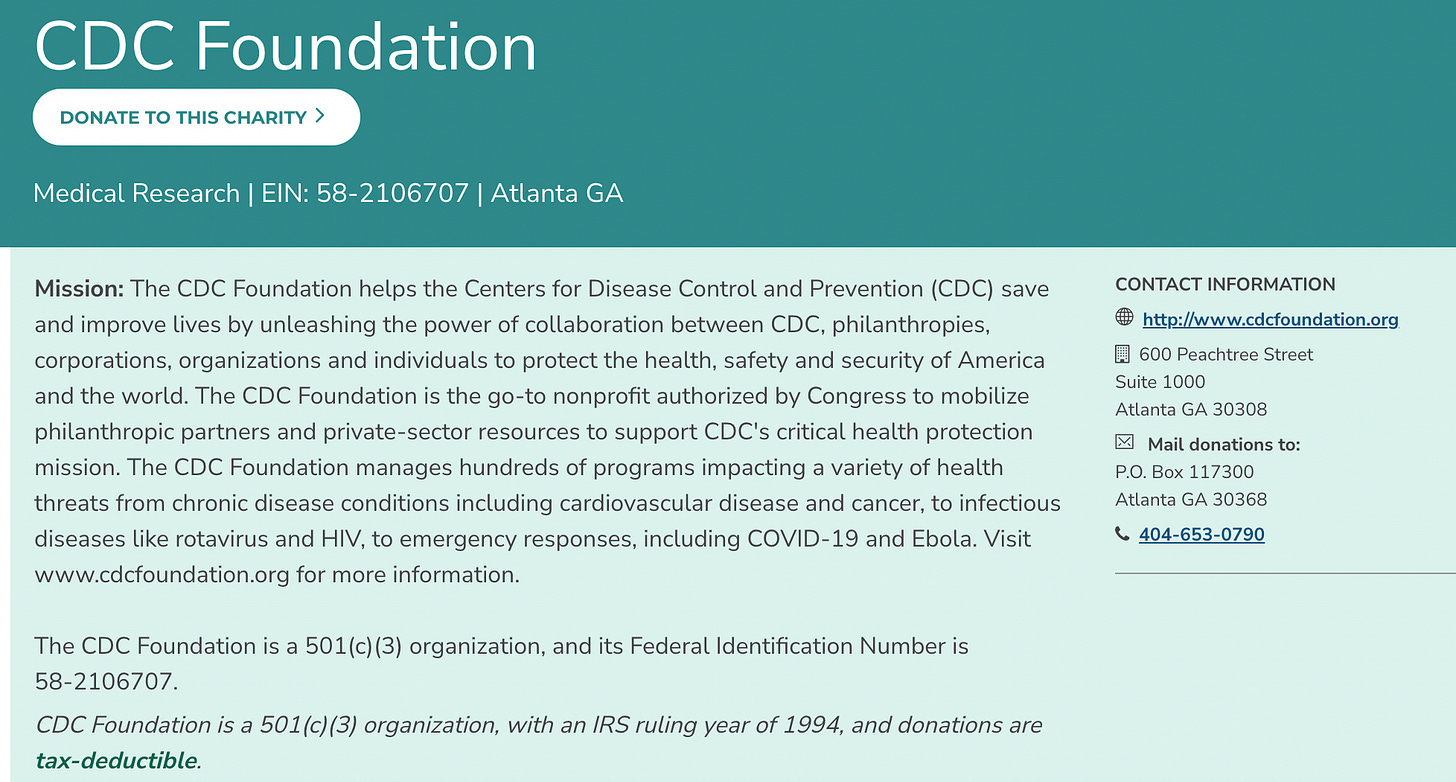
Note: unlike the agencies, these foundations are not subject to legal oversight such as Freedom of Information Act requests, many foundation directors later get lucrative pharmaceutical employment and Julie Gerberding (who ran the CDC through the 2000s and pushed Gardasil through before leaving to become president of Merck’s vaccine division), now heads the NIH’s “non-profit” foundation.
Not surprisingly, the CDC Foundation has been accused of egregious conduct since its inception and has received nearly 1 billion dollars from corporate “donors” (criticisms include a scathing editorial in one of the world’s top medical journals). Some of the best examples of this corruption are documented in a 2019 letter to the CDC from a group of non-profit watchdog organizations. To quote part of it:
In 2011, Type Investigations reported that Exponent Inc, a firm that performs research for the pesticide industry, gave $60,000 to the CDC Foundation for a study to prove the safety of two pesticides. “We have a professional money-laundering facility at the Centers for Disease Control Foundation….They accept projects from anyone on the outside,” said James O'Callaghan, a researcher at the National Institute for Occupational Safety and Health (NIOSH).
Between 2010 and 2015, Coca-Cola contributed more than $1 million to the CDC Foundation. It also received significant benefits from the CDC, including collaborative meetings and advice from a top CDC staffer on how to lobby the World Health Organization to curtail its efforts to reduce consumption of added sugars.
The BMJ also reported on contributions from Roche to the CDC Foundation in support of the CDC’s Take 3 flu campaign, which encourages people to “take antiviral medicine if a doctor prescribes it.” Roche manufactures Tamiflu, an antiviral medication for the flu [for reference, Roche was able to convince governments around the world to stockpile hundreds of millions of dollars of Tamiflu while refusing to release any of their clinical data—and it was eventually concluded that the benefits of the drug are negligible, while significant harms result from the medication].
These “donations” in turn often shape the “impartial” guidelines we are expected to follow:
“In 2010, the CDC, in conjunction with the CDC Foundation, formed the Viral Hepatitis Action Coalition, which supports research and promotes expanded testing and treatment of hepatitis C in the United States and globally. Industry has donated over $26 million to the coalition through the CDC Foundation since 2010. Corporate members of the coalition include Abbott Laboratories, AbbVie, Gilead, Janssen, Merck, OraSure Technologies, Quest Diagnostics, and Siemens—each of which produces products to test for or treat hepatitis C infection.”
Conflict of interest forms filed by the 34 members of the external working group that wrote and reviewed the new CDC recommendation in 2012 show that nine had financial ties to the manufacturers. A report by the Office of the Inspector General found that CDC’s external advisors played an influential role in decision-making for the federal government and that there was a systemic lack of oversight of the ethics program with 97% of disclosure forms filed by advisors found to be incomplete, and 13% of advisors who participated in meetings not filing any disclosure at all.
Note: key funders of the CDC foundation (detailed here) include Act Blue (a key Democratic political advocacy group), key vaccine organizations such as GAVI and the Bill and Melinda Gates Foundation, the major vaccine manufacturers (e.g., Pfizer, Moderna, Merck and J&J), and tech companies such as Facebook, Google, Microsoft, and PayPal.
Recognizing these concerning trends, employees of the CDC in 2016 anonymously complained to their leadership regarding the agency’s corruption:
It appears that our mission is being influenced and shaped by outside parties and rogue interests…What concerns us most, is that it is becoming the norm and not the rare exception. Some senior management officials at CDC are clearly aware and even condone these behaviors. Others see it and turn the other way. Some staff are intimidated and pressed to do things they know are not right. We have representatives across the agency that witness this unacceptable behavior. It occurs at all levels and in all of our respective units.
Recently, the National Center for Chronic Disease Prevention and Health Promotion (NCCDPHP) has been implicated in a “cover up” of inaccurate screening data for the Wise Woman (WW) Program. There was a coordinated effort by that Center to “bury” the fact that screening numbers for the WW program were misrepresented in documents sent to Congress; screening numbers for 2014 and 2015 did not meet expectations despite a multimillion dollar investment; and definitions were changed and data “cooked” to make the results look better than they were. Data were clearly manipulated in irregular ways. An “internal review” that involved staff across CDC occurred and its findings were essentially suppressed so media and/or Congressional staff would not become aware of the problems.
Finally, most of the scientists at CDC operate with the utmost integrity and ethics. However, this “climate of disregard” puts many of us in difficult positions. We are often directed to do things we know are not right. For example, Congress has made it very clear that domestic funding for NCCDPHP (and other CIOs) should be used for domestic work and that the bulk of NCCDPHP funding should be allocated to program (not research).
Why in FY17 is NCCDPHP diverting money away from program priorities that directly benefit the public to support an expensive [global health] research that may not yield anything that benefits the [American] public?
Finally, the CDC’s dealings with corporate interests had drawn scrutiny and concern from Congress:
In February 2019, Congresswomen Chellie Pingree and Rosa DeLauro wrote the Inspector General of the Department of Health and Human Services calling for an investigation of CDC’s interactions with Coca-Cola. They noted that the evidence shows “a troubling pattern of the company using access to high-level CDC officials to shape debates over public health policy directly involving the nutritional value of its products.” The congresswomen requested that the Inspector General “determine whether there is a broader pattern of inappropriate industry influence at the agency, and make recommendations to address this issue.”
Unfortunately, due to the politicization surrounding COVID, all of this was swept under the rug, the requested 2019 investigation was never conducted, and the (fairly recent) story was largely forgotten.
Lastly, this mechanism of funding is not unique to the CDC. For example, the CIA has its own “non-profit” foundation, a venture capital firm shielded from Congressional oversight that secures cutting edge technology (primarily from Silicon Valley).
Note: a disturbing story I recently came across (which highlights how interconnected these "too big to fail" sectors are) comes from a class action lawsuit alleging that shortly after Biden's COVID vaccine mandate for federal workers, the CIA ordered its Counter Espionage Department (a unit created to catch foreign spies and traitors within the government) to investigate thousands of its unvaccinated employees and contractors, effectively treating a personal medical decision as an act of disloyalty to the United States. Worse, unlike ordinary security or HR violations (which can be expunged), material gathered in these espionage investigations permanently remains in the CIA's files and "can be used by the Agency for any reason it deems necessary." When ODNI's weaponization probe later pressed the CIA on this, the agency confirmed the scope of the investigations but refused to cite any legal authority for ordering them, and to this day it has ignored formal requests (both from affected employees and the whistleblower who exposed the program) to remove the material from their records.1,2
The Foundation That Shaped COVID-19
Established in 1990, the NIH foundation shares many of the same issues as the CDC foundation and hence has become a vehicle for the private sector to shape government policy.
As RFK noted in The Real Anthony Fauci, one of the individuals who has best leveraged these opportunities was Bill Gates, who through targeted donations, was able to shift the focus of many public health organizations (e.g., the WHO) away from proven public health measures to an ever increasing focus on vaccines. One of his investments was a 2003 “donation” to the NIH foundation which began a long endeavor to shift the direction of the agency.
Recently, investigative journalist Paul Thacker (writing for RealClearInvestigations) obtained several dozen of the NIH’s internal emails and planning documents from an agency whistleblower, which trace how that $200 million donation (an unprecedented sum for a private donor) grew, over two decades, into a deep entanglement between Gates’s private foundation and the NIH.
Like all outside money, it was routed through the NIH’s foundation, the firewall meant to keep donors from steering federal research. As two Rice University researchers pointed out in 2008, that firewall was effectively meaningless, since the foundation held and administered the funds while the projects that got funded were chosen by the Gates Foundation’s own scientific board.
Note: similarly, in 2018, NIH officials designing a major study on the health effects of alcohol were found to be coordinating with the beer and liquor companies bankrolling it through the foundation, in a study structured to surface alcohol’s benefits while passing over harms like cancer, and that same year the pharmaceutical industry (unsuccessfully) attempted to route $400 million through the foundation to study opioid addiction and alternatives.
After Gates gave a lecture at the NIH in 2013, the agency began coordinating grant funding and scientific policy with the foundation across ten separate programs and hosting a run of joint workshops, held on federal property but giving the Gates Foundation top billing. By 2016 the two were running shared workshops, co-funding clinical trials, merging research policies, and pooling grant efforts, with a researcher the NIH could not fund often passed to Gates, and vice versa.
Gates made his first personal appearance at the series in April 2016. The night before, the foundation paid for a catered dinner for nearly two dozen Gates executives at a stone castle in rural Maryland, while NIH staff worked to confirm the attendance of senior Obama-era HHS officials and FDA commissioner Robert Califf (who had major pharmaceutical financial conflicts of interest). For the visit itself, staff prepared a minute-by-minute itinerary for NIH director Francis Collins: NIH police would meet Gates at the entrance, escort his three-vehicle convoy the final half-mile to one of the main research centers, and Collins would greet him at the door and walk him into the auditorium. One of that day’s panels, moderated by Anthony Fauci, covered microbial outbreaks and the public-private partnerships needed to develop pandemic-preventive vaccines, four years before Operation Warp Speed did exactly that.
Later that year, the foundation gave Gates an award recognizing the $413 million he had by then donated to the NIH (the only other recipient was Pfizer, for $73 million in “donations”).
Reading the itinerary, one senior Trump-administration official noted that this level of treatment is normally reserved for the president, the first lady, or visiting heads of state. The documents also point to why few of the people Thacker contacted, including longtime critics of Gates and the NIH, would speak on the record: by the whistleblower’s account, Gates and the NIH together account for 57% of all global health research funding worldwide.
Furthermore, this same funding leverage extends well beyond the research world and into the press that is supposed to scrutinize it. A 2020 Columbia Journalism Review investigation found that the Gates Foundation had quietly directed more than $250 million into journalism, with recipients including the BBC, NPR, The Guardian, Al Jazeera, ProPublica, the Financial Times, and The Atlantic (NPR alone received $17.5 million, all of it earmarked for the global-health and education topics Gates funds). This builds on a pattern the Seattle Times documented back in 2011, which found that beyond funding outlets directly, Gates was bankrolling journalist training programs, research into how to craft media messages, and think tanks that produce op-eds and media fact sheets (part of roughly $1 billion spent on “advocacy and policy” over the decade). Some of those grants even spelled out the coverage topics, including clinical trials, which happen to be central to the Gates-backed vaccines and drugs being tested (and then deployed) in the developing world. Not surprisingly, media coverage of Gates tends to be consistently favorable, while stories about COVID corruption have drawn so little attention in the establishment press.
Note: the most damning of Thacker’s revelations (e.g., the exact internal wording, the 57% figure, and the official’s assessment of who else warrants such treatment) come from private internal emails rather than public filings, so they rest on the whistleblower’s account and hence cannot be definitively verified. However, I was able to verify the rest of Thacker’s claims against public records (e.g., the 2003 donation and its size, the 2008 Rice warning, the top-billed workshops, the $413 million award, Pfizer’s matching $73 million, and the officials involved), so those claims are likely true as well (particularly since they match Gates’ documented pattern of monopolistic behavior).
Conveniently, Gates also stood to profit from the agenda he was helping shape. For instance, before COVID his foundation held a $40 million stake in the vaccine maker CureVac and a $55 million stake in BioNTech, Pfizer’s eventual vaccine partner. After aggressively lobbying for mRNA vaccines to be the solution for the pandemic, his foundation then sold the BioNTech position for more than $550 million after the vaccine reached the market (likely exceeding what he needed to invest to ensure those vaccines would be widely adopted).
Note: the same routing of public money to private consultants appears elsewhere in the documents, where Gates channeled funds through the NIH foundation so NIH staff could hire McKinsey (which would later pay $650 million to resolve a federal investigation into its simultaneous work for Purdue Pharma and the FDA during the opioid crisis) to help shape federal research strategy, after which McKinsey’s survey of the Ebola field concluded that the two vaccines furthest along belonged to Merck and GSK (both longstanding Gates Foundation partners).
A second cache of NIH emails, obtained and reported by Maryanne Demasi, illustrates what this apparatus was used for. In the years before COVID, Francis Collins worked alongside the same organizations (the Gates Foundation, the Wellcome Trust, the World Bank, the World Economic Forum, and the major vaccine makers) to build much of the pandemic-response framework in advance, so that a good deal of the machinery that later governed the response was already in place before COVID appeared.
The emails trace this to Davos in January 2016, where figures from the Gates Foundation and the World Bank proposed running large-scale pandemic simulations modeled on military war games, a concept nicknamed “Germ Games.” World Bank president Jim Yong Kim proposed drawing on the US Department of Defense’s war-gaming expertise, offered to find the funding, and called on the NIH, the Wellcome Trust, and the Gates Foundation to develop it jointly. Writing to Fauci afterward, Collins noted that with Gates and the World Bank behind it, it would be hard to stop. The same approach resurfaced in Event 201, the October 2019 simulation of a fictional coronavirus pandemic that Johns Hopkins ran with the WEF and the Gates Foundation, months before COVID appeared.
When COVID emerged, these organizations took up the roles they had prepared: CEPI directed vaccine funding, the Gates Foundation handled financing and distribution, the World Bank mobilized resources, and the WHO coordinated messaging. The public was locked down, masked, and told to wait for vaccines. When three epidemiologists (Jay Bhattacharya, Sunetra Gupta, and Martin Kulldorff) challenged this in October 2020 with the Great Barrington Declaration, Collins did not debate them but privately called for a “quick and devastating published takedown” of their work, the same handling of dissent already documented inside the FDA.
Lastly, much of what Demasi’s emails show had already been assembled five years earlier by Peter Breggin, whose 2021 book COVID-19 and the Global Predators exposed the planning documents behind this apparatus. Chief among them was a July 2017 presentation from Gates’s Coalition for Epidemic Preparedness Innovations (CEPI, founded with the Wellcome Trust, the World Economic Forum, and the governments of Norway and India, and backed by GSK, Merck, J&J, Pfizer, Sanofi, and Takeda) to the World Health Organization, laying out how the next pandemic would be handled: rapidly financing liability-free “emergency” vaccines and bringing them to market under a “no loss” guarantee that reimbursed developers for their direct and indirect costs, with no mention anywhere of the early or effective treatments that could have removed the justification for those emergency vaccines.
Conclusion
One of the things I found the most frustrating about COVID was how many simple and highly effective ways to contain the pandemic were disregarded (e.g., safe indoor sterilization of buildings with UV lighting and countless proven but unpatentable COVID-19 treatments including things as simple as disinfecting the upper airway—which I recently detailed in an article on treating sinus issues).
Instead, we got mandates, fear, and countless policies so ridiculous we’d have a hard time believing such a hysteria had gripped our society had we not just witnessed it.

Because of this, many have understandably completely lost their trust in the medical field, with many polls corroborating that loss exceeds anything seen before in history (e.g., a JAMA survey of 443,455 American adults found in every sociodemographic group, trust in physicians and hospitals decreased substantially over the course of the pandemic, from 71.5% in April 2020 to 40.1% in January 2024).
On one hand, I think this is a fortunate development, because many of the egregious actions of the medical industry have only been possible because it has been completely shielded from outside scrutiny (whereas now many are discovering through social media that common sense, basic research and AI often provided more useful information than a typical medical visit)—hence creating an opportunity to finally subject the industry to outside competition that forces it to adopt low-cost therapies like DMSO which can actually fix the problems patients face rather than putting them on a lifetime of costly prescriptions and medical procedures which gradually make them worse. Likewise, within medical research, at this point, we waste billions upon billions of dollars each year on repetitive research which is unlikely to ever produce cures for longstanding illnesses while simultaneously shunning the things which have produced “impossible” results (e.g., here I showed how this is the case with Alzheimer’s).
Conversely, I also find it quite worrisome, as the medical field does provide many essential services (particularly for emergency conditions) and science, for all its flaws, has been a revolutionary system that has created tremendous advancements for humanity (particularly in the past when there were less restrictions on what could be researched). Likewise, every society depends upon trust in its institutions (which take decades of work to put into place), and once that is no longer present, instability and breakdown inevitably follow.
Because of that, the path forward is unclear, but presently I believe the best options we have are to openly discuss the flaws in the current paradigm and build parallel systems that are not dependent upon the existing status quo (e.g., local regenerative food supplies and obtaining the tools we need to heal ourselves) so that the medical system is exposed to genuine competition that forces it to offer a better product. Given how many parties are deeply invested in the current status quo, the path away from it will be anything but smooth, but at the same time, I feel it is impossible to avoid (particularly as the self-perpetuating greed of the medical system is gradually making it no longer possible to pay for its excesses).
My hope hence is that we can pass through this turbulent period as quickly and smoothly as possible (rather than say being forced to experience an even more draconian pandemic before the rest of the public wakes up) and I sincerely thank each of you for your support which has enabled me to do my part in helping to expose and finally fix this mess.
Lastly, I have received a lot of requests to discuss chlorine dioxide here. The reason I have avoided doing so (beyond limited time, as our team, despite doing all we can to produce material here still has many existing professional responsibilities offline) is because many have already explored the subject (making it less urgent to cover in detail) and because I feel the subject that needs exposure first is medical ozone. This is because in addition to it being a suppressed “umbrella” remedy (with a massive volume of research supporting its use across a wide range of conditions and it being regularly used in countries not subject to the FDA’s restrictions) many of the mechanisms necessary to understand how oxidative therapies like CDS work were mapped out by the ozone field.
Now that I am finally starting to clear the backlog from the DMSO project (I started in October), I’ve begun the initial process of compiling the ozone literature base, and for that reason, if any of you have had positive experiences from ozone therapy, please leave them here (as a comment or reply) or email Dan, who has been compiling reader DMSO testimonials for me at DMSOexperiences@proton.me. Likewise, if you have any compelling DMSO stories (e.g., I would really like to reconnect with the readers who treated colorblindness, FOP and interstitial lung disease with DMSO), please do not hesitate to send them either as they will greatly help those who subsequently see them.
We live in a capitalist society. Teaching people how to be healthy does not increase shareholder value.
Fantastic report!!!
Money makes the world go round, and the LOVE of money is the root of all sorts of evil.