
Story at a Glance:
• Throughout history, ruling elites have relied on a recurring playbook (manufactured crises, public examples, bought-out hierarchies, and economic coercion) to keep populations compliant, and nearly every tactic was used during COVID.
• Federal policies paid hospitals tens of thousands of dollars per COVID admission, boosted reimbursement for ventilated patients, shielded providers from liability, and made remdesivir the standard of care, creating powerful incentives for harmful protocols.
• At a recent Senate hearing, families shared strikingly consistent tragic stories of unvaccinated patients being isolated, told they would die, denied safe repurposed drugs, given remdesivir over their objections, and pushed onto ventilators and into DNRs.
• An attorney who sued hospitals on behalf of 212 families reported that only 3 of the 72 patients who received court-ordered ivermectin died, while every one of the 140 who didn’t get it died—making suing hospitals one of the most effective treatments in history.
• Trauma surgeon James Miller testified that his hospital was never overwhelmed despite the headlines, inflated its COVID numbers, and had infectious disease doctors who seemed to know remdesivir was harmful, and he was driven out of surgery after opening a free clinic for the unvaccinated.
• Because the system steadily removes the doctors who will break a failing protocol to save a patient, trust in physicians and hospitals fell from 71.5% to 40.1% between 2020 and 2024, and it will only return if medicine becomes honest and starts offering things that work.
The ruling elite typically aims to accumulate an immense amount of wealth, which often can only be obtained by extracting it from a large number of people, hence requiring each of those people sacrifices their quality of life to meet the elite’s needs. An excellent meme, in turn, synopsizes the challenge ruling elites seeking this excessive wealth and power have faced throughout history:
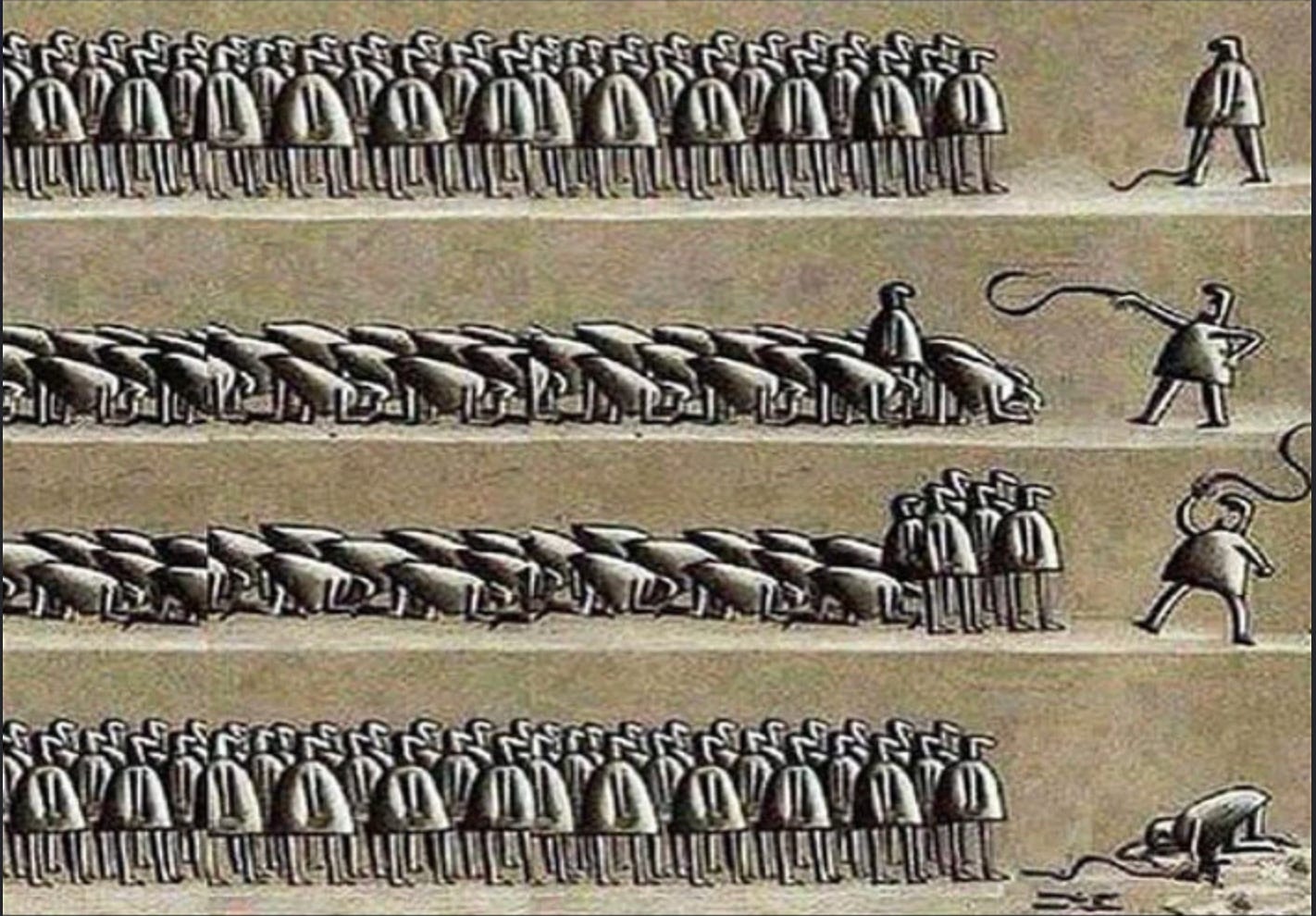
Since it is not economically feasible to directly force an entire population into submission (e.g., the estimates I’ve found put 3-5% of the population as the maximum number of soldiers a society can afford to support), a variety of other tactics have been reused throughout history to keep the population compliant. These include:
•Use crises (e.g., war, plague, famine, or financial panic) to justify emergency powers, mute ordinary skepticism, and recast dissent as sabotage. The pattern is ancient: a problem arises, the public demands protection, and the apparatus claiming to provide it expands—all while fear makes the population far easier to divide and control.
•Make public examples of non-compliant individuals so everyone is scared into compliance, or maintain a system for punishing (and monitoring) dissenters that everyone feels is always hanging over their shoulder. This goes hand-in-hand with making the legal and bureaucratic system so complex it can’t be navigated without specialists the system itself trains (raising the cost of challenging it) and that almost everyone is technically in violation of something—which allows the law to be selectively applied so only those who challenge vested interests are arrested or prosecuted.
•Reward compliance, as careers, grants, titles, access, and prestige for those who play along are just as important as the examples made of the defiant (since most people would rather climb the existing hierarchy than tear it down).
•Create a rigid social hierarchy everyone defers to, and then buy out its top (e.g., having a few select “prestigious” medical journals, “impartial” guideline panels, regulatory agencies, or “experts” be deferred to for medical guidance while everything else is ridiculed as “uncredible”—despite each of them typically taking significant pharmaceutical money and only supporting industry narratives).
Note: one major problem in medicine (which is ingrained through numerous compliance mechanisms) is that the majority of doctors are not willing to deviate from standardized protocols and guidelines—even when it is clear they will not produce an acceptable outcome for the patient (instead, in those situations, they will simply insist they did their best and there was “nothing we could do”).
•Structure the system so everyone is forced to work within that hierarchy (e.g., making physician employment, reimbursement, and immunity from lawsuits dependent upon following the “standard of care” and requiring all other healthcare workers to defer their judgement to physicians).
Note: I believe this accounts for the aggressive push to move doctors from independent to corporate practice. For example, Obamacare was structured to facilitate this, as immediately prior to its passage, 60-70% of physicians were in independent or doctor-owned practices,1,2,3 whereas by 2024, only 35-42% were1,2 (e.g., a 2024 article was titled “Doctors continue to shift away from private practice, citing insurer payment rates and regulatory issues”).
•Make accumulating money be a guiding principle everyone in the society strives for and then use economic incentives (since they can easily be changed from the top down) to create the desired behavior in the population (e.g., Biden’s federal policies leading to most workers being told they would be fired if they didn’t vaccinate).
•Have every media source parrot the same message needed to maintain the status quo (as this persuades most of the population since people like to follow the crowd). This is often paired with well crafted propaganda that effectively misleads the public.
•Create a devout belief in the state or its leader, which not only makes people compliant but also leads them to attack those who aren’t, thereby making the population police itself.
•Create a robust social framework everyone is expected to fit into that requires compliance at each step while simultaneously training people to be compliant (e.g., go to school to go to college to get a job to get married).
•Atomize the population. Independent bases of loyalty (e.g., extended family, church, guild, or town) are much harder to extract from than isolated individuals, so weakening them leaves people facing the state and the market alone—at which point they are far easier to message, hire, saddle with debt, and shame.
•Whenever something awful and unacceptable will be done, first test and refine it on a marginalized group that cannot advocate for itself, and once it succeeds, use that success to normalize it so it can be done to the general population. This is why I feel it’s critical not to ignore it when this happens to others, as beyond that apathy being immoral, it often sets people up to be subjected to the same thing once it has gained so much momentum it can no longer be easily opposed (best synopsized by the famous Holocaust poem where the speaker did not speak up for each successive group targeted because he did not belong to it, which concludes with “Then they came for me, And there was no one left To speak out for me”).
Note: pages could be written about how this applies across the medical field (e.g., prior to COVID, one of my longstanding frustrations was helping people who’d been severely injured by a pharmaceutical that never should have been in general use, as despite the immense suffering, no one really cared because not enough people were affected). Likewise, I’ve recently been thinking about the broader implications of the Ukrainian government’s decision to sacrifice its population and country to keep the war going so it can continue enriching itself from it.
•Normalize and gradually increase the exploitation so people view it as a fact of life rather than noticing (let alone questioning) it. For example, since the medical system is structured to continually produce costly proprietary drugs patients must take for long periods (if not permanently), treatments which compete with this model are suppressed. When DMSO was discovered in the 1960s, it was better than any existing therapy for many illnesses, yet it was dismissed for “insufficient evidence” compared to “proven cures” (many of which were later pulled from the market), and it remained suppressed despite tens of thousands of studies showing its utility and foreign healthcare systems (e.g., Russia and Ukraine) adopting it. Most importantly, when I drew interest back to it sixty years later, it was still more effective than any approved therapy for many ailments (which is why that series got so much traction). A major reason I’ve put so much work into it, in turn, was to show that the primary obstacle to solving many of the illnesses we face is the structure of the medical system itself.
Note: I think one of the major mistakes the ruling class has made recently, in the pursuit of further profit, was to escalate the exploitation so rapidly that the public is now noticing it.
•Distract and preoccupy the populace so they don’t focus on the major issues facing them (e.g., with “bread and circuses” or by dividing them so they blame another segment of society rather than the ruling class actually creating their problems).
Note: one of my major fears about AI is that it effectively solves the problem elites have struggled with for centuries (being able to afford enough soldiers to police the population), since AI is much cheaper than a full time soldier and hence makes it feasible to exert a much greater degree of control over each member of the population.
The COVID-19 Pandemic
Since people are uncreative, the above playbook also explains exactly what happened during COVID.
In my own case, through internet posts, I believe I became aware of a problematic coronavirus circulating in China in late December (based on checking my calendars I think it was around December 19th, but when I looked up the timeline it appeared on the internet around December 31st). I subscribe to the view that pandemics are almost always massively hyped up to support the biopreparedness industry (detailed here), but in this case, I instead broke from my preconceived biases and became increasingly concerned about this virus as:
•It seemed to be quite dangerous and highly transmissible
•It seemed highly likely it was an lab-made weaponized pathogen.
•Despite more and more signs accumulating that it was the deadly pandemic the industry had been waiting decades for, rather than hype it up, the media (and the Democrat party) continually downplayed its significance and attacked those who raised concerns about it—even once it had spread to Europe and created a similar wave of problems to what was seen in China.
Given what Fauci and the health system had done to the (marginalized at the time) gay community during AIDS (where as much fear as possible was generated about the virus while everything that worked was suppressed, and a toxic and ineffective drug was pushed through despite public and Congressional pushback), I assumed Fauci and those behind him would do the same thing during COVID. As such, my sense was that if I did not find a way to treat this illness (as I had no faith the medical system would), people I knew were going to die, and likewise, if an effective cure could not be adopted, a lot of really bad stuff was going to happen (most of which subsequently did).
Note: I initially thought COVID would be an issue for about a year before it mutated to a much more benign variant (as this is what always happens), but once I saw how measures were being taken to prevent the population from developing herd immunity to protect the market for the vaccine (which was later admitted by HHS officials), I realized this would drag on far longer, particularly since the design of the vaccines also prevented the population from developing herd immunity.
Because of this, in the months leading up to COVID hitting America, in addition to looking down every alley I could for a viable solution to COVID, I tried to alert my colleagues to the problem we were facing (almost none of whom believed me) until eventually, in the middle of March, one working in NYC sent me this text (along with many more describing the catastrophe they were facing and the climate of fear there):
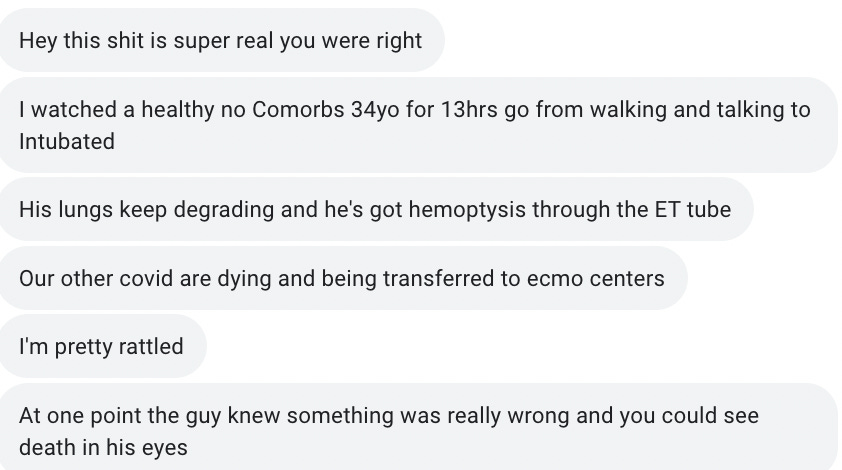
Note: one of the most common debates about COVID was if “it really mattered.” My own assessment is that the original variants (that many did not see) were much more dangerous than the later ones, individual susceptivity greatly varied, it only hit certain areas really badly (I still don’t know why this is, but my best guesses are either that harmful variants were seeded there or a collective fear in the area worsened the disease), and that as time went on and the industry had established itself but the virus became less dangerous, more and more things were done to justify the industry perpetuating itself (e.g., relabeling flus or automobile injuries as COVID and using harmful hospital protocols to significantly inflate the death rate). As such, depending on which part of that picture you focused on, COVID could appear to be extremely dangerous or completely harmless.
Likewise, once the pandemic started, I was inherently skeptical of sending people to hospitals, as:
•While hospitals are excellent at addressing many serious ailments, they tend to fare poorly on viral disease (because most effective antiviral therapies are not patentable and hence rejected by medicine).
•Hospitals are very quick to give up on patients and say “nothing can be done.”
•Hospitals are highly resistant to allowing people to try alternative therapies, even when everyone agrees that patient will die and nothing can be done (which had led to more cases than I can count of people being snuck alternative therapies in the hospital and then “miraculously” recovering).
•There was a climate of fear amongst medical professionals (as for the first time in their careers, they felt they were in danger too) so they wanted to minimize their interactions with patients as much as possible (which would lead to even worse care). Likewise, I was expecting below average care because the hospital systems were overwhelmed and locked into a triage mindset.
Note: generally, these issues tend to be much worse with large “prestigious” hospitals than small rural ones (which mirrored what I saw during the pandemic). For this reason, I previously wrote an article on the dangers of hospital care and how one can best navigate it here.
Likewise, I was also alarmed by two federal policies (that were likely shaped by lobbyists):
•First, to combat COVID, a series of (well-intentioned) policies were enacted, such as the government covering COVID hospitalizations for the uninsured (incentivizing hospitals to admit more “COVID” patients and diagnose admitted patients with COVID), shielding healthcare providers from malpractice when treating COVID (thereby incentivizing poorer care and the use of unsafe countermeasures), and the Trump administration doing all they could to secure ample ventilators for America (which incentivized ventilating patients who weren’t good candidates for ventilators and needing people without adequate ventilator training being needed to operate many of them—both of which increased mortality).
Note: one of the least appreciated facts about COVID was that since the spike protein (through disrupting zeta potential) caused microclotting throughout the body (which disproportionately affects the smallest vessels) blood oxygenation was much poorer in the periphery than the internal organs. Since oxygen saturation is measured in the finger tips, many patients hence had critically low blood oxygenation (which requires intubation) despite them clinically being fine, and since it took a while for the medical field to recognize many of these patients did not need ventilation (and that ventilation often resulted in death), for a prolonged period, many were inappropriately vented and died.
Most importantly, to make up for the money hospitals had lost (because they saw fewer patients for other things due to the lockdowns), grant subsidies were given to make up the shortfall. While these were initially automatic and first based on the previous year’s revenue (and then increased so the total came to about 2% of their net patient revenue), those that followed were allocated to hospitals in high COVID impact areas (hospitals that had higher numbers of COVID admissions), where, in addition to their standard reimbursement billing, hospitals received $76,975 per COVID admission, and then, after 4 months, $50,000 instead (as this policy predictably incentivized more “COVID” admissions—corroborated by a senior HHS official, in a media call stating that the reduced funding is due to the number of such admissions surging from about 50,000 in the first round to more than 400,000 by the time of the second round1). Likewise, the March 27 CARES Act required Medicare to increase reimbursement for COVID hospitalizations by 20%.1
Note: prior to COVID, Medicare’s average payment for someone hospitalized for a respiratory infection was $13,297, $17,437 if they were also vented for less than 4 days, and $40,218 if vented for over 4 days, so venting patients long-term effectively tripled the reimbursement (before the 20% add-on was included).1
•Second near the start of the pandemic (4/29/2020) Fauci announced to the world that the antiviral remdesivir would be the standard of care for COVID, not unlike how he’d made the antiviral AZT be the standard of care for AIDS (despite minimal evidence of efficacy, and significant evidence showing it made AIDS worse). Beyond the AZT parallels, it was also a red flag that remdesivir was a non-specific antiviral that needed a home (as it had not worked for Ebola) rather than a therapy specific to COVID, that the existing data for remdesivir was very poor (Fauci even cited fairly lackluster benefits to justify it being the standard of care), and that like AZT, safety concerns existed with the drug. Because of Fauci’s pronouncement, I felt hospitals would aggressively push remdesivir protocols as following the standard of care significantly shielded them from liability, particularly since insurance subsidies were likely (and in November Medicare even created a separate add-on for costly new COVID drugs such as remdesivir, to ‘mitigate potential financial disincentives,’ which made hospitals less likely to lose money when administering them to an expensive inpatient1).
Note: in contrast to remdesivir, the monoclonal antibodies were new drugs that were specific to COVID, and in turn, they actually worked quite well (which not surprisingly led to their access being increasingly restricted, as being able to treat COVID disrupted the existing business model.
So, in the early part of the pandemic, I quickly concluded the most valuable thing the hospitals could do for COVID was provide oxygen (and hence sourced a lot of home oxygen concentrators for people), and then went through a very nerve-wracking period of treating people across the country at home (who’d only contacted me late in the illness) and having to repeatedly make the call on whether home care would work or we had to take the risk of a hospitalization (where things became much more complicated due to how frequently things were mismanaged and us not having colleagues at the hospital who could address them for us). Much of this came from the fact that in addition to me expecting the hospitals to be unprepared to correctly treat COVID, they were also incentivized (and equipped) to aggressively hospitalize patients for COVID and have them fare poorly enough to require extended ventilation (which was often fatal).
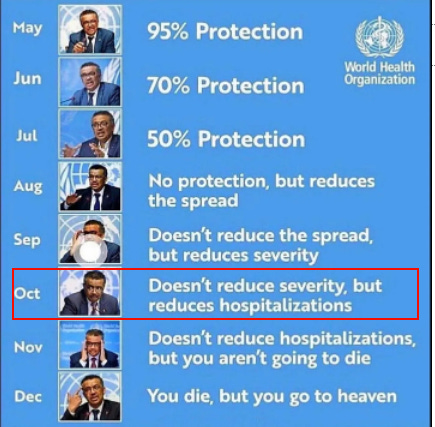
Later, right before the vaccines came out, for many reasons I’ve detailed in this newsletter, I was concerned they would be unsafe and ineffective—which most of my colleagues refused to consider, as they were desperate for the solution the vaccine offered (as everything previously, possibly by design, had abjectly failed to mitigate the pandemic). So, once the failures of the vaccines became readily apparent, rather than admit it, the medical system kept on doubling down on them, leading to this meme:
As public resistance to the vaccines increased (due to both their toxicity and ineffectiveness), increasingly aggressive measures were taken to promote them. These included staff-vaccination mandates (in November 2021 CMS made COVID-19 vaccination a Condition of Participation for Medicare and Medicaid hospitals, so a facility that did not require eligible staff to be vaccinated could be terminated from those programs and lose that funding1) and medical professionals (and medical students), along with many on the left, openly holding the unvaccinated in contempt.
On one hand this was alarming as it went against every principle of medical ethics (e.g., doctors are taught to have compassion and understanding for a combative drug addict who has an addiction related hospitalization and may carry hepatitis or HIV) but also did not surprise me, as in the 2015 measles outbreak (where 117 people got measles1 and one previously vaccinated person died1), the media incited a hysteria about it (presumably to enable the subsequent push for highly unpopular mandatory vaccine laws) at which point, I saw numerous physicians (and a few medical students who cycled through) that had branded themselves as “highly compassionate” and “viewing every patient’s life as sacred” wish death upon the children of parents who wouldn’t vaccinate them.
Note: I feel one of the major shortcomings in medical education is the minimal focus on ethics (despite physicians carrying a massive ethical responsibility), and as a result, “whatever results in a billable procedure” or “maximizes revenue” often becomes the guiding principle in medical ethics—which I believe explains why contradictory positions are frequently taken such as promoting late-term abortions where the fetus is viable but simultaneously mandating childhood vaccines to “protect the child” (or why many existing ethical principles were thrown out the window during the pandemic because so much money was to be made from feeding people through the hospital pipeline).
In turn, the media began promoting the message that if you did not vaccinate, you did not deserve to take up a bed at a hospital and medical professionals became quite condescending or hostile to hospitalized patients who had not vaccinated—all of which became worse once most of the justifications for COVID vaccination had been lost and a pivot was made to them protecting against severe illness (e.g., Fauci and the CDC director repeatedly claimed that 98-99% of patients in hospital and dying were the unvaccinated1)—despite the trials not being able to determine this, numerous studies showing vaccinated had a higher hospitalization rate,1 and later studies showing the benefit was mostly seen for the early variants in the elderly for a few months after vaccination. Because of this, I frequently heard stories of unvaccinated patients being treated poorly in the hospitals (and pushed towards the ventilator pathway), and I began hearing of cases of people lying and stating they were vaccinated to get better care.
Note: I always suspected the unvaccinated numbers were inflated (as the extreme mortality claims did not match what I was seeing), and eventually learned through one activist they’d been able to show their hospital was inflating their percentage of COVID admissions that were in unvaccinated patients. Later, I found out through Pierre Kory that the EMR they used (EPIC, one of the largest ones in the country) made vaccination status “vaccinated” or “unknown” (which was typically the status patients who vaccinated outside the hospital system ended up in—and quite difficult for providers to correct), but “unknown” was then interpreted by the CDC to mean “unvaccinated” (all of which is detailed in his excellent article on the topic). So in essence, rather than unvaccinated increasing your probability of being admitted to a hospital, being admitted to a hospital significantly increased your likelihood of being reclassified as unvaccinated. Most tellingly, EPIC corrected this (so the unvaccinated option reappeared and it was easy to change) after the need to increase unvaccinated numbers decreased.
So, if we take a step back, two things should be apparent:
First, many of the tactics the elite have used throughout history to exploit the population were at play here.
Second, many incentivizes were in place for hospitals to do bad things which went against the ethical conceptions most people hold of how the medical field could ever act.
COVID Hospital Protocol Hearing
Senator Ron Johnson (who understandably wanted to retire) made the decision to run for a third term in 2022 because he was appalled by what was happening during COVID and by the fact that almost no one was advocating for those injured by the COVID vaccines.
From the start of COVID, he sent (mostly ignored) oversight requests to HHS, and as a committee chair, began hosting Senate events questioning how things were being handled, beginning with 11/19/2020 and 12/8/2020 Senate hearings on using repurposed drugs to treat COVID before the hospital stage. Then, after he lost the chairmanship (as Senate control flipped in 2021), he held a series of roundtables and panels on COVID vaccine injuries, early treatment (which was the only solution to the pandemic and hence stonewalled by the medical system), and the other numerous ways the COVID response was mishandled1,2,3,4 (along with additional events outside the Senate1,2,3,4). Finally, in 2025, once Republicans regained control of the Senate, he became Chair of the Permanent Subcommittee on Investigations (the Senate’s chief investigative body with broad subpoena powers), and began both aggressively pursuing federal records that would reveal the malfeasance during the pandemic and hosting a series of poignant Senate hearings on the same topics (along with childhood vaccine injuries and the healthcare system in general).1,2,3,4,5,6,7
This week, he hosted a gripping hearing on the hospital protocols used throughout COVID that, due to how much many people related to the horror in it, went viral on Twitter (with many clips receiving hundreds of thousands to a million views). As such, while these hearings are long, I believe many will find this one worth watching in its entirety (especially with the context I previously mentioned factored in).
In the hearing, family members of patients who died in the hospital shared their surprisingly consistent stories alongside doctors and nurses who worked inside the system. In case after case, an otherwise healthy patient walked into the hospital and was isolated from their family. Once staff identified them as unvaccinated, they were told some variation of “you’re going to die” or “you’re unvaccinated, what did you expect?” Requests for ivermectin, hydroxychloroquine, vitamins, or monoclonal antibodies were refused (and in several cases cut off right after the patient began improving on them).
Some of the doctors seemed to know this was wrong (e.g., one, when asked why she wouldn’t try anything else, teared up and said “I used to save lives”), but said their hands were tied, and in one instance, an Orlando hospital system had sent its 2,000 doctors a memo recommending against steroids, hydroxychloroquine, ivermectin, and any preventive measures while recommending routine remdesivir. Remdesivir, in turn, was given anyway, often over explicit objections and frequently followed by kidney failure (in one case, to a patient with pre-existing kidney damage whom staff had told his mother did not have an active infection).
Patients were pressured or forced onto ventilators, and families were pushed to sign DNRs (in one case, to donate the organs of a man who was not an organ donor). Likewise, one patient was told she could only see her priest for last rites if she accepted remdesivir, and another family was told they might be allowed to visit if they switched their father to a DNR. Basic care such as food, water, hygiene, and clothing was neglected for days, and one physician shared that the only way he could get families in to visit was to write in the chart that each of his patients would die within 24 hours.
Getting out was no easier. One husband had to endure a six-hour standoff with police to bring his wife home (where she fully recovered on the treatments the hospital had refused her), a court order to give ivermectin was simply ignored (after which a hospital employee warned the wife that the doctors were angry she’d defied them and might let her husband die to prove ivermectin didn’t work), and families resorted to smuggling medicine in (e.g., in a stuffed novelty pillow or crushed into a feeding tube).
Likewise, the attorney who sued hospitals on behalf of 212 families shared that of the 72 cases where he got ivermectin administered, only three patients died, whereas every one of the 140 where he couldn’t died (making suing hospitals amongst the most successful medical interventions in history). Meanwhile, the clinicians described being fired, reported to their licensing boards, subjected to sham peer review, fined, or ordered into psychological counseling for giving patients what they’d asked for.
James Miller
Since this hearing is too long for many people to go through, I wanted to draw attention to one of its most widely seen parts—James Miller’s testimony:
Many readers here are familiar with Dr. Miller, both because he helped me write an article on the gradually disappearing art of surgery and because I’ve repeatedly cited the remarkable results he’s had with DMSO in his new practice. What many don’t know is that I got to know him very early in this publication’s history. Traumatized by what had happened to him in Washington, he reached out to me, and we began corresponding because I really liked where his head and heart were at (he had the rare capacity to see things for what they were and break from the crowd to do the right thing). Since I felt his story needed to be heard, and he both has a great deal of integrity and is an excellent communicator, I offered him a platform, and once he was ready, did what I could to get his story seen—beginning with the first article we published which went viral and was featured nationally on Fox News, followed by three others we put together1,2,3 (including a detailed affidavit of what he’d witnessed) and most recently, his Senate testimony.
I’m immensely grateful he was given a place on the panel, as few things are more likely to break the narrative we’ve been stuck in than a doctor of his caliber saying on the record what really happened.
Dr. Miller’s Story
Dr. Miller was a trauma surgeon and the top producer at Providence Regional Medical Center Everett (meaning he operated the most, had the best outcomes and fewest complications, and made the hospital the most money). Before COVID, he’d already gotten a taste of how the system treats people like him. After he raised the standards for the surgeons while serving as interim director of the trauma team, a nurse leader emailed staff that “we need to get Dr. Miller,” eleven baseless complaints were filed against him in two weeks (including one accusing him of racism for waving hello to a maintenance worker in a hallway), and the email was then deleted from his inbox.
Note: those years also gave him a front-row seat to how robotic surgery had hollowed out surgical training (e.g., none of the hospital’s 7-8 urologists could remove a kidney without the robot, so he had to be given emergency privileges to do it). Those same urologists then became the leaders of the hospital’s safety committees, redefined “competence” so it had nothing to do with patient outcomes, and drove out those who objected.
In February 2020, his hospital admitted the first diagnosed COVID patient in America, and shortly after, the CDC sent it remdesivir, which leadership pitched to Miller and other physician leaders as a powerful antiviral everyone should wait for. In practice, it did not work, and the hospital’s infectious disease doctors seemed to know it (e.g., when Miller brought them a young trauma patient who was a textbook remdesivir candidate, the on-call infectious disease physician told him not to give it to her because she “seemed like a nice girl”).
Likewise, his hospital’s COVID wave peaked around March 17, 2020, and it never faced a shortage of beds, staff, or equipment—yet it kept promoting the idea it was overwhelmed. At one point in July 2020, Miller and his colleagues were drinking coffee at the nurses’ station of an ICU that was 30% full (with nurses being sent home for lack of patients) when someone pulled up a news story saying their ICU was overrun, at which point the ICU director panicked and called the administrators to strategize about the crisis. Death certificates, in turn, defaulted to COVID and were cumbersome to change (e.g., an elderly dialysis patient who came in with a brain bleed was repeatedly tested until she finally tested positive, and when she died from the bleed, Miller was prevented from correcting her death certificate).
Once the vaccines rolled out, things got darker. The head of infectious disease told Miller he was working with the governor’s office to make driver’s license renewals contingent on vaccination (and when Miller warned this would incite violent protests, he was excited by the prospect). Unvaccinated members of Miller’s church began telling him they’d been refused care by primary care and urgent care doctors (including diabetics who could no longer get their prescriptions), and when he raised this with the medical group’s chief medical officer, he was told it was the appropriate policy to “keep the staff safe.”
So Miller opened a free clinic through his church, and of the more than one hundred patients he and a few nurses (including his wife) cared for, only one died—after he sent her to the ER for oxygen and she was sent home without it. After that, they obtained oxygen concentrators for the clinic, and every other patient recovered. Meanwhile, once the federal directives began dictating hospital care, the unanticipated mortality in the hospital’s trauma patients doubled, yet when the administration was shown this, it made no changes.
In January 2022, Miller resigned but agreed to stay for 7 more months at the request of the Chief of Trauma to help orient new hires. Four days later, the hospital launched a sham peer review against him for a “microaggression” that had occurred a month earlier—asking an OR charge nurse to stop watching cat videos on her phone with the on-call team so they could operate on a patient who’d been waiting over nine hours for surgery to untwist his intestines. Subsequently, his colleagues were told not to speak to him if they valued their jobs, his four requests for a fair hearing were denied, and he was told he was suspended and would be arrested if he set foot on hospital grounds, even to collect his personal belongings (until his whistleblower attorney sent a letter, at which point he was told he had never actually been suspended and that the court-couriered letter the hospital’s CEO had sent him was a “typo”). A month later, after he had sold his home, he was exonerated by two separate investigations and told to return to work within the week—with the warning that any further accusation of “microaggressions” or similar offenses would get him reported to the national provider databases (which would end his ability to practice). When he asked for a mediator to rebuild trust with his surgical team, the hospital paid out over $100,000 rather than agree to a mediator, and then offered him more money if he signed a gag order (which he declined).
Note: roughly two thirds of that hospital’s surgical ICU nurses left, not from “burnout,” but from moral outrage over what they’d been made to do to patients.
Dr. Miller, in turn, chronicled the many disturbing things he witnessed (which helped set the course of the pandemic) in a far more detailed affidavit, which can be read here:

The Doctors We Lose
For the most part, surgeons can only operate under the umbrella of a hospital (and hence at the mercy of its administrators), so leaving Washington meant Dr. Miller had to give up the specialty he’d spent over a decade mastering. He now practices primary care in Florida, which has been great for him (as he can finally do what he knows will help his patients, and has had remarkable results with DMSO and with a variety of therapies for over a hundred vaccine-injured patients). For patients, however, it’s an immense loss, as a trauma surgeon of his caliber takes years to train, is exactly who you want operating on you, and is often the only person around who can fix the mistakes less competent surgeons make.
Sadly, his story was not an anomaly. Almost every clinician at the hearing who put their patients before the protocols was fired, reported to their board, put through sham peer review, or forced out, and Pierre Kory and Paul Marik (who embody the ICU doctors anyone would want caring for them) were likewise driven out of hospital medicine. As a result, the system steadily removes the doctors who will deviate from a failing protocol to keep you alive, and keeps the ones who will follow it and then tell your family “nothing more could be done.”
Johnson put it well at the end of the hearing—it doesn’t take many people being hanged in the town square before everyone falls into line—and noted that many of the doctors who privately whispered their thanks to him couldn’t afford to step out themselves (e.g., because they had $400,000 in student loans and families to support). This is a major reason why, as mentioned earlier, whenever we can safely do it, we prioritize getting patients who are on the border of being hospitalized well at home, as once someone is admitted, the doctors who would break protocol to save them are increasingly no longer there.
Conclusion
In the middle of COVID, a colleague told me he’d realized COVID was the Democrats’ version of the Iraq War. Both were sold to the public through lies and a fear campaign every media outlet parroted, both were used to justify sweeping emergency powers and recast anyone who questioned them as a threat (or a source of “misinformation”), and both allowed a small group of insiders behind the party to loot the country while countless people were harmed (e.g., Halliburton’s subsidiary KBR received $39.5 billion in Iraq contracts,1 while Pfizer became the first pharmaceutical company to bring in $100 billion in a year, $56.7 billion of which came from its COVID vaccine and Paxlovid1). Likewise, in both cases, almost no one responsible has been held accountable.
Despite spending more than any other nation to fight COVID, America ended up with one of the worst outcomes in the world (over a million deaths), whereas Africa, which could afford very little of what we did, fared far better (as even after accounting for underreporting, its mortality rate remained lower than Western Europe’s1).
Given all of this, between April 2020 and January 2024, the share of Americans with a lot of trust in doctors and hospitals fell from 71.5% to 40.1%1 (which the study’s authors framed as a barrier to getting people vaccinated)—trust the medical industry has worked for decades to create (as its entire business model depends upon it). Since much of that trust was created by public relations and media manipulation, the medical field has tried to solve the problem with more of the same.
However, since so much of the public watched what happened firsthand (and hence won’t swallow up a fabricated version of the past), and we have now entered an era where the vertical monopolization of propaganda the society has depended upon for nearly a century (media monopolized by a few large companies that all promote the same sponsored narrative) is no longer viable, as independent media has broken that monopoly (e.g., I’m nobody, but on my own limited budget I’ve produced numerous things seen by millions of people, and I am just one of many doing that). Because of this, no public relations campaign can fix the loss of trust in medicine that has been created. Rather, the only way that trust will return is if medicine is honest about what it did during COVID, holds those responsible accountable, protects rather than punishes doctors like Dr. Miller, and starts giving patients things that actually work.
Until that happens, the most important lesson from COVID is that while medicine provides numerous essential services, you cannot afford to fully depend on the medical system. That means learning to take care of yourself and your family (which also creates the economic pressure medicine needs to produce better outcomes so it can stay in business), knowing your rights as a patient, and unless you are fortunate enough to live near a hospital you can trust, never letting a loved one go into the hospital without an advocate.
As Johnson put it at the end of the hearing, when it comes to healthcare, you have to be your own advocate—and the more of us who can do that (or better yet know enough to not need much of what the medical system has to offer), the less leverage the system has over us and the more room doctors like Dr. Miller will have to practice the way they always wanted to. Given how bad things were just a few years ago, it’s been incredible to see how quickly things have shifted, and I deeply thank each of you for the support that has helped make that possible.
To learn how other readers have benefitted from this publication and the community it has created, their feedback can be viewed here. Additionally, an index of all the articles published in the Forgotten Side of Medicine can be viewed here.
Excellent article, thank you, AMD. I have written about my experience with hospital malfeasance during the COVID debacle several times, but not on this substack so I’ll write about it here. In June of 2020, shortly after I reopened my dental office after closing it down for seven weeks due to CA rules, lockdowns, and fear driven insanity, a patient who worked in the area of a local large hospital that records cause of death on death certificates, came in for an appointment. She was visibly distraught and when I asked her how she was doing, completely unloaded on me the horrifying details of the unethical fraudulent behavior that she was witnessing and participating in at this hospital. She and her co workers had brought it to management’s attention that they were being told to mark cause of death as Covid on death certificates when the patient medical records indicated otherwise. She talked about a motorcycle crash victim, a gang related gunshot victim, and a long term cancer patient who had all died recently and when they were swabbed and PCR tested, their swabs came back positive for Covid, and even though they were asymptomatic as far as the medical records indicated ( the motorcycle accident victim and gunshot victim were at death’s door on arrival), their death certificates were labeled as cause of death COVID, so that the hospital would get the money. I was shocked by this as I hadn’t heard of this before. She and her coworkers had been told by management after bringing up the unethical nature of this policy, that they could either keep their mouths shut or quit their jobs. She had just received this news that morning before her appointment and was visibly shaken by it.
I had been following Dr. Malone, Bret Weinstein, Dr. Kory and others by this time, so I had an idea what was going on already, but that real world account was my first experience with a direct account of this type.
I still don't trust them and don't know if I ever will again.
A soulless, greedy bunch.