
Story at a Glance
Throughout history, harmful products have rarely been removed because of the harm they caused consumers or the environment; they were removed once an equally profitable alternative existed. Here I will apply that principle to the largest deployment of capital in American history—the AI data center buildout.
Roughly $800 billion is being spent on AI infrastructure this year, $1.4 trillion next year, and data centers now account for nearly a quarter of all nonresidential construction starts in the country. Because they need city-sized amounts of power, they are being placed next to communities, which are experiencing rising electricity bills, constant noise, and a cluster of health complaints that closely matches what electrically sensitive people have reported for decades.
A Bloomberg analysis of 770,000 home sensors suggests why: data centers inject enormous amounts of “dirty electricity” back onto the grid, and the worst power distortion in the country clusters within 20 miles of them. Meanwhile, the administration’s response to the growing opposition (which has already recalled local officials and become a midterm issue) has been to override it rather than address it.
The industry’s proposed alternative, data centers in space, fails on physics and economics, and even if it worked it would leave nothing behind for anyone on earth.
A better option exists on U.S. soil, and the unprecedented need for power next to it creates the first real chance in fifty years to bring a cheap, safe, and abundant form of nuclear energy to market—one that was demonstrated at Oak Ridge in the 1960s but abandoned because it could not make weapons.
The decisions that determine whether America builds this or buys it from China are being made now, and this article lays out how taking that path can not only protect communities across the country from the proliferation of data centers but also at last make affordable and abundant green energy.
Much of what is written here is guided by the fact I spend a lot of time thinking about the problems the world faces and what solutions could potentially address them, either now or in the future when cultural circumstances change. This year I realized a few longstanding issues were converging into a potential long-term solution that I wanted to have this newsletter help bring to light.
The Law of Displacement
One of the depressing things I have come more and more to terms with as I’ve gotten older is how so, so, many things ultimately come down to money (e.g., a lot of medicine is structured into sales funnels that ensure robust sales of medical services and many seemingly irrational ways the practice of medicine is structured finally make sense once you see it through that lens).
As such, all throughout history, you can cite examples of people being exploited for profit (e.g., for most of human history in most societies slavery was widely practiced). Once science entered the picture, this frequently resulted in profitable technologies being deployed which advanced the national wealth but harmed a significant portion of the population in the process (e.g., Monsanto’s profitable chemical plants poisoning their community’s water supply).
In all the case studies I’ve looked at, a recurring process occurred:
•Industry was aware of health issues from their product, but buried all of it (with this frequently being revealed in subsequent lawsuits).
•The profit margins for the products were typically larger than the cost of keeping it on the market (e.g., they could afford to fund doctored science that cast sufficient doubt on health issues with the product). Likewise, typically a small enough number of people were directly harmed (e.g., an isolated community or less than 1% of the people who took a pharmaceutical) that it was easy enough for the industry to sweep everything under the rug—especially since until recently, corporate news controlled the media landscape and was structured to support narratives from large corporate clients.
•Government typically sided with industry, due to some combination of lobbying (e.g., bribes), the industry effectively controlling the narrative (so government regulators thought the product was “safe”) or the government viewing the product as a strategic national asset which justified a certain degree of sacrifice to promote the national interest.
Because of this, you would again and again see things that were clearly toxic be able to stay on the market for decades despite those harmed by them doing all they could to bring attention to the issue (and supportive researchers providing the data to substantiate their claims).
Note: the most extreme example of this is likely the COVID vaccines, as the scale of harm they have done eclipses arguably any other product in history, there is widespread public opposition to them (to the point a clear majority now refuses to take them) and more researchers have come forward to expose their dangers than virtually any other product in history—but nonetheless—the FDA continues to advocate for them. Why? Because there is so much money to be made off mRNA technology too many parties are simply not willing to let it go.
Rather, what typically gets these products off the market is a commercially viable alternative to them being developed, as at that point, the same profit can be made, but it is no longer necessary to bear the additional cost of defending the old product to keep it on the market (which, for lack of a better term, I call the “law of displacement”).
For example, almost immediately once leaded gasoline was created in 1922, serious health concerns were raised about it—the Surgeon General questioned it before a gallon had been sold, workers making it began dying within months of its 1923 launch, and the engineer who invented it wrote the industry’s reassurances to the government while recovering from lead poisoning himself. However, since GM held the patent and collected a royalty on nearly every gallon of gasoline sold in America, rather than be ethical, GM wrote into its contract with the Bureau of Mines that the government’s safety findings required company approval before publication, then funded a university laboratory that produced essentially all of the “safety” data on lead for the next forty years. When Caltech’s Clair Patterson proved in 1965 that Americans carried roughly a hundred times the lead burden of their ancestors, the industry tried to buy him and then had his government contracts pulled. As such, all of the efforts to get lead out of gasoline were unsuccessful (which is truly remarkable given the massive health consequences of it such as 256,000 premature deaths from cardiovascular disease each year in America).
Rather, what did was the catalytic converter as automakers needed them to meet the 1970 Clean Air Act, lead destroys them on contact, and in 1970 GM (which had conveniently sold its stake in the lead business a few years earlier) announced it was switching away from leaded gas. As such, once the world’s largest carmaker needed unleaded fuel, refiners had a product that was just as profitable to sell, and the same machine that had defended lead for half a century quietly phased it out. Notably, a non-toxic alternative had existed the entire time (GM’s own researchers had tested ethanol blends before lead); it lost because it couldn’t be patented (whereas by 1970 other patentable additives existed).
Furthermore, this is not an isolated pattern. For example, DuPont fought the science linking CFCs to ozone depletion for fifteen years, then abruptly reversed its position in 1988—once it held the patents on the replacement refrigerants. The Montreal Protocol had been signed the year before, and the “impossible” phase-out proceeded on schedule.
Likewise, many things in medicine have fit this pattern:
Seldane (terfenadine) was known from 1990 to cause fatal arrhythmias when taken with common antibiotics, but stayed on the market until 1998—eighteen months after the same company got Allegra approved (which is simply Seldane’s active metabolite without the cardiac risk). The FDA’s own withdrawal proposal stated the reasoning plainly: now that a safer alternative existed, Seldane’s risks were no longer acceptable.
Rezulin (troglitazone) caused fatal liver failure and was pulled in Britain in 1997. The FDA kept it on the market until 2000, and when it finally withdrew the drug, explicitly cited the fact that Avandia (rosiglitazone) and Actos (pioglitazone) were now available to replace it.
Bextra (valdecoxib) was withdrawn in 2005 for cardiovascular risk and rare, life-threatening skin reactions, with the FDA noting it offered no advantage over the NSAIDs already on the market—while Celebrex, Pfizer’s bigger-selling COX-2 inhibitor (with the same COX-2 class risk), was allowed to stay.
Phenacetin was one of the most widely used painkillers in the world and was linked to kidney failure in the 1950s. It wasn’t banned in the U.S. until 1983, by which point Tylenol (phenacetin’s own metabolite) had already taken over its market.
Barbiturates were known to be lethal in overdose and highly addictive by the 1930s, yet remained the default sedative for another thirty years until Librium and Valium (benzodiazepines) arrived in the 1960s with fresh patents and the same customers.
Halothane hepatitis, a frequently fatal liver necrosis, was recognized within a few years of halothane becoming the standard anesthetic in the 1950s. It was tolerated for three decades until patented replacements (isoflurane, desflurane, sevoflurane) captured the operating room in the 1980s and 90s. Tellingly, halothane is still widely used in poorer countries where those patented pharmaceuticals are unaffordable.
Tardive dyskinesia, an often irreversible movement disorder, was identified in patients on Thorazine and Haldol by the late 1950s and accepted as a cost of doing business for forty years. The older drugs were rapidly displaced once patented “atypical” antipsychotics arrived in the 1990s—which then turned out to cause diabetes and metabolic syndrome at rates that arguably made them no safer, only newer.
The whole-cell pertussis (DTwP) vaccine had a high rate of causing encephalitis and nearly bankrupted the vaccine industry in lawsuits, leading to the 1986 National Vaccine Injury Act being passed (giving the industry immunity from lawsuits). As activists had begged for years for the safer but more expensive Japanese acellular (DTaP) vaccine to replace the DTwP vaccine (which the industry refused to spend the money to do), the 1986 Act was structured to require HHS to promote safer vaccines (leading to the necessary research being Federally funded) and a few years later DTaP quietly replaced DTwP (except in poorer nations where the WHO continues to promote DTwP).
After the idea of X-raying a fetus throughout pregnancy was proposed in 1923, it was quickly taken up by the medical profession. Before long, evidence accumulated that this was very dangerous, but it was not until 1975 that the obstetric field shifted away from it—a shift that largely occurred because an alternative way (ultrasound) was found to conduct those routine exams.
Cylert (pemoline), an ADHD drug, carried liver-failure warnings from 1996 onward but stayed on the market until 2005, once the stimulant market was fully covered by other products and it no longer filled a gap.
OxyContin’s abuse potential was known to Purdue for a decade before it “solved” the problem in 2010 with a crush-resistant reformulation—which conveniently extended its patent protection and let the company argue the original (now unsafe) version should be blocked from generic competition.
So, while there are many harmful products on the market I believe should be banned, rather than continually emphasize how bad they are, I try to have my focus here be directed towards safer alternatives which can displace them, as I feel that is the most realistic way to get them off the market and have them stop harming people.
The AI Boom
One of the topics I’ve seen many people debate is how far AI is likely to go as on one hand, there are projections it will displace many people’s jobs and completely redo the economy, while on the other many argue that dystopian vision is simply hype the AI industry is creating to justify inflated stock values as the companies go public (and to obtain private investor funding prior to that).
Given the potential cultural implications of AI, I’ve hence put a lot of thought into how they actually generate their answers, the relative accuracy of the different types of responses they get, how AI can be a productivity increasing or decreasing tool, and the overall effects I expect them to create upon the society (e.g., a lot of the responses AI gives are terrible because its conversational style is tuned to please raters, which produces the same pretentious and obnoxious responses that dominates Reddit). From that, I’ve essentially concluded:
•A significant portion of the population prefers to follow the crowd, tends to defer to authority, and is somewhat averse to the hard effort it requires to think for oneself or deal with adversity. For these people, AI (as most currently understand it) will be irresistible, resulting in them being trapped in a bubble where they can’t grow or change (exemplified by the rising phenomenon of AI boyfriends and girlfriends) and it becoming increasingly easier for the system to manipulate them into compliance (in part because AI answers inevitably regress toward the orthodoxy of their training data and the preferences of the people who rate their answers).
•A smaller portion will recognize that AI provides a tool that allows them to greatly increase their productivity. This, I believe, will ultimately lead to a wealth explosion that will be concentrated in the upper classes (hence increasing the income division in society). However, I do not believe this benefit will be seen for many of the people pursuing it due to them failing to recognize what AI is and is not useful for. Put differently, AI will benefit users who make a point to keep their own agency while using it and harm those who hand it over.
•Since many of the things we are trained by the educational system to do are ultimately algorithmic (and hence possible for AI to do), AI will place an increasing pressure upon the population to shift to providing things which offer an inherent value that goes beyond what can be automated and trained (e.g., a genuine authentic human presence in medicine that is naturally therapeutic). However, I do not think many of the people who economically need to do this will do so, and as a result, AI will also amplify the income inequality in society from the opposite direction (by making the less wealthy poorer).
•A significant portion of the value of AI comes from things most users cannot see (AI interfacing with programs rather than individual users talking to chatbots), as this setup makes it possible for programs (or programs connected to physical systems) to do a lot of things that previously were not possible (e.g., to create a variety of highly profitable technologies or meticulously micromanage the population). Because of this, I suspect one of the main purposes of the chat bots (beyond creating positive PR for the AI industry) has been to provide free human training that can be used to develop these far more lucrative invisible systems.
To put all of that in more concrete terms; initially, I was strongly opposed to using AI as I felt it was highly inaccurate (due to it sharing the exact same subtle biases I was used to seeing on websites like Wikipedia) and found its pretentious and condescending style of conversation to be extremely obnoxious (until we realized you could stop a lot of that by telling the chatbots to stop “sounding like Reddit”). Later, I realized it was very useful for rapidly executing second and third order searches (e.g., I am going from point A to point B, based on my criteria, the possible routes I can take, and the time I am leaving, what is the optimal place for me to stop at midway) as it could quickly do all of that rather than requiring me to manually sort through each part of the decision tree (saving a lot of time).
Likewise, with writing, I was initially strongly opposed to using AI at all both because I could not tolerate the errors it continually introduced (e.g., AI hallucinations or regressions to the orthodoxy) and because I did not like the feel of AI writing (which beyond having a “Reddity tone” also just felt empty, which was a deal breaker as I am not willing to ask readers here to read things I myself would not want to read). I then switched to viewing AI as a good way to obtain “orthodox” perspectives (many of which are correct) and edit what you are working on (which for me works best by generating word document copies of articles with suggested edits highlighted so I can go through each one and manually add in the ones that make sense).
Later, I realized that while AI has a high rate of hallucination for anything it generates on its own (and pulls from fairly limited datasets), it’s fairly good with material you directly give it to process. So if you understand the entire pipeline that is required to create a finished output, it often makes sense to save a lot of time by having AI automate certain parts of the pipeline (rather than asking for the whole thing start to finish—which inevitably creates a highly erroneous and useless output). Because of this, one of the main things we’ve done over the last year has been to give them well over ten thousand studies (from all the databases AI systems do not look at) and have them process each one into a paragraph highlighting all the pertinent data in the study (and then sort those paragraphs by category and then sort those categories by overlapping information).
From doing this, it’s made it possible to compile a lot of information that simply was never accessible before and to do it in a very short timeframe (thereby making it actually possible to get all of this into the public domain while RFK is still HHS Secretary). For example, papers get exponentially harder to write the more sources they contain, and the capstone paper on DMSO for brain spine and heart injuries the top experts in the field wrote (after spending a decade researching the subject) contained 78 references—yet the four articles I released this year on this topic collectively contained nearly 5,000 references.1,2,3,4 So while doing these four articles was immensely time consuming, with the help of AI (and very careful vetting of the outputs), it was possible to do orders of magnitude more than anyone ever has been able to do before, thereby, at last making that forgotten literature base accessible.
One of the main reasons I did all of this, in turn, was because I knew it was simply not feasible for independent researchers to ever uncover most of the actual research that had been done with DMSO. As such, my hope was that by making it all easily available, other researchers could copy my work and use it as a foundation for their own works on DMSO (as prior to me beginning this project, I’d realized almost every DMSO book in print rather than independently research the subject had just copied what was in the previously published books and hence all were collectively drawing from a very limited pool of scientific studies). So, if a much larger body of compelling literature was made available to everyone, it would effectively promote the therapy and make something that could help a lot of people widely available, thereby creating the pressure to shift us to a better model of medical care (which is why I chose to start by the writing the longer and far more difficult articles which make that critical literature available rather than jumping to the shorter ones that have more commercial appeal).
This has basically happened, and over the last two years, a lot of books and articles have started to be published on using DMSO which are incorporating many of those forgotten studies that have never before been seen in print. However (and this is the key point), what I’ve noticed is that most of them were AI generated summaries of what I wrote rather than the authors using them as a scaffolding to assist in developing their own DMSO content. On one hand, this has been problematic as the AI summaries introduce a significant amount of errors or misinterpretations (so in cases where authors who did this credited me, many people have asked me why I said something I never actually did but the AI summary erroneously concocted).
However, what I feel is far more important (and why I shared this story) is that even in cases where I’d already done the vast majority of the work for anyone who would want to broach the DMSO topic (and held off on writing the shorter DMSO pieces so an economic niche was created for other people to do it), when authors were faced with the choice between doing the last bit themselves or letting AI do it with the errors doing so inevitably entails, they chose the latter. I mention this because I do not think this issue is at all unique to DMSO, but rather that (as I alluded to in the first bullet point of this section) if AI provides an easier and faster way to do tasks at the expense of quality, human nature dictates that a lot of people will use AI to do that (which amongst other things is why the amount of content on the internet is rapidly increasing while in tandem its quality is rapidly declining).
So to summarize, I feel AI is a very useful tool which makes a lot of things previously not possible possible. However, my fear is that the majority of users will treat it as a crutch and not utilize it in a manner that productively enhances their own lives (or their personal development). In contrast, there will also be a sizable number of individuals who will grasp how to effectively leverage AI, but I think there is a high likelihood most of them will not have the ethics (or wisdom) to prevent their projects from harming humanity (e.g., one of the current AI enabled gold-rushes is AI facilitated mass surveillance while another is using mRNA to cure illnesses by "rewriting the programs your body runs on"—neither of which is likely to provide a net benefit to humanity). Put differently, the tool amplifies whatever its user brings to it, but most people instead rely upon AI to do everything for them.
Note: since America’s tech industry originates from a very left-wing area, it exists within a cultural ethos where presenting the appearance of aiming to benefit humanity is paramount. Because of this, many people I’ve spoken to have collectively seen more investor pitches than I can count from Silicon Valley tech companies over the years that claimed the company would help humanity but in reality were entirely about profit and often later created a negative impact on humanity (e.g., Facebook’s first president recently admitted he deeply regrets what they did to children’s brains). Because of this, I am fairly skeptical about all the (repackaged) utopian language I am seeing being increasingly wrapped around AI—particularly since more and more military spending is going towards developing AI weapon systems, which I feel is very dangerous for humanity (as once human beings are no longer held back by being confronted with the visceral reality of killing another person it opens the doors to unspeakable horrors occurring).
Datacenter Proliferation
Despite unresolved questions existing on the inherent worth of AI, leaders around the world (who seem unable to grasp AI is well suited for certain tasks but not others) have made the decision to go all in on creating robust national AI frameworks as AI dominance has been equated with economic supremacy and being a superpower in the 21st century.
In America’s case, this has mostly meant the government clearing the way for private money rather than building anything itself. On his second day back in office (building on the precedent he established in his first term of expediting business projects he felt advanced America’s interests—such as Operation Warp Speed or obtaining massive amounts of ventilators and hydroxychloroquine), Trump hosted the launch of Stargate (a $500 billion, four-year private venture between OpenAI, SoftBank, Oracle, and MGX to build roughly 10 gigawatts of AI data centers—much of which has not yet come to fruition), and in July 2025 the White House released an “AI Action Plan” whose central pillar was “Build American AI Infrastructure.” The accompanying executive order designated any data center needing more than 100 megawatts of new power as a priority federal project, directed agencies to fast-track and narrow their environmental review, opened federal land (including contaminated Superfund sites) to them, and directed the Commerce Department to arrange loans and guarantees for qualifying projects with at least $500 million of private capital behind them. That same month's tax bill restored full immediate expensing for this type of investment,1 which David Sacks (who ran AI policy for the White House until this year) has credited as a key driver of what followed.
What followed has no precedent—Sacks told the G20 on September 2, 2026 that about $800 billion is being invested in AI infrastructure in the United States this year, that the figure is expected to reach $1.4 trillion next year, that the estimates keep being revised upward, and that the only comparable buildout was the railroads in the 1800s1 (it already exceeds the fiber-optic buildout of the internet era). The companies’ own numbers agree: Amazon, Microsoft, Alphabet, and Meta spent around $410 billion in 2025 and plan roughly $725 billion or more in 2026,1 with analysts projecting their combined spending will pass $1 trillion in 2027 and Goldman Sachs expecting $5.3 trillion from those four companies alone by 2030.1 In short, these are some of the most profitable enterprises in human history, and they are now spending so fast that Alphabet's (Google's) free cash flow went negative in the second quarter of 2026 for the first time since it became a public company.1
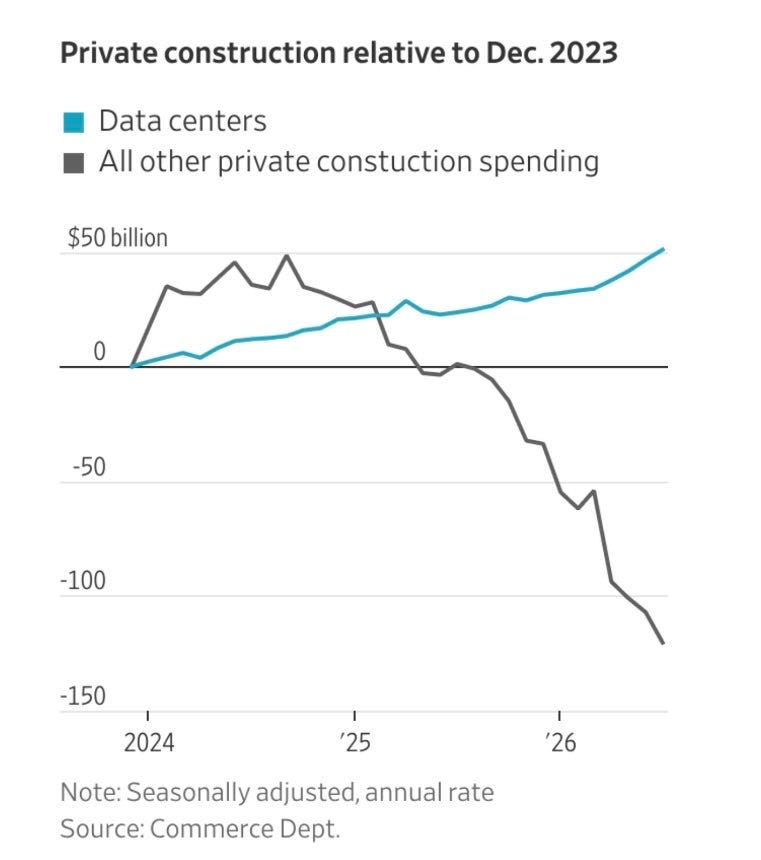
Much of this shows up as physical construction. The Census Bureau only recently began tracking data centers as their own category, and when it did, it found they had overtaken traditional office construction in the country.1 By July 2026 data center construction was running at an annual pace above $75 billion, up nearly 60% from a year earlier—during a month in which total U.S. construction spending fell (with residential construction down 7.3% from the previous year).1,2 Data center construction projects now account for nearly a quarter of all nonresidential building in the country (and the buildings are only about a fifth of a data center's cost; the equipment inside is the rest), with nearly three times as much spent so far this year as in the same period last year1 while nearly every other category of investment is flat or falling.1 In turn, one analyst group estimates AI capital spending is adding roughly 1.4 percentage points to U.S. growth this year,1 and Sacks has argued it accounted for about 75% of first-quarter GDP growth.1
Note: this spending is not confined to America. China, for example, is preparing to spend around 2 trillion yuan ($295 billion) over the next five years on data centers,1 the EU has announced a €200 billion "InvestAI" initiative,1 Saudi Arabia is deploying hundreds of megawatts of Nvidia and AMD chips through a state-backed company,1 and the UAE is building a 5-gigawatt AI campus in Abu Dhabi.1 One analyst group, in turn, puts global data center capital expenditure (by a narrower definition than Sacks's) at roughly $800 billion per year in 2026 and projects $31.6 trillion will be spent on AI infrastructure through 2050.1
Community Resistance
While understandable fears that AI will displace jobs have created public opposition to AI, the primary source of political pushback against the industry has actually come from communities AI data centers are being placed in. This is because:
•Data center processors require a massive amount of energy (a single facility can draw as much power as a mid-sized city), which in turn is spiking electricity demand1 and hence electricity costs in the areas around them (as the grid upgrade costs get passed to residential ratepayers—so a key fight in most states is over who pays for those upgrades). That said, the extent to which data centers are raising electricity prices is hard to quantify as estimates vary widely (e.g., some have found none, one found a 10-20% increase and others found far more; the clearest documented case is the PJM grid serving the mid-Atlantic, whose independent monitor attributed most of a ten-fold jump in capacity prices to data center demand), but even in the most cited extreme cases, other pre-existing factors could explain some of the increases that occurred.
Note: those upgrades also mean new high-voltage transmission lines being run through communities, which raises residential exposure to the low-frequency magnetic fields that IARC classifies as a possible carcinogen and which have repeatedly been linked to childhood leukemia at exposure levels far below existing standards (an association IARC considers real but unexplained, as no [accepted] mechanism has been established).1
•Since all that electrical usage creates heat, many facilities (particularly those using evaporative cooling) also require large amounts of water.1 As such, ia March 2026 study estimated that $10–58 billion of new water infrastructure will be needed by 2030 to meet this demand (assuming the water is even available), with data centers' additional peak-day requirement by then roughly matching New York City's entire daily water use.1 Presently, this translates to communities with robust water infrastructures being relatively unaffected, but smaller ones having challenges such as reduced water pressure and price increases, especially during surges (e.g., hot summer days). Furthermore, like the electrical cost increases, it’s hard to estimate exactly what degree of the increase can be attributed to data centers vs. pre-existing factors which were already increasing costs.
Note: evaporative cooling also produces blowdown (leftover water concentrated with salts, biocides, and corrosion inhibitors, plus traces of metals from pipes). This wastewater is usually sent to a municipal plant or a permitted discharge where poor handling can still stress a small treatment plant or creek.
•Data centers create a significant amount of constant noise (primarily due to the cooling systems, but also diesel generators during tests or outages, with some sites also having onsite turbines that run all the time). This noise makes it very unpleasant to live next to the centers and has resulted in many people who invested their lives into homes near the data centers wanting to move but having trouble doing so, with many saying the centers made their homes harder to sell (and as such, more and more heartwrenching documentaries are appearing on how communities have been negatively affected by data centers). Likewise, many are now reporting health effects from living in proximity to data centers (which is in part due to the air pollution their generators create1).
Note: since data centers need a lot of power, land, and fiber, many newer ones are being placed in less affluent communities, including in the Midwest, so this is becoming an increasing problem in my region (which is a large part of why I wrote this article)—while in contrast, it’s easy for people in more affluent areas that don’t host them (but often profit off them) to not notice as cheaper regions are favored for new data center deployment.
Because of this, there is increasing community pushback against the data centers, which has led to local politicians who approved them despite vocal opposition in their communities subsequently being recalled1 and data center opposition becoming one of the key issues in the midterms in certain affected districts.1,2 More than 300 state bills targeting data centers were filed in the first six weeks of 2026 alone,1 and in July New York's governor signed the nation's first statewide moratorium, pausing new hyperscale data center permits for a year."1,2
In response to this, the industry has become increasingly aggressive in buying up land for the data centers (and pressing landowners to sell), while utilities use eminent domain for power lines across private land to serve those sites, and the industry has both lobbied politicians at every level and sued municipalities to push the projects through—all of which is expected given how much money is being invested.
Note: the industry is also beginning to work on innovations (e.g., onsite power generation and closed-loop cooling), which illustrates the displacement effect is already beginning.
Likewise in response to the pushback:
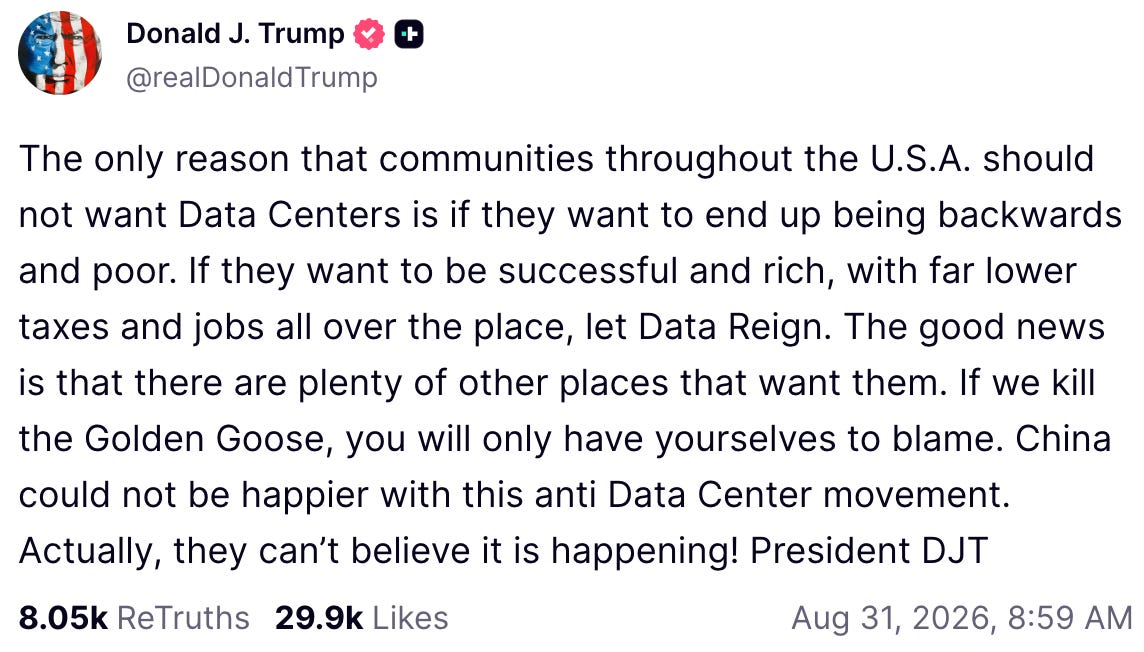
•President Trump has recently taken the position it is against one’s interest to oppose data centers:
•Individuals like Vice President Vance have tried to find middle ground positions like emphasizing the necessity of tech companies needing to build the power generation for the data centers rather than take it from the local grid and spike local electrical prices.
•Fox News originally aired data center concerns (and claimed they could be solved with deregulation, infrastructure improvements or developers absorbing some of the costs). However, as public opposition grew (e.g., in March 2026, 71% of Americans opposed data centers being constructed in their areas) Fox pivoted to the position that supporting data centers was necessary for US technological dominance, and that opposing data center proliferation helped China’s interests (e.g., “You’re against data centers, you are for China”). In tandem, Republican leaders have pressed the position that opposition to data centers is (at least in part) a Chinese campaign against America’s interests.
Note: as I discussed in a recent interview with Pierre Kory, dealing in absolutes is immensely problematic for society. So, while it is true opposition to data centers likely helps China, and that some of that opposition is probably being egged on by groups that benefit from the Trump administration’s AI attempts being derailed, that does not negate the fact that the thing motivating most of the opposition to the data centers is the impacts they are having on communities.
•The large conservative influencers have become split on the datacenter topic (e.g., Ben Shapiro has said opposition to them equates to working for China and Russia, others have linked opposition to existing left-wing groups, Matt Walsh has rejected both panic-bans and a no-questions buildout, arguing there are real problems with how centers are being rolled out that require a serious public debate before the country sprints further, and Tucker Carlson has come out strongly opposed, arguing communities are being stripped of the power to say no while paying the costs and getting no convincing public benefit).
Data Center Health Effects
Thus far, in this newsletter, I’ve focused on one half of this equation: some individuals are much more sensitive to toxicity, and hence are disproportionately injured by pharmaceutical drugs but then gaslighted by their doctors and community when they experience those inevitable injuries. The way I make sense of this is by viewing injuries as distributing on a bell curve, where the severe injuries (that are unmistakeable) are fairly rare, while the less severe (but harder to recognize ones) are fairly common.

This distribution pattern sadly makes it easy to dismiss the injuries, as the extreme ones are rare enough that they can be written off as spontaneous coincidences unrelated to the pharmaceutical, while the common ones are minor enough they are either not recognized or attributed to something else. In contrast, the way I interpret this curve is that if I see a cluster of severe events, I immediately assume the agent is dangerous and there will likely be a massive number of less severe effects, and likewise, if I see a high rate of people reporting moderate reactions to something (especially in different parts of the body), that means there are severe ones hiding in the background.
The COVID Vaccine Bell Curve
Since the COVID vaccine is fairly toxic and was given to a massive number of people, beyond this bell curve occurring, all of it was amplified to the point people who are not trained to spot it could still tell it was occurring. As such, when the COVID vaccine was approved, I had concerns it would have issues (which led to me advising people to hold off on it until more was known), but I initially expected the issues to primarily be chronic problems like delayed onset autoimmune diseases, increases in cancer a few years down the road and future fertility impairments (the potential risk of which I felt would most likely exceeded the meager benefit the vaccine was likely to offer).
However, the week it was released to the public, I began seeing distant colleagues post on social media they felt absolutely awful after vaccinating (but still intended to continue) and having multiple patients each day (in the demographics the vaccine had thus far been rolled out to) complaining about fairly significant (but not life-altering) reactions to the vaccines they’d never experienced from other shots (which most of the other doctors wrote off as not enough to justify skipping the second dose—despite reactions typically being worse from the second one).
As such, within a week I realized I had significantly underestimated the toxicity of the shot, and began pleading with people I knew to not get it as I was fairly certain the reactions I was seeing meant there were also going to be a lot of more severe ones that likely would take a while to show up (after which I had to watch quite a few of the people I cared about who didn’t listen to me develop much more severe chronic complications from the vaccine). Likewise, after about a month, I started having people around the country (many of whom I had not spoken to in years) reach out to ask if the COVID vaccines could cause sudden death as this had happened to a relative or friend.
I share all of this to highlight both why I have been so upset about the whole COVID vaccine program (as with the extremely limited data I had access to at the time, I could tell within a month of their rollout they were one of the most dangerous pharmaceutical products in history—yet the regulators with orders of magnitude more data than me could not at that time—and instead have continued to double down on their safety claim regardless of how much evidence mounts against the vaccines) but also to give an illustration of how this bell curve functions in real life.
However, that is only one half of the story. The other is simply that people are more sensitive to stimuli in their environment (which often goes hand in hand with them being predisposed to illness following a toxin exposure). For example, one of the projects with this newsletter has been to expose the COVID-19 mRNA vaccine shedding phenomenon, something we were told was impossible based on the design of the vaccine, but nonetheless we saw more and more cases of as time went on and eventually collected enough data to determine there were clear reproducible patterns in what was happening that elucidated what was actually occurring (all of which I detailed here). With the shedding phenomenon, I was originally clued into its reality because a few highly-sensitive patients I knew told me they could tell if someone had recently been vaccinated (as it made them ill and they shared overlapping sensory observations) and because numerous unvaccinated women (closer to the middle of the bell curve) had shared with me being around a vaccinated individual significantly disrupted their menstrual cycle (indicating that while shedding reactions were less severe than COVID vaccine reactions, there were likely still rarer severe reactions I would likely later come across and eventually did).
Note: when profitable projects are pushed through at the expense of the population, “sensitive” people normally bear the brunt of the human cost, but in almost all cases, are viewed as an acceptable sacrifice (since they are rare enough they can be swept under the rug) rather than as “canaries in the coal mine” that indicate larger but not yet detected issues will arise in the future.
The EMF Sensitivity Bell Curve
One of the areas where all these concepts best converge is with electromagnetic field sensitivity, as:
•A minority of people are “electrically hypersensitive” being both able to feel EMFs and becoming quite ill around them (which ultimately requires them to live in low EMF areas—which sadly are becoming increasingly rare).
•Some (myself included) are EMF sensitive (so we sometimes sense certain EMFs) and feel generally better in low EMF environments but can essentially tolerate everyday life (e.g., I will go to cities when I need to but prefer rural areas).
•Some don’t notice EMFs at all, but with careful deduction you can link certain symptoms they have to EMF exposure (which goes away once they go to low EMF environments or do things like turning off their wifi router at night and not keeping their phone by their bed).
•Many people really do not seem to be at all affected by them (but the data that would be needed to assess their longterm risks of things like cancer is not there).
As such, while a case can be made that EMF sensitivity is a primary contributing factor in many diseases (which has been observed by segments of the natural medicine field for decades), it’s also quite easy for someone who does not have a lived experience of the process to write it off—so that is what normally happens. Likewise, since so much of the economy revolves around EMF producing technologies, the necessary research in this area has been heavily suppressed (although a lot of it does exist if you know where to find it). Instead, the rebuttal typically is that EMFs are too weak to create ionizing radiation, so any biological effect they create must be thermal, and as all consumer devices are below the heating threshold, they are therefor harmless (whereas in reality the devices can still do many harmful things—particularly those in the microwave spectrum such as cellphones, bluetooth radar and wifi—which I suspect is due to their partial resonance with water). So as you might expect, the existing scientific consensus and mainstream research reject the notion of EMF sensitivity and the vast body of literature indicating it is harmful to life.
Note: two of the best books in print on the proven harms of EMFs are Devra Davis’s1 and Arthur Fristenberg’s.1 One of the most interesting studies I recently came across on this topic was one which discovered cell phones caused blood cells to clump together1 (a process I believe underlies many diseases and which “sensitive patients” are predisposed to).
Given this, the symptoms many reported from living next to data centers (and attributed to the noise they made) caught my eye:
Note: a * means there is also decent scientific support that chronic environmental noise (or, for air items, combustion exhaust) can cause or worsen the reported effect.
What people notice from the site (exposures):
Constant hum, high whine, or “vacuum left on,” indoors and outdoors* ¹ ² ³
Vibration or rattling in windows, walls, floors, porch, or sometimes the body ¹
A sense of pressure rather than an ordinary sound ¹
A tone or hum that still seems audible after going inside ¹ ²
Diesel, exhaust, “rotten,” or chemical odors when generators test or run ¹
Construction dust, dirt, truck traffic, and early-morning work
Bright site lighting / loss of darkness at night*
Most commonly reported effects:
Sleep disruption — trouble falling asleep, nighttime awakenings, waking early and being unable to get back to sleep* ¹ ² ³
Stress, irritability, anxiety, or feeling constantly on edge* ¹ ² (including feeling agitated even with earplugs or headphones ³)
Avoiding or no longer using the yard, porch, patio, or open windows* ¹ ²
More often reported around very loud cooling or on-site power:
Ear pressure, fullness, pain, or a “fluid” feeling ¹
Perceived hearing problems or hearing deterioration ¹
Tinnitus, or a tone felt in the head, skull, or behind the eyes; some with pre‑existing tinnitus report worsening during high‑noise periods* ¹ ²
Note: I have met a few EMF sensitive people who can hear EMFs and reported their tinnitus improves when they avoid EMFs (e.g., by turning off their house breakers at night).
Air and breathing:
Other common complaints:
Can’t sit outside, garden, entertain, or enjoy the property* ¹
Feeling trapped in the house* ¹
Worries about electricity bills, water, utilities, or infrastructure
Concerns about property value ¹
Pets becoming restless or behaving differently ¹
Fewer birds or other wildlife changes ¹
The reason this list caught my eye is that beyond it being immensely unfortunate for the people who have to deal with it, many of these symptoms (e.g., headaches, sleep disruption, fatigue, brain fog, anxiety or feeling on edge, nausea, dizziness, tinnitus) also overlap with what individuals with electromagnetic hypersensitivity (EHS) report1,2,3 and likewise, already EMF sensitive individuals report some of the other symptoms they experience (e.g., burning skin) near data centers.
This overlap in turn suggests:
•The same effects which trigger EHS are present with data centers, but, since they are stronger, rather than only the ends of the bell curve being affected, significantly more people (closer to the middle of the curve) are also being affected. So, much in the same way the COVID vaccines awakened the public to the dangers of the other vaccines (due to them being toxic enough large numbers of people were harmed the toxicity could no longer be covered up), the data centers could potentially do the same for the EMF issue.
•The overlap in symptoms is not due to strong EMFs being present by data centers, but rather due to the fact infrasound (sound below the typical threshold of human hearing which data centers generate and is a recognized hazard at high exposure levels) is a “harmful frequency,” and that some of the symptoms individuals experience from a variety of harmful frequencies have a significant overlap.
This hence made me curious about what was happening, as I did not see a reason why data centers would need to emit massive amounts of microwave radiation into their vicinity.
Note: with EMFs, the greatest effects individuals experience are typically from microwave sources. However, the fields generated by electrical wiring do also cause issues (particularly for more sensitive individuals) especially if “dirty electricity” (high-frequency electrical noise riding on household 50/60 Hz wiring) is present,1,2,3,4 a process that often is due to devices within the home (e.g., solar power inverters or certain types of bulbs sometimes need to be removed to provide EHS individuals with relief).
From looking this up, I discovered the actual issue appears to be that data centers draw their power through enormous non-linear loads (tens of thousands of switched-mode server power supplies, uninterruptible power systems, and variable-speed cooling), which inject harmonics and high-frequency voltage distortion (dirty electricity) back onto the grid—however rather than a few low output devices creating it, something which draws 10,000 times as much power as a house is doing it and affecting everything.1
Bloomberg News, in turn, in December 2024, published a remarkable study of 770,000 home power-quality sensors made by Whisker Labs (whose devices monitor the wiring inside homes to detect fire hazards, and which are dense enough that nearly 90% of American homes are within half a mile of one), cross-referenced against the locations of nearly 1,500 data centers.
Note: at the time this study was published there were far fewer data centers, far less pushback against them, and far less money behind them. As such, it is unlikely anything similar will be published again in the mainstream media despite the fact the issue Bloomberg highlighted has become much worse since late 2024.
Using the 8% total harmonic distortion threshold the Institute of Electrical and Electronics Engineers considers damaging to equipment, Bloomberg consistently found:
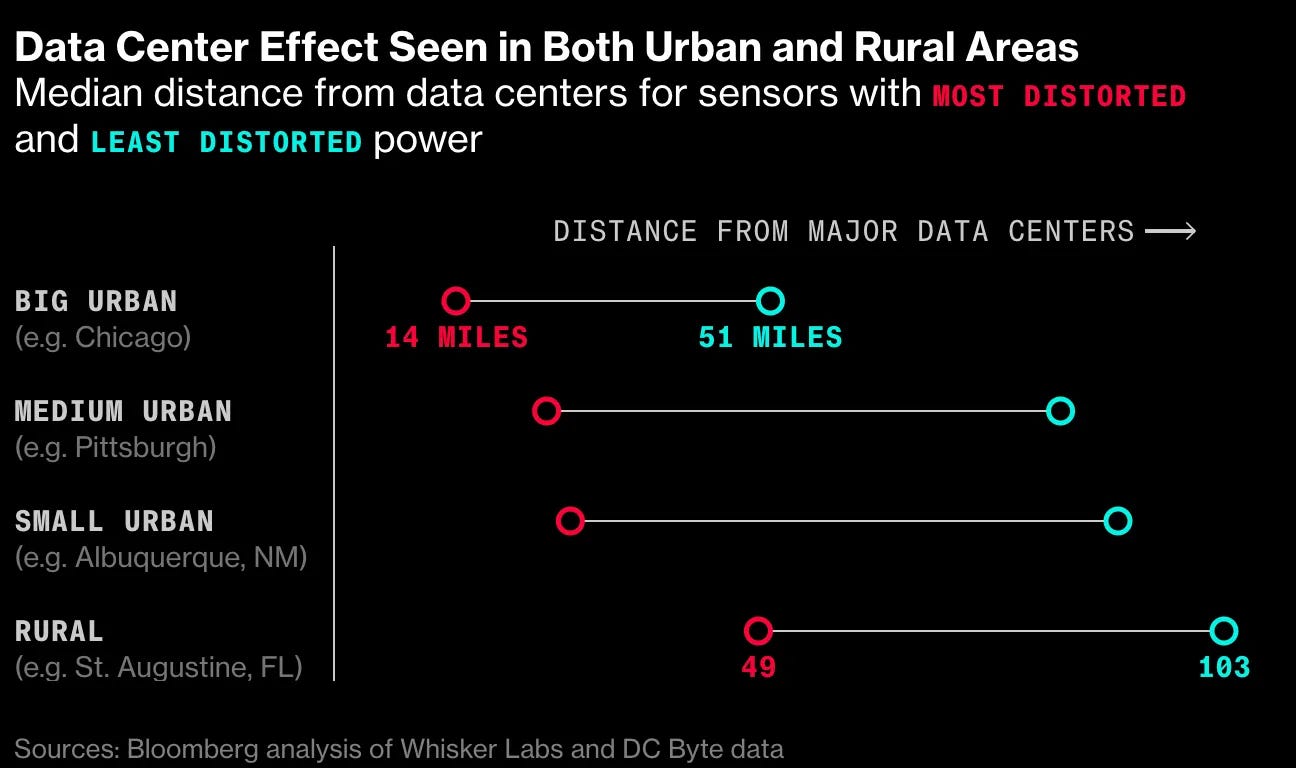
More than three-quarters of the highly distorted readings in the country were within 50 miles of significant data center activity, and more than half of the households with the worst distortion were within 20 miles. The sensors with the cleanest power were typically at least 87 miles from any major data center. By the Census Bureau’s figures, about 3.7 million Americans live in the most affected areas.
The pattern held in rural areas as well as cities. In big urban areas the median distance to a data center was 14 miles for the worst readings versus 51 for the best; in rural areas it was 49 miles versus 103.
In Loudoun County, Virginia (home to “data center alley” and roughly 3,000 megawatts of capacity), the share of sensors exceeding the 8% threshold was more than four times the national average. In neighboring Prince William County, about 6% of sensors were over the limit, nearly all within 7 miles of a data center, with some readings reaching 12.9%. Around one newly opened Prince William facility, 78% of nearby sensors were above the limit in October. By contrast, in York County, Virginia, 80 miles from the nearest major data center, harmonics averaged under 3%.
In the Chicago area, more than a third of sensors showed sustained high readings over nine months, and over 9,300 of the county’s 16,000 sensors had at least one monthly reading at or above 8%.
The worst distortions occurred at night, when data centers make up a larger share of total demand (i.e., when everyone else is asleep and the servers are not).
Bloomberg tested whether large solar installations could explain the pattern and found they did not. It concluded that while the sensor data alone cannot prove a single cause, the correlation with data center proximity was too strong to be coincidence. As you might expect, the utilities questioned these findings (e.g., one company said its 200 grid monitors showed nothing unusual), but Bloomberg stood by them as numerous sensors across the same neighborhoods replicated the findings.
Note: this is also acknowledged within the industry itself, as data center engineering guides note that the harmonic disturbances these facilities generate can extend beyond the facility to anything connected to the same electrical infrastructure.1 Likewise, a 2025 industry piece concedes that customer loads can distort power for their neighbors.1
Bloomberg News also quoted a Bloom Energy executive explaining that AI workloads draw power in a sawtooth pattern of sudden swings rather than a steady line, which no grid was designed to absorb from one facility, let alone dozens (so given this and more importantly the massive demand being placed on the grid, a real risk exists our aging electrical infrastructure will not be able to handle the demands data centers are placing on them).
Notably, Bloomberg’s concerns centered on the health of electronics, highlighting that once AC power deviates from the ideal 60-cycle-per-second pattern, issues consistently emerge such as appliances running hot, motors in refrigerators and air conditioners rattling, lights flickering, increased fire risk during voltage surges, greater vulnerability to brownouts and blackouts, and billions of dollars in cumulative damage to home appliances and aging grid equipment.
However, as a limited body of research in dirty electricity has indicated, there are also consequences for the health of human beings, including many of the exact same symptoms individuals living by data centers have reported (e.g., sleep disruption, headaches or head pressure, irritability, anxiety or feeling on edge, fatigue, poor concentration or brain fog, dizziness or vertigo, tinnitus, worsened asthma or breathing, and nausea).1,2,3
Note: animal studies also corroborate certain effects of dirty electricity (e.g., a study of 1,705 cows across 12 dairy farms found milk production fell in proportion to the number of transients and harmonics on the farms' power, that the cows' behavior tracked the voltage measured on their legs, and that the distortion was coming from the utility lines rather than the farms themselves).
Furthermore, many of the symptoms reported near data centers that are not classically associated with dirty electricity (e.g., ear fullness or pain, hearing deterioration, feeling the sound in the chest) have been extensively linked to infrasound exposure1,2,3,4 (along with it being widely recognized certain animal species like elephants can hear infrasound or become more agitated when it is present).
Since Bloomberg’s data only showed what was reaching people’s homes, I also wanted to know what was actually coming out of the data centers themselves. It turns out this was measured in a 2026 study,1 where researchers put a magnetometer inside the server room of a university’s data center and recorded the electromagnetic field continuously for a month (although this was a small facility with 250 servers running at about half capacity, so nothing like what is being built for AI).
What they found was that the field itself was not particularly strong (around 0.5 microtesla), but it was very distorted. On a typical day, the distortion averaged 36%, during working hours it rose to 65%, and 41 times during the month it spiked far beyond that (in one case to 330%, at which point the “noise” on the signal was three times larger than the signal itself). To put those (likely conservative) numbers in perspective, the same instrument in an office in the same building measured 5–7% during the day and 21–24% at night.
Finally, like Bloomberg, the authors of the 2026 study were only concerned with what this did to equipment (e.g., they noted the type of harmonics data centers produce don’t cancel out on the wiring but instead pile up in the neutral line, overheating wires and transformers), and the study had its limits (one sensor, one small facility, and it couldn’t measure the higher frequencies where computer power supplies emit the most). Nonetheless, it confirms that the electricity inside these facilities is far dirtier than what a normal building produces, and hence why homes twenty miles away from an AI data center drawing a thousand times more power are being affected (but again, the research needed to conclusively determine what is really happening has not been done).
Note: utilities typically only monitor dirty electricity harmonics up to about 2–3 kHz (as did both the Bloomberg report and the 2026 study), whereas the dirty electricity health studies focused on higher frequencies (the filters used in the school studies work between 4 and 100 kHz), which fall within the 2–150 kHz "supraharmonic" band that switching power supplies emit most strongly. That said, while they are almost never monitored on the grid, a 2023 study demonstrated that data centers also make emissions in these higher ranges.
Solving the Datacenter Dilemma
At this point, the AI sector appears to be facing a few critical bottlenecks:
•Shortages of chips and rare earth elements they need to function (much of which China currently controls the supply of but the United States is making an effort to create supply chains for).
•Insufficient energy to run the data centers (e.g., in a recent talk Musk stated the consensus estimate among analysts that follow the AI space very closely is that there will be at least a 15-gigawatt shortfall of power in 2027 for AI chips1 and there is often a 2-5 year wait time for the major power components like generators and transformers data centers require1 along with grid interconnection queues that commonly run two to three years).
•Inability of the electrical grid to sustain the power loads AI data centers requiring external power are creating.
•Increasing public pushback against data centers that has the potential to block new constructions or shift elections.
These constraints make the industry’s forecasted exponential growth (which has fueled their rapid rise in stock values) unlikely on the advertised timeline as the deployable capacity is likely to cost more than projected and take a while to arrive.
As such, a few (non-mutually exclusive) possibilities exist:
•First, AI encountering structural limitations that make it fail to live up to its hype will prevent it from taking over our society, or at least give us time to adapt to it.
•Second, to aid AI in overcoming the obstacles it faces, there will be increasing pressure to support it (e.g., consider how much Fox’s positions on the topic shifted over the last year). To this point, it must be emphasized that changing the party in power is unlikely to impede the AI roll-out as while certain Democrats are beginning to publicly oppose the datacenter push, the major tech companies primarily support the Democrat party, and hence will ensure the push continues if the presidency flips in 2028 (much as Biden, days before leaving office, signed his own order opening federal land to AI data centers, which Trump simply revoked and replaced with a more aggressive version; and not unlike how Kamala Harris cast doubt on “Trump’s COVID vaccine” in October 2020 and then pushed it onto the public once elected1).
•Third, the pressures facing AI will force the industry to develop a better solution that allows the technology to scale without public pushback (which, given the law of displacement, I believe is the only realistic option to make things better here).
Since data centers need enormous amounts of power and are best placed where no one lives, Elon Musk has proposed an elegant solution that is very on-brand: use SpaceX’s launch capacity to put the data centers in orbit alongside Starlink and run them on solar power (which in the right orbit is nearly continuous and up to eight times more productive than on the ground). SpaceX, in turn, has filed with the FCC for up to one million data center satellites, Google is launching prototype satellites carrying its AI chips in early 2027, Nvidia announced a space-rated GPU, and China has already run an AI model in orbit on a small constellation.1,2
However, while this could potentially solve many of the problems we are facing, I do not think this can be scaled to the degree needed as:
Everything a data center does eventually turns electricity into heat. In vacuum that heat can be dumped to the environment only by thermal radiation. At temperatures chips can survive, each square meter rejects only a modest amount of power, so an orbital node is mostly solar arrays and radiators around a relatively small compute payload. However, getting that cooling to be light enough is a real jump from currently existing options (e.g., the international space station’s radiators are on the order of 13 watts per kilogram, while published orbital-data-center concepts assume something like 160–350) and nothing in that class of what will be needed has been built at data-center scale yet.
Unlike on land, once in space, the hardware most likely cannot be fixed or upgraded (satellites in low orbit are almost never serviced; they are replaced), which is a major issue as AI chips go obsolete every three to five years (and possibly faster in space due to radiation shortening the chip’s life). Given the cost needing to replace all the data centers every few years adds (unless we have an inconceivable paradigm shift like say UFO antigravity technology being discovered or functional servicing robots being deployed to space) I am hence, doubtful this approach will ever be able to economically compete with the land based model (despite Musk’s knack for making the impossible possible).
Getting large amounts of data down from orbit (or up to it) is much harder than sending the same data through fiber on the ground (making fiber much cheaper than space links).
Beyond the sheer cost of launching all of that into space, scale itself is a manufacturing problem. A million satellites of the size SpaceX describes would take many years at build rates far beyond today’s Starlink production, and with the demonstrations being scheduled for late 2027, this likely puts any meaningful space data center capacity in the 2030s.
As such, I think this proposal realistically could be used for niche applications (space-native data, some batch training, or a future orbital data infrastructure for colonizing Mars), but I do not see a viable path for it to beat terrestrial facilities on general-purpose computing.
However, there is another approach I believe can displace the data centers flooding our communities.
The War on Climate Change
I care immensely about the health of the earth, so for a long time I was a fairly committed environmentalist. However, in the early 2000s, I distanced myself from that movement due to a more unfortunate occurrence of the law of displacement: one prong of the environmental movement (reducing carbon dioxide to prevent global warming) becoming a lucrative thing to promote (e.g., by selling expensive hybrid cars or carbon credits) and rapidly taking over the movement. I objected to this because:
•It caused the other legitimate environmental issues I cared about and had fought for to be pushed out of the discussion.
•It was highly debatable if carbon dioxide emissions were causing global warming (or even problematic), so I felt the dire predictions were unlikely to happen, and if they actually were going to occur as forecast, the changes were so rapid it was unlikely anything could be done to stop them.
•Reducing global warming was an extremely nebulous target, so it could never be falsified and the goal posts would be possible to continually shift on it. As such, once the inertia behind this orthodoxy became established, it would be immensely difficult to overturn it, so as time went on, it would inevitably consume more and more of the environmental movement.
Note: in 2009, a series of hacked emails indicated that global temperature data had been distorted by climate scientists1 (with reactions, based on political leanings, ranging from it being treated as proof global warming was a hoax, to acknowledgments illegal scientific misconduct occurred but not questioning of the underlying consensus, to attempts to excuse everything).1,2,3 Around this time, the environmental movement pivoted from global warming to the even more nebulous term “climate change” (something I suspected could likely be attributed, at least in part, to solar cycles and weather modification programs).
•The measures being implemented to stop global warming and carbon dioxide emissions skipped the options that could produce clear tangible results (e.g., stopping slash and burn farming practices in the rain forests) and instead focused on technologies with their own host of issues that primarily served to centralize power and make money.
Note: this is commonly analogized to how leaders in the new environmental movement would tell people not to drive cars but then fly on private jets to climate change conferences. Likewise, I have now see numerous memes highlighting that the same tech companies which cared so much about climate change and the environment threw it all to the wind once that got in the way of them building (far more profitable) data centers.
That said, I do think an argument exists for shifting away from fossil fuels due to the (non-carbon dioxide) emissions they create, so I’ve spent a while looking at every alternative energy option which exists, particularly since I’ve held the longstanding belief technologies which reduce the profitability of large markets inevitably get sidelined (e.g., this newsletter is devoted to showing how better and far cheaper medical alternatives have existed for decades but been largely kept off the market by the medical monopoly).
Note: I also hold the minority view (detailed here) that petroleum is not biological in origin but continually upwells from deep within the earth (and contains biological traces because it was the birthplace of the earliest lifeforms)
Because of this, over the years, I’ve spoken to numerous people researching “free energy” systems and seen a few which, when demonstrated, were quite compelling. From looking at the existing options, I eventually concluded “green nuclear power” was likely the most practical and viable option we had available to adequately address the energy needs of humanity, but then as the decades went by, much as I’ve seen with many transformative medical discoveries, I watched the promising nuclear designs go nowhere.
However, much in the same way the data center moment is finally creating the potential window to bring widespread attention to EMF toxicity, the unprecedented need for massive power generation in the immediate vicinity of data centers (along with the current Iran war) is finally creating the window to bring green nuclear power to market as more money can finally be made off a cheap and abundant energy source than the energy industry has made by locking the world into a limited and overpriced commodity.
Nuclear Power Designs
Every atom is composed of a nucleus of positively charged protons and neutrally charged neutrons (with the common isotope of hydrogen being the only one lacking neutrons) along with nearly massless negatively charged electrons which surround the atom’s nucleus. In most chemical reactions, while electrons shift, the nucleus never changes. But when it does, a nuclear reaction occurs, and the total mass of the nucleus shifts.
Anytime an atomic mass shift occurs, the collective mass of the resulting parts typically do not exactly total to what they were before, as some of that mass is converted to energy. The famous equation E=mc2, in turn, quantifies this shift, illustrating that a tiny amount of mass being lost creates a massive amount of energy (as “c” equals the speed of light).
In stars, the immense heat and pressure primarily create these shifts by causing light nuclei to fuse together, whereas on Earth they occur naturally through radioactive decay. Very large nuclei (or those with the wrong number of neutrons to hold the nucleus together) are the least stable, so nuclear engineering focuses on the few heavy isotopes that can be made to split apart when struck by a neutron, releasing that stored energy on demand.
When the nuclear age began, uranium was identified as the optimal element for nuclear applications as beyond being intrinsically radioactive, one of its naturally occurring isotopes, U-235, could undergo fission (splitting into two much smaller nuclei), and the neutrons released when it split would trigger fission in adjacent U-235 atoms, thereby creating a chain reaction that quickly released a vast amount of energy. Nuclear power hence focused on using fuel with enough U-235 to sustain fission, plus neutron-absorbing control rods that could slow or stop the reaction so energy was released gradually enough to harvest for power rather than run away, while nuclear weapons (at least the early U-235 designs) focused on assembling a supercritical U-235 mass fast enough that the fission reaction ran away and exploded.
Note: a few natural nuclear reactors have been found in uranium deposits in Gabon, where two billion years ago, the ore still had enough U-235, and groundwater slowed the neutrons enough for a fission chain reaction. The reaction ran in pulses: heat boiled the water off, the reaction stopped, the deposit cooled, water returned, and it started again.
However, while U-235 is an optimal isotope to use for nuclear applications, it still has a few major problems.
First, only 0.72% of the earth’s uranium is U-235, whereas much higher uranium U-235 concentrations are needed for nuclear applications (typically 3–5% for nuclear reactors and around 90% for nuclear weapons).
Note: uranium enriched above 20% is called highly enriched uranium and is considered weapons-usable, whereas uranium enriched to 90% U-235 is called weapons grade uranium.
This, in turn, leads to two issues:
•In addition to uranium mining and milling creating large amounts of radioactive tailings to obtain uranium, since most of the uranium obtained is not U-235, concentrating the small fraction that is into usable fuel leaves the majority of it behind as "depleted" uranium. This waste is still radioactive, has piled up by the hundreds of thousands of tons, and some of it is used by the military for armor and ammunition, as uranium's density allows it to punch through other metals (but those rounds aerosolize into dust after hitting a target, which has been a major issue in many of the areas where these munitions were deployed).
•Concentrating the U-235 is challenging, as the uranium must first be converted into a fluoride gas (uranium hexafluoride) so its isotopes can be separated—originally through gaseous diffusion, and now with gas centrifuges, the difficulty of which has been a major barrier to smaller countries obtaining uranium-based nuclear weapons. The Iran conflict, in turn, was driven in large part by the fact Iran had developed centrifuges to enrich uranium for nuclear power and fears existed that this capacity could be pushed to the much higher enrichment required for nuclear weapons.
Note: many have wondered why something as toxic as fluoride is put into the water supply. The idea originated in the 1930s with the aluminum industry (Alcoa), which faced mounting lawsuits over fluoride pollution from its smelters and hence had a strong interest in the chemical being seen as beneficial. America’s Public Health Service was initially wary of it due to fluoride's toxicity. However, as documents declassified in the 1990s showed, the Manhattan Project needed enormous quantities of fluorine to enrich uranium, its workers were being injured and killed by it (deaths that were kept secret for fifty years), it was venting fluoride over the surrounding communities, and it was already being sued by farmers. So in 1944 the bomb program secretly organized and paid for a conference on fluoride's health effects while having the Public Health Service host it under its own letterhead, and its chief fluoride toxicologist, Harold Hodge, then chaired the advisory committee for the first water fluoridation trial at Newburgh, New York—which his classified program at the University of Rochester quietly monitored, collecting blood and placenta samples from residents to learn how much fluoride the body retains. Six years later, the official who endorsed fluoridation for the United States was Oscar Ewing, previously Alcoa's Wall Street lawyer (all of which is detailed in this 2004 book).
Second, once U-235 is obtained, the reactors still have a few key problems:
•The most well recognized is that both the chain reaction and the heat the fuel keeps producing after it is shut down have to be continuously controlled, so if the cooling or shutdown systems fail, the fuel can melt, destroy the reactor, and release radioactive material into the environment. This is what happened at Chernobyl in 1986 and Fukushima in 2011, nearly happened at Three Mile Island in 1979 (where the core partially melted but very little radioactivity escaped), and also occurred in a number of earlier military and experimental reactors that were barely reported at the time.
Note: these include a partial meltdown at a Canadian research reactor in 1952, another at the Santa Susana site outside Los Angeles in 1959 (whose extent was concealed for twenty years), a 1961 explosion at an Army reactor in Idaho that killed three operators, a partial meltdown at a breeder reactor near Detroit in 1966 (which most of the public only learned of from a book published nine years later), and several Soviet nuclear submarines whose reactors lost cooling at sea (most famously the K-19 in 1961, where crew members died of radiation sickness after improvising a repair), all of which were kept secret until the Soviet Union collapsed.
•The less recognized issue is that even “normally functioning” nuclear reactors release some radioactivity into their vicinity, and a number have had unplanned leaks of tritium and other material into local groundwater. The data I’ve seen, in turn, has led me to believe real health issues exist with this, but like many inconvenient things, the actual health effects on nearby residents have not been sufficiently researched and remain an open question.
Thorium Reactors
In addition to concentrated U-235 driving nuclear reactors, another alternative exists: exposing thorium to neutrons, which converts it into U-233, a uranium isotope that also undergoes fission (but being much shorter-lived than U-235, is much rarer in nature and cannot be procured through mining or enrichment). Thorium designs, in turn have a few major advantages over U-235 ones as:
•There is 3-4 times as much thorium in the earth as uranium,1 mining it is cleaner than uranium, and since all of it is an isotope that can be used (rather than only 0.72%), beyond far less needing to be mined, large amounts of depleted nuclear waste are not created (though, as discussed below, the reactor still needs a small amount of fissile fuel to start it).
Note: once mined, thorium is usually mixed with rare-earth elements it must be separated from. That is both an advantage (those rare earths are strategically scarce) and a disadvantage (the separation is complex and uses harsh chemicals). As such, we already “mine” thorium, but it is presently disposed of as an unwanted radioactive waste from rare-earth processing.
•In the molten-salt designs usually paired with thorium, the fuel is already a liquid at low pressure, so there is no solid core to melt (reducing the risk of nuclear meltdown); if it overheats, the salt expands and the reaction slows, and it can be drained into a dump tank to shut down without pumps (the trade-off being that a leak anywhere in the system releases highly radioactive liquid, and the salts slowly corrode the reactor's plumbing, which remains the main engineering hurdle).
Note: some thorium designs instead use a particle accelerator to supply the neutrons (so the reaction stops the moment the accelerator is switched off, and the reactor can also burn existing nuclear waste). The concept has been pursued for over thirty years (most notably by a Nobel laureate at CERN in the 1990s), and Belgium and China are each currently building demonstration units, but none has yet operated, as the accelerator required to drive a commercial reactor is so expensive it costs about as much as the plant itself—which is why molten salt, rather than accelerators (which may ultimately be the superior technology), has become the focus of thorium development.
•Thorium reactors make far less long-lived non-uranium nuclear waste (plutonium, americium, curium) than conventional reactors, because thorium is lighter than uranium and does not climb the ladder of neutron captures as easily (but at the same time still produce ordinary fission-product waste).
Note: some thorium reactor designs (e.g., the accelerator ones) claim to further reduce the resulting nuclear waste.
•Thorium reactors greatly reduce (but do not eliminate) the risk of nuclear proliferation. Thorium itself cannot sustain a chain reaction, so a reactor needs a small amount of fissile material to start it, but once running it breeds its own fuel (U-233) from the thorium, which means a country does not need the standard enrichment plants that are also the path to weapons-grade uranium, and the reactor produces very little of the weapon’s grade plutonium formed in uranium reactors. Nuclear weapons can be made from U-233 (the United States tested this), but the U-233 a reactor produces is typically contaminated with U-232, whose decay products emit intense gamma radiation, making the material dangerous to handle, difficult to fabricate into a weapon in secret, and easy for detectors to spot.
Note: since Iran has been adamant it needs nuclear power to address the (real) rolling blackouts the country faces, during the war a former congressman proposed offering Iran American thorium reactor technology in exchange for permanently ending uranium enrichment, on the logic that this would give Iran electricity while making the weapons pathway harder to exploit rather than dependent on inspectors (although without additional safeguards nuclear weapons could still be made). As far as I can tell this never made it into the actual negotiations (which centered on enrichment limits, Iran's existing stockpile, and IAEA access), and in any case it could not have been implemented on any near-term timeline, as no commercial thorium reactor yet exists.
This then raises an obvious question: if thorium was the superior technology, why was it never adopted? Simply put, because the entire American nuclear complex was built as a weapons program with a civilian branch attached, and uranium was the fuel that made weapons. Enriching it produced bomb material directly, irradiating it produced plutonium, and so the enrichment plants, production reactors, and reprocessing facilities were all built around the uranium fuel cycle (with the civilian reactors that followed adapted from the Navy’s submarine designs and fed from that same infrastructure).1 Thorium’s low proliferation risk, which is now its great selling point, at the time simply meant it did not offer what the nuclear establishment wanted. The decisive moment came in the early 1970s, when the Atomic Energy Commission (at Nixon’s direction) committed the country’s reactor future to a liquid-metal breeder that ran on plutonium, and its reactor chief pursued that program, in Weinberg’s words, “with Rickoverian dedication: woe unto any who stood in his way.” Weinberg kept arguing that his molten salt reactor was the safer path and was pushed out of Oak Ridge after eighteen years as its director; the program was cancelled in 1973.1,2 Once that choice was made (and other factors reinforced it such as the Navy's light-water experience, abundant cheap uranium, and later cheap gas), the rest followed: the supply chain for uranium reactors was firmly established (making it difficult to justify creating an entirely separate one), regulatory requirements became far tighter after Three Mile Island (making it much harder for any new design to enter the market), and the existing industry became large enough to have the clout to keep competitors that would displace its plants, fuel mills, and licensing framework from getting off the ground (mirroring the pattern I have watched play out with countless forgotten medical technologies).
Notably, when the program was cancelled, Oak Ridge had already demonstrated the reactor itself worked, but simply had not yet built the remaining pieces (e.g., the chemistry for continuously processing the fuel salt, a solution to the slow corrosion of the reactor’s metal alloy by the fluoride salts, and a way to manage the tritium the salt produces)—all of which researchers believed could be solved but which have never been demonstrated at commercial scale, because the work was never funded.1 After that, essentially no new reactor designs of any kind were built in America, and the regulatory framework hardened around the light-water reactors that already existed, so a design that used liquid fuel at atmospheric pressure did not fit any of the rules (and there is still no licensing framework for a thorium fuel cycle anywhere in the world).1 Meanwhile, the original rationale for breeding fuel from thorium (a fear that uranium would run out) evaporated as uranium turned out to be abundant, and cheap natural gas removed any economic pressure to try something new.
The result is that the technology now requires an entire supply chain that does not exist, so Thorium, despite being abundant, currently has to be extracted from rare earth ores through costly processing, no facility exists to fabricate it into fuel, and a thorium reactor still needs a small amount of fissile material to start it,1 which means either the high-assay uranium fuel America is only now beginning to produce or plutonium.1 Finally, the fluoride molten salt these reactors run on requires lithium enriched to over 99.99% in a single isotope (lithium-7), and the United States has not produced enriched lithium since 1963—the only suppliers are China and Russia,1,2 China has at times restricted exports to feed its own reactor program,1,2 and a single molten salt reactor needs tens of tons of it (compared to the roughly 300 kilograms a year the entire existing American reactor fleet uses).1,2 That said, the first serious commercial attempt to restart domestic production was a $7 million seed round recently closed (on 8/31/26).1
What this essentially means is that for thorium technology to take off, two things are needed: a relaxing of regulatory restrictions (which has already begun: in May 2025, Trump signed four executive orders that set a goal of quadrupling U.S. nuclear capacity by 2050, ordered the NRC to decide new reactor applications within 18 months, created the Department of Energy test-reactor pathway described below, and invoked the Defense Production Act for the nuclear fuel supply chain1) and a very large investment (which is now possible for the first time, as an industry has emerged that needs enormous amounts of power and is willing to pay almost anything for it). On the cost side, while no one can know the actual number until a commercial reactor is built, the published techno-economic models place thorium power among the cheapest sources of electricity ($20–55 per megawatt hour),1,2,3 which is a fraction of what new conventional nuclear plants cost ($175–255)1 and well below the roughly $110-115 that analysts estimate Microsoft agreed to pay for twenty years of power from a restarted uranium reactor at Three Mile Island (the contract price itself was not disclosed).1
For this to happen, the regulatory opening and the money have to start now, because of how long every step takes. Building the early reactors under Department of Energy authorization rather than NRC licensing can get a test reactor running within a few years (this summer that path took four privately developed test reactors from construction to criticality, one in about eight months1), but it does not license a commercial plant, and even the fastest program still needs years of operating data on salt chemistry, corrosion, and tritium before anyone will build the next size up. Likewise, the supply chain the reactors depend on (lithium-7 enrichment, fuel salt, thorium processing) does not exist at U.S. scale and has to be built alongside the reactor rather than after it works, which is why “a few billion dollars” is the entry price rather than the total. Put together, a serious American program could have a molten salt test reactor running by the end of this decade and first commercial power in the mid-2030s, with more money shortening the timeline by a few years but not skipping it. As such, thorium will not power the data centers going up this year—those will run on gas, restarted plants, and (if their schedules hold) the small uranium reactors now under construction, which at best can be sited away from people—but a decision now decides the second and third waves of data centers in the 2030s. China already has a molten salt reactor running and a public ladder toward a 10-megawatt demonstration around 2029–30, a larger one around 2035, and commercial units by 2040.1 So if America waits until those are built to begin, it will be buying the technology from China rather than fielding it.
Note: thorium is not the only promising nuclear design to have been shelved for lack of permission and money. In the 1990s, Argonne’s Integral Fast Reactor—a sodium-cooled design that recycled its own fuel on site, consumed existing nuclear waste, and had been running as a prototype for decades—was cancelled by the Clinton administration in 1994 with roughly three years of work left, on the grounds that it had “no foreseeable commercial value” and undercut nonproliferation goals rather than for any technical failure.1,2,3 Later, Bill Gates spent over a decade arguing that his company’s nuclear reactor design was ready and simply needed someone to fund the first plant (a partnership to build it in China collapsed under export restrictions in 2019); it finally received an NRC construction permit in March 2026, with federal cost-sharing, Meta (Facebook) as a customer, and a first unit targeted for around 2030.1,2,3 That plant is one of a handful of small modular and advanced reactors now actually being built or licensed in America (the others include Google’s salt-cooled reactors in Tennessee, which broke ground this April but whose first unit has slipped to 2029, and a pebble-bed design for Dow in Texas expected to be permitted next year), and restarts of existing plants such as Three Mile Island (targeted for 2027) are closer still.1,2,3,4 These are being funded in a way earlier reactor designs never were—the major technology companies have contracted for roughly ten gigawatts of nuclear capacity in two years, and the announced U.S. nuclear pipeline now stands near 74 gigawatts, much of it from data center buyers1,2,3—and while much of that will slip, they are the most immediately viable nuclear option for data centers: slower than gas, but arriving around 2030, well before any thorium reactor, and building the licensing precedent and industrial base thorium will need (Google's salt-cooled uranium reactor developer, for example, is already building its own fluoride salt plant and lithium-7 enrichment—the very supply chain thorium requires).
The Space of Alaska
While space fits some of the requirements for America’s data center project, the ideal site would be cold (so the enormous cost of cooling largely disappears), on U.S. soil (which is why the Nordic countries and Greenland, despite coming up constantly, will never receive serious consideration for strategic data centers), sparsely populated (so the noise, water, and dirty electricity land on no one), rich in energy that can be used on site rather than pulled off a residential grid, wanted by its state government, and reachable by the transport and fiber needed to move equipment in and data out. Alaska meets all of these except the last, and that gap is both the entire problem and the reason this moment is different from every earlier attempt to industrialize the North Slope.
The climate case is straightforward: Alaska’s mean annual temperature is about 35°F against Texas’s 65°F (and Deadhorse on the North Slope averages 14°F), which the governor has been telling operators saves a one-gigawatt campus on the order of $150 million a year in cooling costs.1 Likewise, Alaska’s low population density (740,000 people on a landmass larger than Texas, California, and Montana combined) aligns with data center needs and political support for the centers is already in motion—the Air Force is offering 4,700 acres at three Alaska bases for AI data centers, the state has issued a preliminary decision to lease a square mile of North Slope land to a company proposing a 1–3 gigawatt campus (disconnected from the grid and fueled by a new gas spur, with initial operations targeted for late 2028), and the governor has courted Meta, Amazon, and Microsoft for years with no state income, sales, or property tax to offer because Alaska has none.1,2,3
Likewise, Alaska produces far more energy than it uses, and the North Slope holds 37 trillion cubic feet of proven natural gas that has been stranded for fifty years because no pipeline was ever built to move it, so the gas produced alongside oil is simply reinjected into the ground.1 That fuel hence could be what the early data center campuses burn on site—which matters as Alaska does not have spare electricity in the grid state residents depend upon as the Railbelt serving Anchorage and Fairbanks peaks at about 750 megawatts, Cook Inlet gas is running out, and the utilities have already told the Air Force they cannot power large data centers at the bases from existing supply,1,2 so a single AI campus’s demand would exceed the entire Railbelt (and residents are already protesting a planned data center). As such, the model that works in Alaska is the one the lower 48 states lack (and may need in the near future): generation built next to the servers, consumed behind the meter, and never touching a residential wire or threatening the power grid. This is also what makes Alaska the natural home for the reactors discussed above, as the upcoming modular designs (which could also eventually be done with thorium) are small enough to place next to the data centers. The state, in fact, rewrote its nuclear siting law in 2022 to accommodate microreactors, the Air Force’s first one is being built at Eielson (construction 2027, operation 2030), and villages across the state still burn diesel at electricity rates far above anything in the Lower 48, so Alaska has exactly the kind of customers that first-of-a-kind reactors have always needed but never had.1,2,3 The North Slope has the gas; the rest of Alaska does not, and for sites away from it—the bases, the Interior, a Mat-Su industrial district—a reactor next to a data center is the only way to get gigawatt-scale firm power without a pipeline, and the data center is the only customer that will pay for the first ones.
Note: data latency, which is usually cited against Alaska, actually sorts the workload sensibly. AI training (the gigawatt-scale load causing most of the harm in the Lower 48) does not care about distance, since nearly all its traffic stays inside the building (training data is moved in once; it is not streamed). Inference that serves users does, and Alaska is far enough from Seattle to rule out the most latency-sensitive applications in the Lower 48. But Anchorage is closer to Tokyo than California is, and a planned trans-Pacific cable landing through Alaska would make it the shortest path between the United States and North Asia.1,2 As such, Alaska could take the training load and Asian-facing inference, while the small inference sites the Lower 48 actually needs stay near their users at a fraction of the scale now being imposed on communities.
The state’s compensation structure is another piece the Lower 48 has never had. Alaska is already built on the principle that resource extraction pays the public: the Permanent Fund, funded by oil royalties, now supplies roughly 60% of the state’s general revenue and still pays every resident a dividend,1 and the Native corporations created in 1971 own 44 million acres and are required to share 70% of their subsurface resource revenue across all twelve regions.1 None of this applies automatically to a data center on state land, and the central dispute in the lease now under review for the North Slope campus is precisely whether the state collects a real royalty or leases a square mile of Arctic at pasture rates.1 But the tools exist (whereas they do not in places like Virginia’s data center alley) and a lease written with a percentage of gross receipts flowing to the fund and, where the land or gas is Native, to the corporations, turns the host from a victim into a shareholder—which is the only arrangement under which “no one fights it” is actually true.
Infrastructure is the final constraint that decides whether Alaska could be a national solution or a press release, and the best candidate to start is Prudhoe Bay as the North Slope was built by barge and hence does not require connecting railways to be built (since 1968, the industrial plant has arrived by summer sealift during the six-to-eight-week window when the ice retreats, with modules the size of ten-story buildings offloaded at the West Dock causeway, and the heaviest equipment still moves there way).1,2 Deadhorse, in turn already has the dock, the airport, the highway, fiber along the corridor, and a workforce accustomed to shift work at forty below, and it sits on top of gas with no other buyer. A pilot campus there does not have to invent an Arctic port or wait for an 800-mile export pipeline; it only has to prove the load, the lease, and the power. Fiber is the harder part: sea ice has cut the Arctic subsea cable twice, most recently in January 2025, when 20,000 residents from Utqiaġvik to Nome lost fiber for over seven months because repair ships could not reach the break until the ice cleared.1 So the training-first, Asia-later sequence depends on the redundant routes now being built (an overland link to bypass the ice-prone segment, a second Arctic cable, and the trans-Pacific landing).1,2 Rail comes after: a 471-mile extension of the Alaska Railroad from Fairbanks to Prudhoe Bay was studied before the oil pipeline was chosen and has been revived repeatedly at estimates of $8–11 billion (a fraction of the $40–55 billion gas line), and it would carry the transformers, modules, and eventually fiber and power that would turn an isolated camp into a district.1,2 It does not need to exist for the first barge-fed campus; it needs to exist if that campus is going to become the second and third waves. Build the pilot on the dock that already works, then spend the billions to pin it to Fairbanks.
Note: other locations in Alaska would also likely make sense once additional railroads were developed—many of which have already been proposed or worked on (which amongst other things, would make it much easier to transport small modular nuclear reactors to them). To this point, in his first term, Trump attempted to begin (and permitted) the process of connecting Alaska’s railroads to Canada1,2 something, which ever developed, would make it very feasible to move datacenter infrastructure (and small nuclear reactors) to Alaska.
That said, there are still real challenged with the initial Alaska deployment. The first campus’s own filings call for seven million cubic yards of gravel to build a pad on the permafrost (nearly twice what ConocoPhillips was permitted for its Willow oil project) and project 1,500 construction jobs but only 60 permanent ones,1 everything (and everyone) has to be shipped or flown much farther than at a typical site in the Lower 48, gas generation still creates local air pollution even when it’s off the grid, and the “$500 million” figure being cited for the campus is only the first phase. Likewise, some Alaskans are already asking if the public will turn on data centers the way the Lower 48 has,.1 which will be a valid concern if what gets built is a few gigawatts of gas turbines on a lease that pays the state almost nothing. However, provided the campuses are kept off the grid and the leases actually compensate Alaskans, this approach eliminates the main problems with the current model (forcing a massive electrical and acoustic load onto people who never asked for it), and more importantly, creates a customer for vital energy technologies that have never had one. A campus that starts on gas can then switch to a microreactor, then a small modular reactor, then a thorium plant, without ever raising anyone’s utility bills, and the rail and fiber built to support it will remain useful regardless of whether the AI boom lives up to its hype.
In short, Alaska shows that while no ideal solution exists to the data center problem, innovators are nonetheless coming up with viable options that are significantly better than what we currently have on the table (e.g., I was quite surprised to learn how much work the state had put into this once I began researching if Alaska could potentially work). That said, I can’t say with certainty if Alaska is the best solution we have for protecting the public from data centers, but I nonetheless felt it was important to layout exactly what the state attempted, as it provides a framework with the real potential to displace what is currently happening.
Conclusion
Throughout America’s history, “successful” industries have emerged that owed part of their success to exploiting the communities they resided in, and in most cases, regardless of how much the public fought it, nothing could be done to stop it. So, given that the finances behind the AI dwarf what’s happened in the past, it is unlikely protest alone with be sufficient to stop this—particularly since it is nearly guaranteed this push will continue regardless of who is in power.
However, while we can’t necessarily stop it (unless the AI business model collapses on itself), we can provide the public pressure to direct things towards a manageable compromise, and if we are savvy, simultaneously solve one of the greatest challenges humanity has faced—finding a clean source of energy which can affordably meet humanity’s civilizational needs far into the future. Likewise, while I never expected this, it’s quite possible giving people the language to explain why they are suffering from the data center push may, at last, be the thing that brings widespread attention to EMF toxicity—something I have long believe to be one of the most neglected foundational determinants of health.
Because of the timelines required to bring many of these options to market, decisions will need to be made in the near future to initiate them, and it is my belief the fundamentals behind them are strong enough that if we do not, competitors like China likely will.
The data center issue has been immensely upsetting for me, so I’ve tried my best to come up with realistic solutions to the crisis we are facing and I sincerely appreciate you taking the time to consider them. My hope, in turn, is that this article provided some insightful ideas on how we can tactically respond to the data center push to turn an appalling situation into something we can instead benefit from and I thank each of you for giving me the voice which makes this type of work possible.
There is one aspect of data centers that must be considered here. These centers will ultimately become surveillance centers collecting and centralizing unprecedented amounts of information on every American, moving the Land of the Free toward communist-style surveillance. And with surveillance comes control. We’re already seeing some of this as those who raise objections to certain agendas are censored, de-banked, de-jobbed, etc.
If you want to see where the world is headed, look at China’s control grid. Conformity is rewarded with high social credit scores, which allow citizens access to the essentials—food, housing, transportation, jobs…. Those who don’t conform are cut off from the essentials.
It’s not a pretty thought, but the end game is control of every human being on the globe as the UN proceeds to ID the global population. The data centers will pave the way to global tyranny.
Hi, do you have any suggestions on how to protect yourself from emfs? I turn my wifi off, phone out of my room. I have various emf protection stickers and plugs. But unfortunately a smart metre was installed in my home, I had no choice) and it’s right on my bedroom wall. I’ve read about aluminium sheeting etc emf paint. But I also don’t want to have a bedroom that reflects all the emfs in the neighbourhood right into my room. Sometimes I feel like we fighting an uphill battle…